Medical Genetic Diagnosis and Therapy Center, Fujian Maternity and Child Health Hospital, College of Clinical Medicine for Obstetrics & Gynecology and Pediatrics, Fujian Key Laboratory for Prenatal Diagnosis and Birth Defect, Fujian Medical University, Fuzhou, China.
Mol Biol Rep. 2023 Sep;50(9):7649-7657. doi: 10.1007/s11033-023-08591-2. Epub 2023 Aug 3.
Determining the reasons for unreportable or no-call cell-free DNA (cfDNA) test results has been an ongoing issue, and a consensus on subsequent management is still lacking. This study aimed to explore potential factors related to no-call cfDNA test results and to discuss whether retest results are reliable.
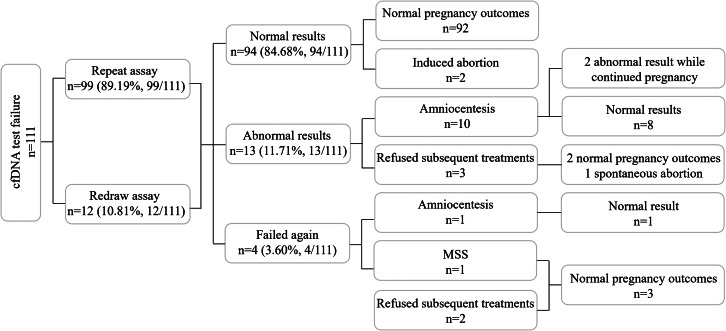
This was a retrospective study of women with singleton pregnancies undergoing cfDNA testing in 2021. Of the 9871 pregnant patients undergoing cfDNA testing, 111 had a no-call result, and their results were compared to those of 170 control patients. The no-call rate was 1.12% (111/9871), and the primary cause for no-call results was data fluctuation (88.29%, 98/111). Medical conditions were significantly more frequent in the no-call group than in the reportable results group (P < 0.001). After retesting, 107 (107/111, 96.40%) patients had a result, and the false-positive rate (FPR) of retesting was 10.09% (10.09%, 11/109). In addition, placental lesions were more frequent in the no-call group than in the reportable results group (P = 0.037), and 4 patients, all in the no-call group, experienced pregnancy loss.
Pregnant women with medical conditions are more likely to have a no-call result. A retest is suggested for patients with a no-call result, but retests have a high FPR. In addition, pregnant women with a no-call result are at increased risk of adverse pregnancy outcomes. In conclusion, more attention should be given to pregnant women for whom a no-call cfDNA result is obtained.
确定无法报告或无细胞游离 DNA(cfDNA)检测结果的原因一直是一个持续存在的问题,对于后续管理仍缺乏共识。本研究旨在探讨与无呼叫 cfDNA 检测结果相关的潜在因素,并讨论重新检测结果是否可靠。
这是一项对 2021 年接受 cfDNA 检测的单胎妊娠妇女进行的回顾性研究。在 9871 名接受 cfDNA 检测的孕妇中,有 111 名出现无呼叫结果,将其结果与 170 名对照患者进行比较。无呼叫率为 1.12%(111/9871),无呼叫结果的主要原因是数据波动(88.29%,98/111)。无呼叫组的医疗状况明显比可报告结果组更频繁(P<0.001)。重新检测后,107 名(107/111,96.40%)患者有结果,重新检测的假阳性率(FPR)为 10.09%(10.09%,11/109)。此外,无呼叫组的胎盘病变发生率高于可报告结果组(P=0.037),4 名患者均为无呼叫组,发生妊娠丢失。
有医疗状况的孕妇更有可能出现无呼叫结果。建议对无呼叫结果的患者进行重新检测,但重新检测的 FPR 较高。此外,无呼叫结果的孕妇发生不良妊娠结局的风险增加。总之,对于获得无呼叫 cfDNA 结果的孕妇应给予更多关注。