Department of Parasitology, Universidade Federal de Minas Gerais, Belo Horizonte, Brazil.
Faculty of Science and Engineering of Maastricht University, Maastricht, Limburg, Netherlands.
PLoS Negl Trop Dis. 2023 Aug 4;17(8):e0011535. doi: 10.1371/journal.pntd.0011535. eCollection 2023 Aug.
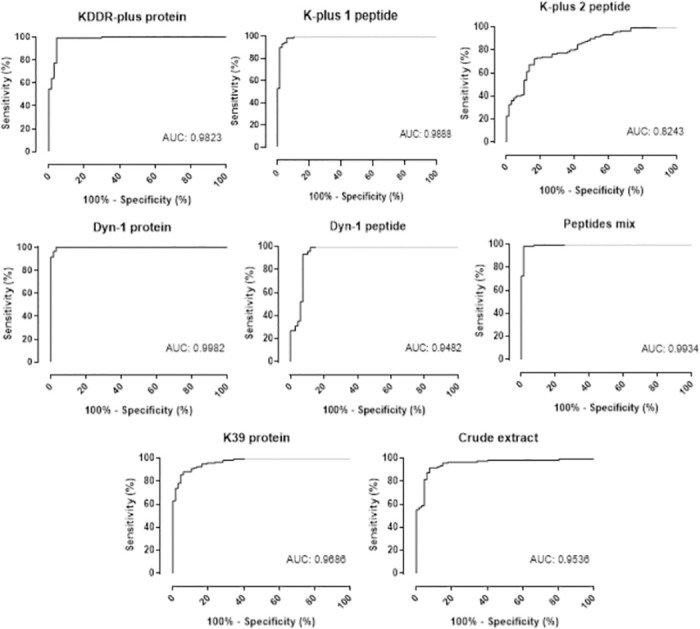
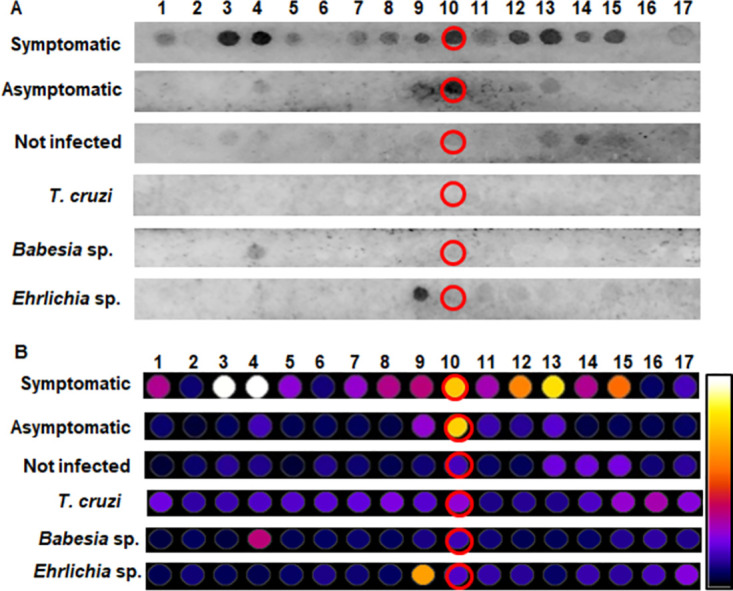
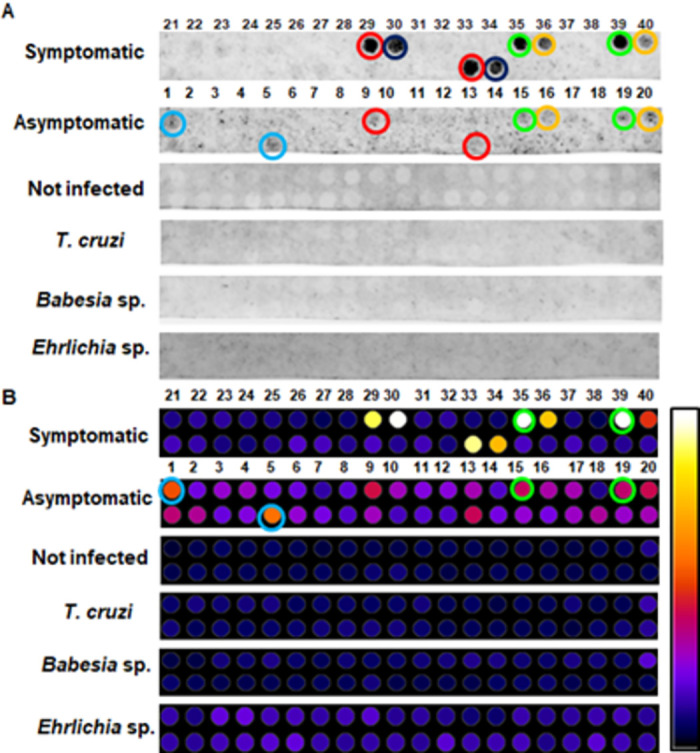
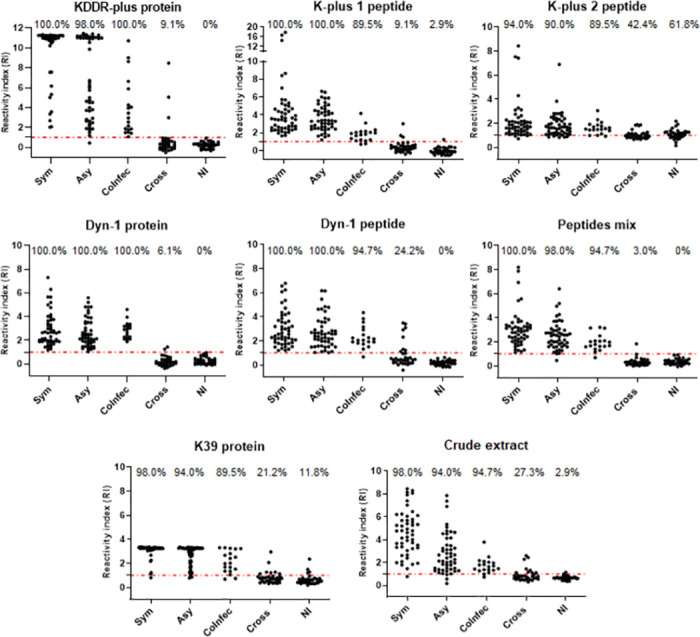
Endemic in Brazil, visceral leishmaniasis (VL) is a zoonotic infection that is among the most important parasitic diseases transmitted by vectors. Dogs are the main reservoirs of canine leishmaniasis (CanL) and their identification is used in some countries as part of disease prevention and control measures in the canine and human population. In this context, serological tests are necessary, composed of antigens capable of correctly identifying infected dogs, minimizing the number of false-negative cases. This study aimed to identify more immunoreactive peptides derived from two previously described whole proteins (rDyn-1 and rKDDR-plus) and compare their performance to the control antigens rK39 and the crude extract for the detection of dogs infected with L. infantum, especially the asymptomatic ones. The three selected peptides and a mixture of them, along with the rDyn-1, rKDDR-plus, rK39, and crude extract antigens were evaluated using indirect ELISA with sera samples from 186 dogs with CanL, being asymptomatic (n = 50), symptomatic (n = 50), co-infected (n = 19), infected with Babesia sp. (n = 7), Ehrlichia sp. (n = 6), T. cruzi (n = 20) and uninfected (n = 34). The results showed that the rDyn-1 protein and the peptide mixture had the highest sensitivity (100% and 98.32%, respectively) and specificity (97.01 and 98.51, respectively). A high degree of kappa agreement was found for rDyn-1 protein (0.977), mixed peptides (0.965), rKDDR-plus protein (0.953), K-plus peptide 1 (0.930) and Dyn-1 peptide (0.893). The mixture of peptides showed the highest likelihood (65.87). The ELISA using the mixture of peptides and the rDyn-1 protein showed high performance for CanL serodiagnosis. More mix combinations of the peptides and additional extended field tests with a larger sample size are recommended.
巴西流行内脏利什曼病(VL),这是一种由媒介传播的重要寄生虫病。狗是犬利什曼病(CanL)的主要宿主,在一些国家,它们的鉴定被用作犬和人群疾病预防和控制措施的一部分。在这种情况下,需要进行血清学检测,使用能够正确识别感染犬的抗原,最大限度地减少假阴性病例。本研究旨在从先前描述的两种全长蛋白(rDyn-1 和 rKDDR-plus)中鉴定出更多具有免疫反应性的肽段,并比较它们与对照抗原 rK39 和粗提物在检测感染利什曼原虫的犬,尤其是无症状犬方面的性能。三种选定的肽段和它们的混合物,以及 rDyn-1、rKDDR-plus、rK39 和粗提物抗原,通过间接 ELISA 与 186 只患有 CanL 的犬血清样本进行了评估,这些犬包括无症状(n=50)、有症状(n=50)、合并感染(n=19)、感染巴贝斯虫(n=7)、埃立克体(n=6)、克氏锥虫(n=20)和未感染(n=34)。结果表明,rDyn-1 蛋白和肽混合物具有最高的敏感性(分别为 100%和 98.32%)和特异性(分别为 97.01%和 98.51%)。rDyn-1 蛋白(0.977)、混合肽(0.965)、rKDDR-plus 蛋白(0.953)、K-plus 肽 1(0.930)和 Dyn-1 肽(0.893)之间具有高度的kappa 一致性。肽混合物的可能性最高(65.87)。使用肽混合物和 rDyn-1 蛋白的 ELISA 对 CanL 血清学诊断具有较高的性能。建议进行更多的肽混合组合和额外的具有更大样本量的扩展现场测试。