Vallet Hélène, Guidet Bertrand, Boumendil Ariane, De Lange Dylan W, Leaver Susannah, Szczeklik Wojciech, Jung Christian, Sviri Sigal, Beil Michael, Flaatten Hans
Institut National de la Santé et de la Recherche Médicale (INSERM), UMRS 1135, Centre d'immunologie et de Maladies Infectieuses (CIMI), Department of Geriatrics, Saint Antoine, Assistance Publique Hôpitaux de Paris (AP-HP), Sorbonne Université, F75012, Paris, France.
Institut Pierre Louis d'Epidémiologie et de Santé Publique, Hôpital Saint-Antoine, service de réanimation, Sorbonne Université, INSERM, AP-HP, 75012, Paris, France.
Ann Intensive Care. 2023 Aug 4;13(1):68. doi: 10.1186/s13613-023-01160-7.
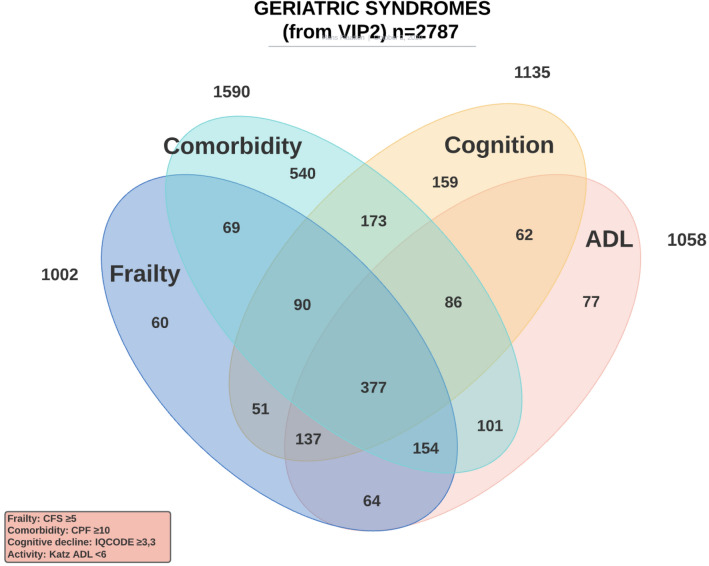
In this narrative review, we describe the most important age-related "syndromes" found in the old ICU patients. The syndromes are frailty, comorbidity, cognitive decline, malnutrition, sarcopenia, loss of functional autonomy, immunosenescence and inflam-ageing. The underlying geriatric condition, together with the admission diagnosis and the acute severity contribute to the short-term, but also to the long-term prognosis. Besides mortality, functional status and quality of life are major outcome variables. The geriatric assessment is a key tool for long-term qualitative outcome, while immediate severity accounts for acute mortality. A poor functional baseline reduces the chances of a successful outcome following ICU. This review emphasises the importance of using a geriatric assessment and considering the older patient as a whole, rather than the acute illness in isolation, when making decisions regarding intensive care treatment.
在这篇叙述性综述中,我们描述了在老年重症监护病房(ICU)患者中发现的最重要的与年龄相关的“综合征”。这些综合征包括衰弱、共病、认知衰退、营养不良、肌肉减少症、功能自主性丧失、免疫衰老和炎症衰老。潜在的老年疾病,连同入院诊断和急性严重程度,不仅影响短期预后,也影响长期预后。除了死亡率,功能状态和生活质量是主要的结局变量。老年评估是长期定性结局的关键工具,而即刻严重程度则决定急性死亡率。功能基线较差会降低ICU治疗后获得成功结局的机会。本综述强调在做出重症监护治疗决策时,使用老年评估并将老年患者作为一个整体来考虑的重要性,而不是孤立地看待急性疾病。