Liang Huazhe, Bi Xingqi, Chen Hongbin, He Tengfei, Lin Yi, Zhang Yunxin, Ma Kangqiao, Feng Wanying, Ma Zaifei, Long Guankui, Li Chenxi, Kan Bin, Zhang Hongtao, Rakitin Oleg A, Wan Xiangjian, Yao Zhaoyang, Chen Yongsheng
State Key Laboratory and Institute of Elemento-Organic Chemistry, The Centre of Nanoscale Science and Technology and Key Laboratory of Functional Polymer Materials, Renewable Energy Conversion and Storage Center (RECAST), College of Chemistry, Nankai University, 300071, Tianjin, China.
State Key Laboratory for Modification of Chemical Fibers and Polymer Materials, Center for Advanced Low-dimension Materials, College of Materials Science and Engineering, Donghua University, 201620, Shanghai, China.
Nat Commun. 2023 Aug 5;14(1):4707. doi: 10.1038/s41467-023-40423-6.
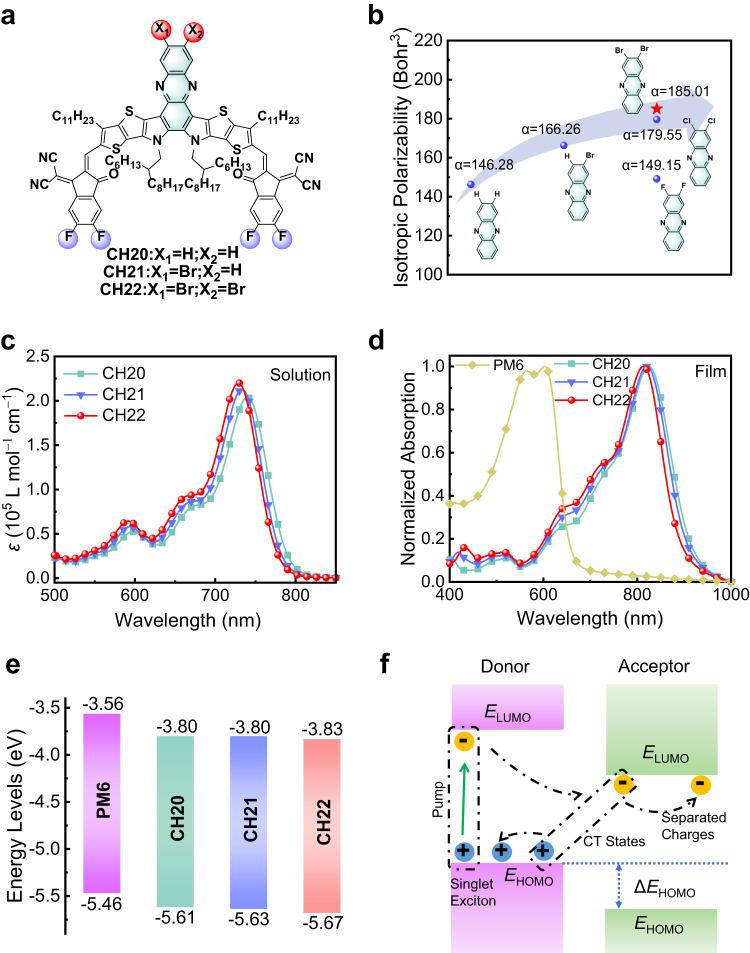
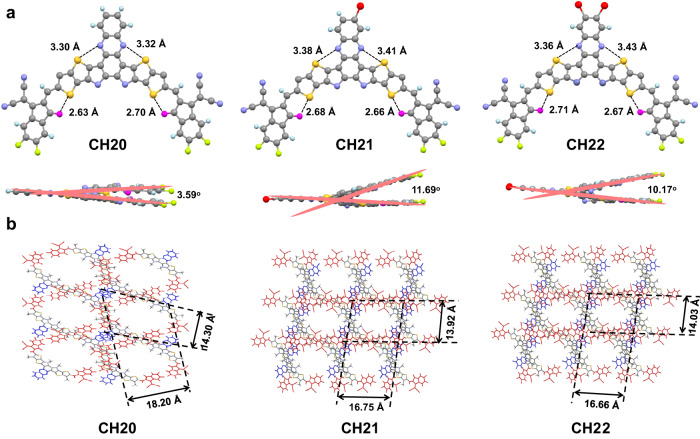
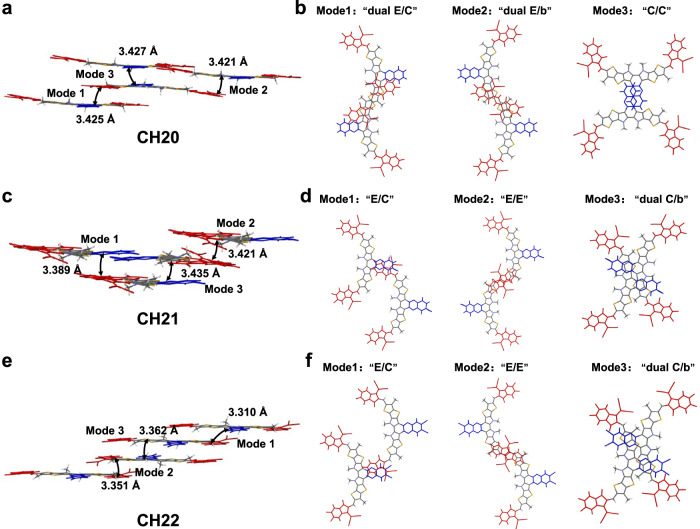
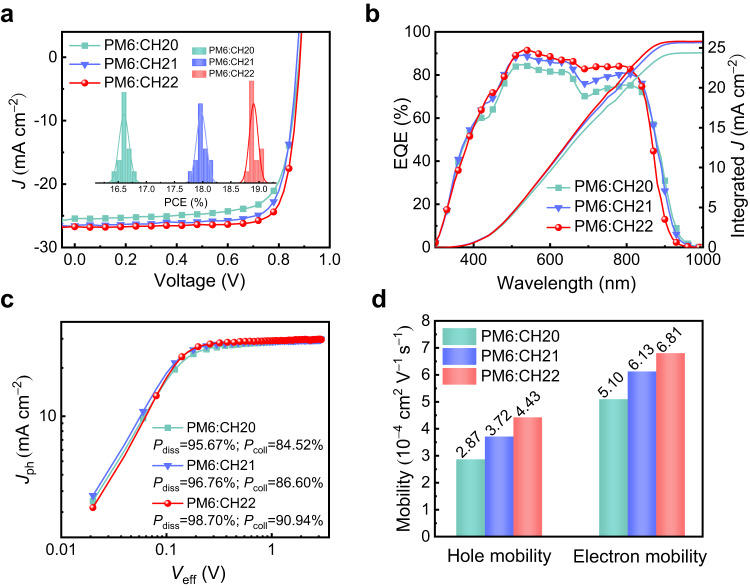
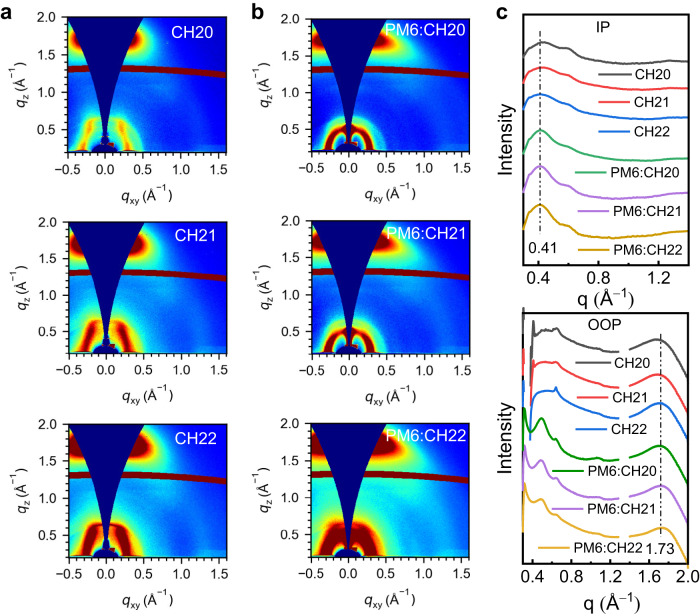
Given that bromine possesses similar properties but extra merits of easily synthesizing and polarizing comparing to homomorphic fluorine and chlorine, it is quite surprising very rare high-performance brominated small molecule acceptors have been reported. This may be caused by undesirable film morphologies stemming from relatively larger steric hindrance and excessive crystallinity of bromides. To maximize the advantages of bromides while circumventing weaknesses, three acceptors (CH20, CH21 and CH22) are constructed with stepwise brominating on central units rather than conventional end groups, thus enhancing intermolecular packing, crystallinity and dielectric constant of them without damaging the favorable intermolecular packing through end groups. Consequently, PM6:CH22-based binary organic solar cells render the highest efficiency of 19.06% for brominated acceptors, more excitingly, a record-breaking efficiency of 15.70% when further thickening active layers to ~500 nm. By exhibiting such a rare high-performance brominated acceptor, our work highlights the great potential for achieving record-breaking organic solar cells through delicately brominating.
鉴于溴具有与同构的氟和氯相似的性质,但具有易于合成和极化的额外优点,令人惊讶的是,很少有高性能溴化小分子受体被报道。这可能是由于溴化物相对较大的空间位阻和过度结晶导致的不理想的薄膜形态所致。为了在规避弱点的同时最大化溴化物的优势,通过在中心单元而非传统端基上逐步溴化构建了三种受体(CH20、CH21和CH22),从而增强了它们的分子间堆积、结晶度和介电常数,同时又不会破坏通过端基形成的有利分子间堆积。因此,基于PM6:CH22的二元有机太阳能电池对于溴化受体的效率最高可达19.06%,更令人兴奋的是,当将活性层进一步加厚至约500 nm时,效率达到了破纪录的15.70%。通过展示这种罕见的高性能溴化受体,我们的工作突出了通过精细溴化实现破纪录有机太阳能电池的巨大潜力。