Connecticut Convergence Institute for Translation in Regenerative Engineering, University of Connecticut Health Center, 195 Farmington Avenue, Suite 2080, Farmington, CT, USA.
Epidemiology and Public Health Group, Faculty of Health and Life Sciences, University of Exeter, Exeter, UK.
Geroscience. 2024 Feb;46(1):1331-1342. doi: 10.1007/s11357-023-00890-7. Epub 2023 Aug 7.
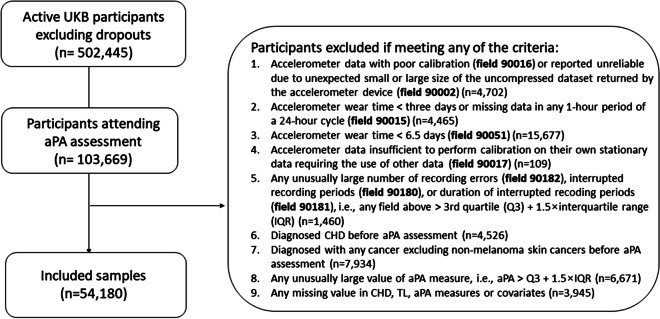
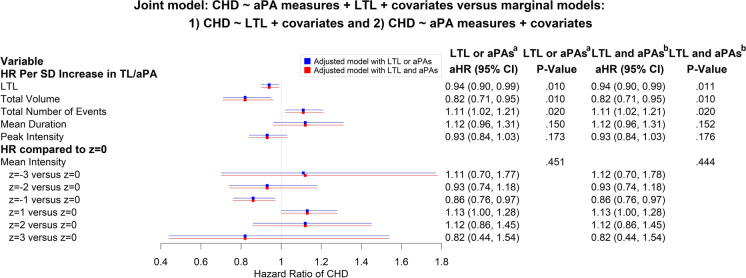
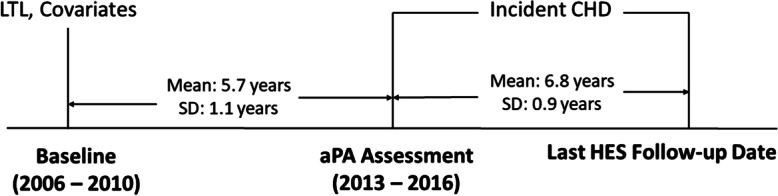
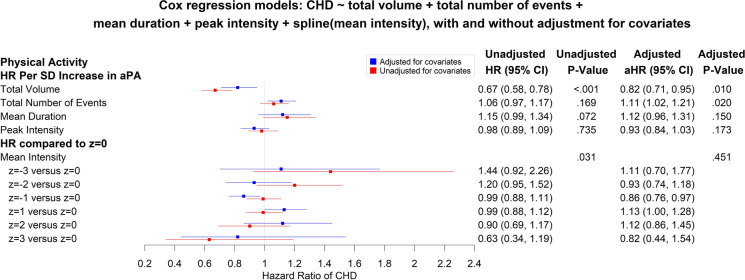
Telomere shortening is a biological aging hallmark. The effect of short telomere length may be targeted by increased physical activity to reduce the risk of multiple aging-related diseases, including coronary heart disease (CHD). The objective was to assess the moderation effect of accelerometer-based physical activity (aPA) on the association between shorter leukocyte telomere length (LTL) relatively in the population sample and incident CHD. Data were from the UK Biobank participants with well-calibrated accelerometer data for at least 6.5 days (n = 54,180). Relative mean LTL at baseline (5-6 years prior to aPA assessment) was measured in T/S ratio, using a multiplex quantitative polymerase chain reaction (qPCR) technology, by comparing the amount of the telomere amplification product (T) to that of a single-copy gene (S). aPA measures included total number of events (at least 10-s continued physical activity > 32 milligravities [mg]), total volume, mean duration, mean intensity, and peak intensity of all events. LTL, aPA measures, and their interactions were associated with incident CHD (mean follow-up 6.8 years) using Cox proportional hazards models adjusting for covariates. Longer LTL (relative to the sample distribution) was associated with reduced incidence of CHD (adjusted hazard ratio [aHR] = 0.94 per standard deviation [SD] increase in LTL, [95% CI, 0.90 to 0.99], P = .010). Incidence of CHD was reduced by higher total volume of aPA (aHR = 0.82 per SD increase in LTL, [95% CI, 0.71 to 0.95], P = .010) but increased by higher total number of events (aHR = 1.11 per SD increase in LTL, [95% CI, 1.02 to 1.21], P = .020) after controlling for other aPA measures and covariates. However, none of the interactions between LTL and aPA measures was statistically significant (P = .171).
端粒缩短是生物衰老的一个标志。增加身体活动可能会影响端粒的长度,从而降低多种与衰老相关疾病的风险,包括冠心病(CHD)。本研究的目的是评估基于加速度计的身体活动(aPA)对人群样本中白细胞端粒长度(LTL)较短与冠心病事件之间关联的调节作用。数据来自英国生物银行参与者,他们有至少 6.5 天(n=54180)经过良好校准的加速度计数据。在基线(aPA 评估前 5-6 年)时使用多重定量聚合酶链反应(qPCR)技术以 T/S 比值测量相对平均 LTL,通过比较端粒扩增产物(T)的量与单个拷贝基因(S)的量。aPA 测量指标包括事件总数(至少 10 秒持续的活动强度>32 毫重力 [mg])、总容量、平均持续时间、平均强度和所有事件的峰值强度。使用 Cox 比例风险模型调整协变量后,将 LTL、aPA 测量值及其相互作用与冠心病事件(平均随访 6.8 年)相关联。与样本分布相比,较长的 LTL 与冠心病发病率降低相关(调整后的风险比 [aHR],LTL 每增加一个标准差 [SD],[95%CI,0.90 至 0.99],P=0.010)。较高的 aPA 总容量与 CHD 发生率降低相关(aHR=0.82,每增加一个 SD 的 LTL,[95%CI,0.71 至 0.95],P=0.010),但总事件数增加则与 CHD 发生率升高相关(aHR=1.11,每增加一个 SD 的 LTL,[95%CI,1.02 至 1.21],P=0.020),控制其他 aPA 测量值和协变量后。然而,LTL 和 aPA 测量值之间的相互作用均无统计学意义(P=0.171)。