Department of Dermatology, State Key Laboratory of Complex Severe and Rare Diseases, National Clinical Research Center for Dermatologic and Immunologic Diseases, Peking Union Medical College Hospital, Chinese Academy of Medical Sciences and Peking Union Medical College, Beijing, China.
Department of Dermatology, Hebei North University, Zhangjiakou, Hebei, China.
Front Immunol. 2023 Jul 20;14:1165106. doi: 10.3389/fimmu.2023.1165106. eCollection 2023.
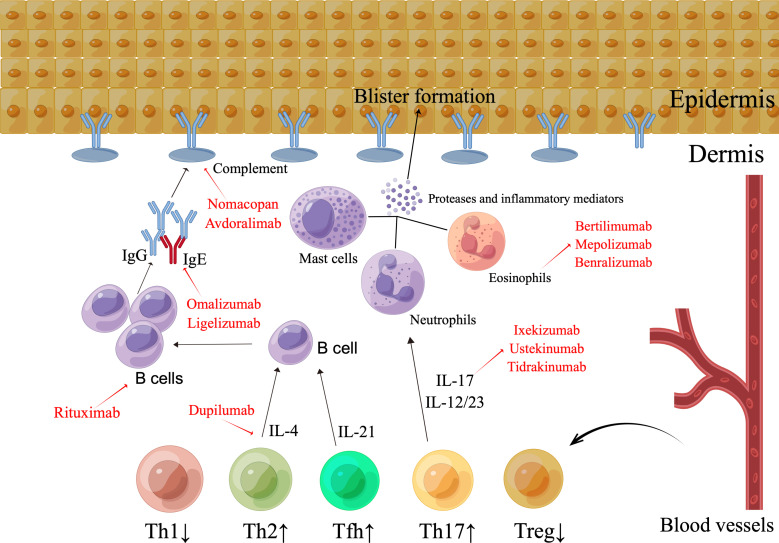
Bullous pemphigoid (BP) is a common subepidermal bullous disorder that lacks adequate treatment alternatives. Dupilumab, an anti-interleukin (IL) 4 receptor α antibody blocking Th2 molecules IL-4 and 13, has been used off-label and shown to be effective in refractory BP cases.
BP patients with various disease severities and comorbidities were included in this case series. All patients received dupilumab alone or in combination with immunosuppressants in a real-world setting. Complete remission (CR) was defined as the absence of pruritus symptoms and previous BP eruptions, with only hyperpigmentation patches and without newly occurring lesions for at least 4 weeks. Disease relapse was classified as the appearance of three or more new lesions within 1 month or at least one large urticarial or eczematous lesion that did not resolve within a week.
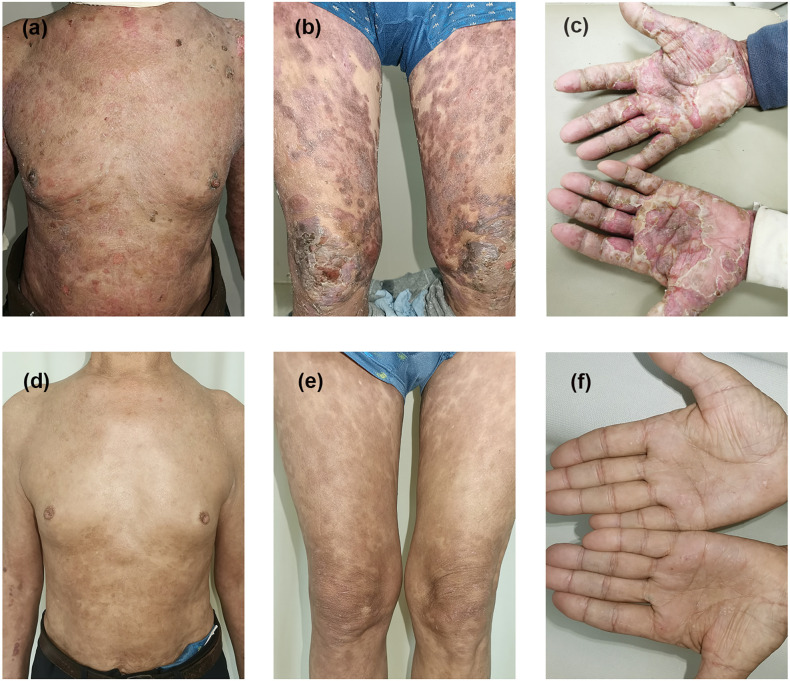
Ten individuals were enrolled in this case series. Pruritus symptoms and BP eruptions improved significantly in nine patients (90%). Seven patients (70%) attained CR, including all mild-to-moderate (100%) cases and three of six (50%) severe BP cases. At the dupilumab monotherapy stage, eosinophilia was observed in two severe cases. One patient out of seven (14.3%) relapsed after 1 year of follow-up after CR.
Treatment of BP with diverse comorbidities with anti-IL-4 receptor α antibody provides further credentials to a prospective randomized study. More impressive efficacy and safety profiles were observed in patients with mild-to-moderate disease after 1 year of follow-up. Eosinophilia may occur in patients receiving dupilumab monotherapy.
大疱性类天疱疮(BP)是一种常见的表皮下水疱性疾病,缺乏有效的治疗选择。白细胞介素(IL)-4 受体 α 抗体阻断 Th2 分子 IL-4 和 13 的度普利尤单抗已被用于超适应证治疗,并已被证明对难治性 BP 病例有效。
本病例系列纳入了不同疾病严重程度和合并症的 BP 患者。所有患者均在真实环境中单独使用或联合使用免疫抑制剂接受度普利尤单抗治疗。完全缓解(CR)定义为瘙痒症状和以前的 BP 发作消失,仅出现色素沉着斑,且至少 4 周内无新发皮损。疾病复发定义为在 1 个月内出现 3 个或更多新皮损,或至少 1 个大的荨麻疹或湿疹样皮损,1 周内未消退。
本病例系列纳入了 10 名患者。9 名患者(90%)的瘙痒症状和 BP 发作明显改善。7 名患者(70%)达到 CR,包括所有轻度至中度(100%)病例和 6 例严重 BP 患者中的 3 例(50%)。在度普利尤单抗单药治疗阶段,2 例严重病例出现嗜酸性粒细胞增多。7 名达到 CR 的患者中有 1 名(14.3%)在 CR 后 1 年随访时复发。
抗 IL-4 受体 α 抗体治疗伴有多种合并症的 BP 为前瞻性随机研究提供了更多证据。在 1 年随访后,轻度至中度疾病患者的疗效和安全性更显著。接受度普利尤单抗单药治疗的患者可能会出现嗜酸性粒细胞增多。