Hwang Alan, Martinez Maximilian, Cora Jones Courtney Marie, Giordano Brian
Department of Orthopaedic Surgery, University of Rochester Medical Center, Rochester, New York, U.S.A.
Arthrosc Sports Med Rehabil. 2023 Jul 28;5(5):100780. doi: 10.1016/j.asmr.2023.100780. eCollection 2023 Oct.
To retrospectively determine the prevalence of multifid tendons in a population of patients who underwent iliopsoas release for painful snapping iliopsoas tendons.
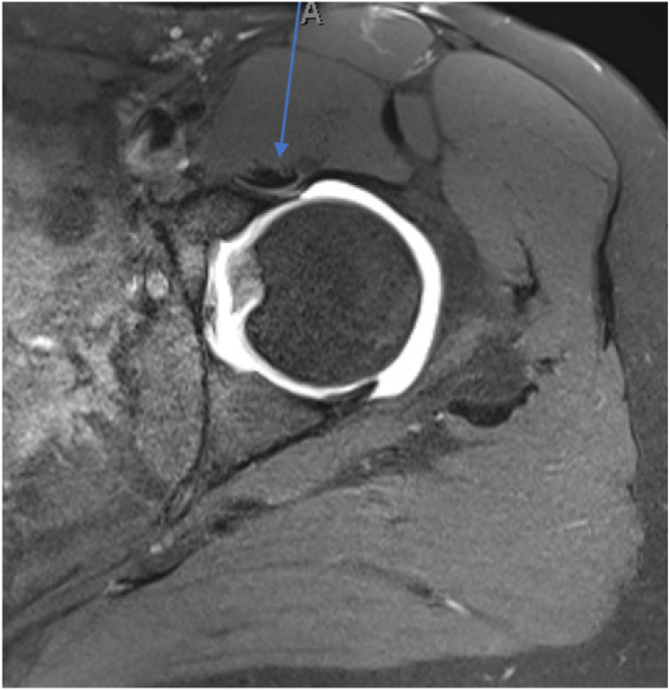
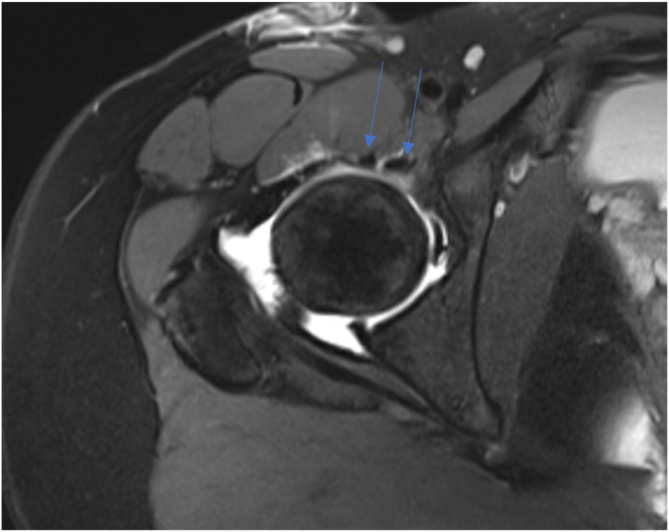
Patients who underwent iliopsoas release for painful snapping iliopsoas tendons were retrospectively identified from a database of patients who had undergone arthroscopic hip surgery performed by a single surgeon between 2011 and 2020. Patients who had incomplete data or who underwent prior fracture fixation, joint arthroplasty, pelvic surgery, or other interventions for snapping hip were excluded. Magnetic resonance imaging (MRI) and operative reports were reviewed and compared with those of an age-matched control group of patients who had undergone hip or pelvic MRI examinations in the past year for different indications.
This study included 91 patients (78 female and 13 male patients; mean age, 23.3 years) who were treated operatively for painful snapping hip and 78 controls (54 female and 24 male patients; mean age, 28.4 years) who received hip or pelvic MRI for other indications. Among the patients who underwent iliopsoas release, there were 5 unifid iliopsoas tendons (5.5%) compared with 86 multifid iliopsoas tendons (94.5%) when classified with MRI whereas operative examination showed 19 unifid tendons (20.9%) compared with 72 multifid tendons (79.1%, < .001). When the MRI scans of the operative group were compared with the MRI scans of the control group, the patients who underwent surgery for painful snapping hip had a higher rate of multifid tendons (94.5% of operative hips compared with 69.2% of control right hips [ < .001] and 74.4% of control left hips [ < .001]). However, when the operative reports were used to classify the iliopsoas tendon, there was no significance between the operative and control groups (79.1% of operative hips had multifid tendons compared with 69.2% of control right hips [ = .141] and 74.4% of control left hips [ = .464]).
For patients with symptomatic snapping hip undergoing iliopsoas lengthening, multifid iliopsoas tendons are more prevalent than in a control population.
Level IV, prognostic case series.
回顾性确定因髂腰肌肌腱弹响疼痛而接受髂腰肌松解术的患者群体中多裂肌腱的患病率。
从2011年至2020年由单一外科医生进行关节镜髋关节手术的患者数据库中回顾性识别出因髂腰肌肌腱弹响疼痛而接受髂腰肌松解术的患者。排除数据不完整或之前接受过骨折固定、关节置换、骨盆手术或其他针对髋关节弹响的干预措施的患者。回顾磁共振成像(MRI)和手术报告,并与过去一年因不同适应症接受髋关节或骨盆MRI检查的年龄匹配对照组患者的报告进行比较。
本研究纳入了91例因髋关节弹响疼痛接受手术治疗的患者(78例女性和13例男性患者;平均年龄23.3岁)以及78例对照组患者(54例女性和24例男性患者;平均年龄28.4岁),后者因其他适应症接受髋关节或骨盆MRI检查。在接受髂腰肌松解术的患者中,MRI分类显示有5条单裂髂腰肌肌腱(5.5%),86条多裂髂腰肌肌腱(94.5%);而手术检查显示19条单裂肌腱(20.9%),72条多裂肌腱(79.1%,P<0.001)。将手术组的MRI扫描与对照组的MRI扫描进行比较时,因髋关节弹响疼痛接受手术的患者多裂肌腱的发生率更高(手术髋关节中为94.5%,而对照组右侧髋关节中为69.2%[P<0.001],对照组左侧髋关节中为74.4%[P<0.001])。然而,当使用手术报告对髂腰肌肌腱进行分类时,手术组与对照组之间无显著差异(手术髋关节中有79.1%有多裂肌腱,而对照组右侧髋关节中有69.2%[P=0.141],对照组左侧髋关节中有74.4%[P=0.464])。
对于有症状的髋关节弹响且接受髂腰肌延长术的患者,多裂髂腰肌肌腱比对照组更为普遍。
IV级,预后病例系列。