Mirza Salahudeen, de Carvalho Lima Camila N, Del Favero-Campbell Alexandra, Rubinstein Alexandre, Topolski Natasha, Cabrera-Mendoza Brenda, Kovács Emese H C, Blumberg Hilary P, Richards Jenny Gringer, Williams Aislinn J, Wemmie John A, Magnotta Vincent A, Fiedorowicz Jess G, Gaine Marie E, Walss-Bass Consuelo, Quevedo Joao, Soares Jair C, Fries Gabriel R
Translational Psychiatry Program, Faillace Department of Psychiatry and Behavioral Sciences, McGovern Medical School, University of Texas Health Science Center at Houston, (UTHealth), 77054 Houston, Texas, USA.
Institute of Child Development, University of Minnesota, 55455 Minneapolis, Minnesota, USA.
medRxiv. 2023 Jul 24:2023.07.20.23292968. doi: 10.1101/2023.07.20.23292968.
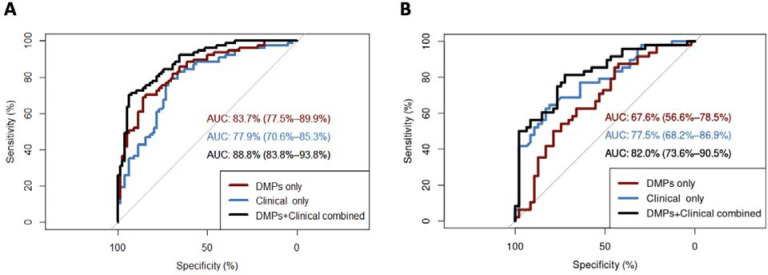
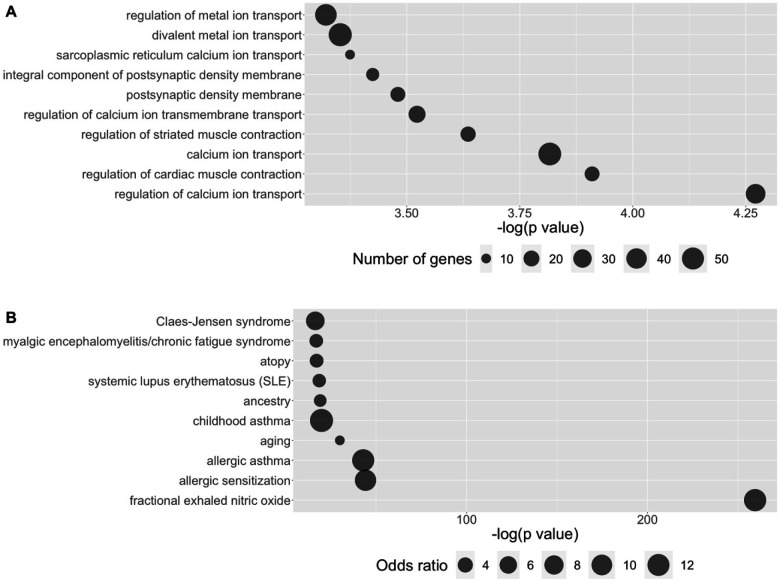
Suicide attempt (SA) risk is elevated in individuals with bipolar disorder (BD), and DNA methylation patterns may serve as possible biomarkers of SA. We conducted epigenome-wide association studies (EWAS) of blood DNA methylation associated with BD and SA. DNA methylation was measured at > 700,000 positions in a discovery cohort of n = 84 adults with BD with a history of SA (BD/SA), n = 79 adults with BD without history of SA (BD/non-SA), and n = 76 non-psychiatric controls (CON). EWAS revealed six differentially methylated positions (DMPs) and seven differentially methylated regions (DMRs) between BD/SA and BD/non-SA, with multiple immune-related genes implicated. There were no epigenome-wide significant differences when BD/SA and BD/non-SA were each compared to CON, and patterns suggested that epigenetics differentiating BD/SA from BD/non-SA do not differentiate BD/non-SA from CON. Weighted gene co-methylation network analysis and trait enrichment analysis of the BD/SA vs. BD/non-SA contrast further corroborated immune system involvement, while gene ontology analysis implicated calcium signalling. In an independent replication cohort of n = 48 BD/SA and n = 47 BD/non-SA, fold-changes at the discovery cohort's significant sites showed moderate correlation across cohorts and agreement on direction. In both cohorts, classification accuracy for SA history among individuals with BD was highest when methylation at the significant CpG sites as well as information from clinical interviews were combined, with an AUC of 88.8% (CI = 83.8-93.8%) and 82.1% (CI = 73.6-90.5%) for the combined epigenetic-clinical predictor in the discovery and replication cohorts, respectively. Our results provide novel insight to the role of immune system functioning in SA and BD and also suggest that integrating information from multiple levels of analysis holds promise to improve risk assessment for SA in adults with BD.
双相情感障碍(BD)患者的自杀未遂(SA)风险升高,DNA甲基化模式可能作为SA的潜在生物标志物。我们对与BD和SA相关的血液DNA甲基化进行了全表观基因组关联研究(EWAS)。在一个发现队列中,对超过70万个位点的DNA甲基化进行了测量,该队列包括84名有SA病史的BD成年患者(BD/SA)、79名无SA病史的BD成年患者(BD/非SA)和76名非精神科对照者(CON)。EWAS显示,BD/SA和BD/非SA之间有6个差异甲基化位点(DMP)和7个差异甲基化区域(DMR),涉及多个免疫相关基因。当将BD/SA和BD/非SA分别与CON进行比较时,未发现全表观基因组范围内的显著差异,且模式表明,区分BD/SA与BD/非SA的表观遗传学特征并不能区分BD/非SA与CON。对BD/SA与BD/非SA对比进行加权基因共甲基化网络分析和性状富集分析,进一步证实了免疫系统的参与,而基因本体分析则涉及钙信号传导。在一个独立的复制队列中,有48名BD/SA患者和47名BD/非SA患者,发现队列中显著位点的倍数变化在各队列间显示出中等相关性且方向一致。在两个队列中,当将显著CpG位点的甲基化以及临床访谈信息相结合时,BD患者中SA病史的分类准确率最高,发现队列和复制队列中联合表观遗传学 - 临床预测指标的曲线下面积(AUC)分别为88.8%(CI = 83.8 - 93.8%)和82.1%(CI = 73.6 - 90.5%)。我们的结果为免疫系统功能在SA和BD中的作用提供了新的见解,也表明整合来自多个分析层面的信息有望改善BD成年患者SA的风险评估。