Pediatrics, University of Iowa, Iowa City, IA, USA.
Department of Physical Therapy and Rehabilitation Science, University of Iowa, Iowa City, IA, USA.
Can Respir J. 2023 Jul 28;2023:1422319. doi: 10.1155/2023/1422319. eCollection 2023.
Cystic Fibrosis Foundation guidelines recommend people with CF perform daily airway clearance. This can be difficult for patients, as some find it time consuming or uncomfortable. Data comparing airway clearance methods are limited. We surveyed patients and their families to understand which methods are preferred and identify obstacles to performing airway clearance.
We designed a REDCap survey and enrolled participants in 2021. Respondents reported information on airway clearance usage, time commitment, and medication use. They rated airway clearance methods for effectiveness, comfort, time commitment, importance, and compatibility with other treatments. The analysis included descriptive statistics and clustering.
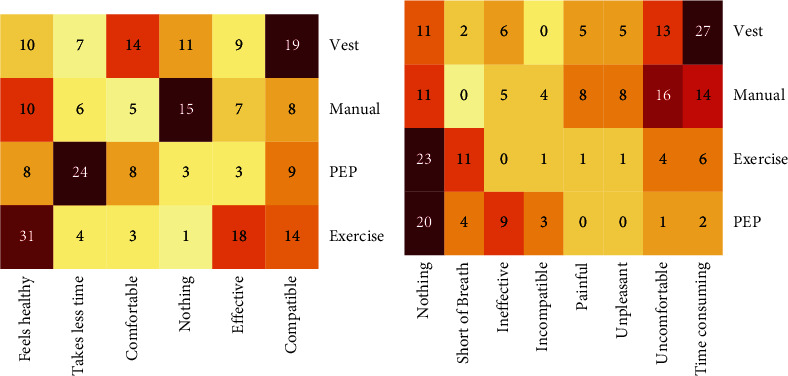
60 respondents started and 52 completed the survey. The median patient age was 20 years. Respondents experienced a median of four airway clearance methods in their lifetime, including chest wall oscillation (vest, 92%), manual chest physical therapy (CPT, 88%), forced expiration technique (huff or cough, 77%), and exercise (75%). Past 30-day use was highest for exercise (62%) and vest (57%). The time commitment was generally less than 2 hours daily. Of those eligible for CFTR modulators, 53% reported decreased time commitment to airway clearance after starting treatment. On a scale of 0-100, respondents rated CFTR modulators as their most important treatment (median 99.5), followed by exercise (88). . Patients and caregivers are familiar with several methods of airway clearance for CF. They report distinct strengths and limitations of each method. Exercise and vest are the most common methods of airway clearance. The use of CFTR modulators may reduce patient-reported time commitment to airway clearance.
囊性纤维化基金会的指南建议囊性纤维化患者进行日常气道清除。这对患者来说可能很困难,因为有些人觉得它既耗时又不舒服。比较气道清除方法的数据有限。我们调查了患者及其家属,以了解他们更喜欢哪种方法,并确定进行气道清除的障碍。
我们设计了一个 REDCap 调查,并在 2021 年招募了参与者。受访者报告了气道清除使用、时间承诺和药物使用等信息。他们对气道清除方法的有效性、舒适度、时间承诺、重要性以及与其他治疗的兼容性进行了评分。分析包括描述性统计和聚类。
60 名受访者开始并完成了调查,其中 52 名。患者的中位年龄为 20 岁。受访者一生中经历了中位数为 4 种气道清除方法,包括胸部振荡(背心,92%)、手动胸部物理治疗(CPT,88%)、强制呼气技术(呼气或咳嗽,77%)和运动(75%)。过去 30 天的使用频率最高的是运动(62%)和背心(57%)。每日的时间承诺一般少于 2 小时。在有资格接受 CFTR 调节剂治疗的患者中,53%的患者报告在开始治疗后气道清除的时间承诺减少。在 0-100 的评分中,受访者将 CFTR 调节剂评为最重要的治疗方法(中位数 99.5),其次是运动(88%)。患者和护理人员熟悉几种 CF 气道清除方法。他们报告了每种方法的明显优势和局限性。运动和背心是最常见的气道清除方法。CFTR 调节剂的使用可能会减少患者报告的气道清除时间承诺。