Khom Sophia, Borgonetti Vittoria, Vozella Valentina, Kirson Dean, Rodriguez Larry, Gandhi Pauravi, Bianchi Paula Cristina, Snyder Angela, Vlkolinsky Roman, Bajo Michal, Oleata Christopher S, Ciccocioppo Roberto, Roberto Marisa
Department of Molecular Medicine, The Scripps Research Institute, 10550 N. Torrey Pines Road, La Jolla, CA 92037, USA.
Department of Pharmaceutical Sciences, University of Vienna, Josef-Holaubek-Platz 2, Vienna, A 1090, Austria.
Neurobiol Stress. 2023 Jun 4;25:100547. doi: 10.1016/j.ynstr.2023.100547. eCollection 2023 Jul.
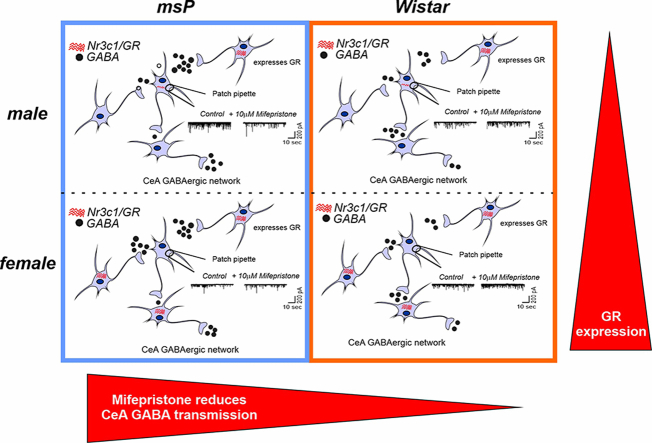
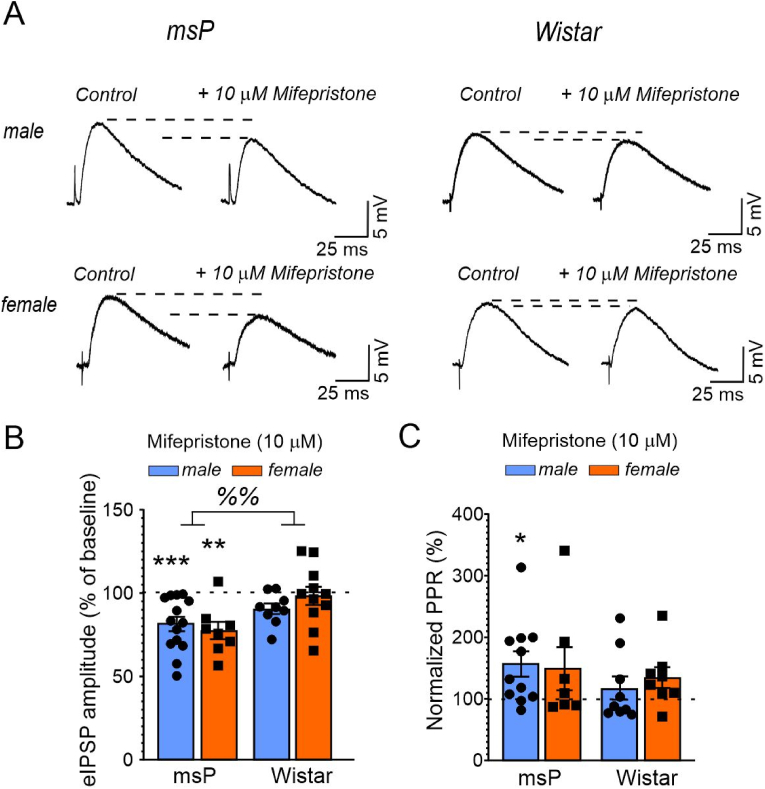
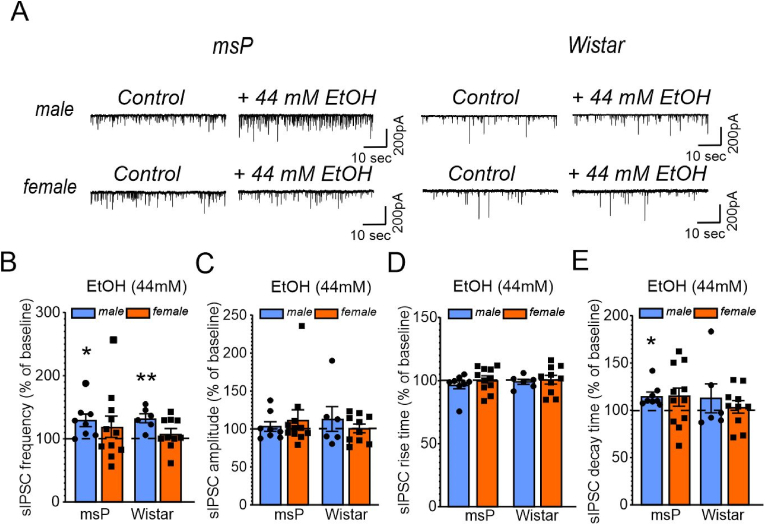
Impairments in the function of the hypothalamic-pituitary-adrenal (HPA) axis and enhanced glucocorticoid receptor (GR) activity in the central amygdala (CeA) are critical mechanisms in the pathogenesis of alcohol use disorder (AUD). The GR antagonist mifepristone attenuates craving in AUD patients, alcohol consumption in AUD models, and decreases CeA γ-aminobutyric acid (GABA) transmission in alcohol-dependent rats. Previous studies suggest elevated GR activity in the CeA of male alcohol-preferring Marchigian-Sardinian (msP) rats, but its contribution to heightened CeA GABA transmission driving their characteristic post-dependent phenotype is largely unknown. We determined (the gene encoding GR) gene transcription in the CeA in male and female msP and Wistar rats using hybridization and studied acute effects of mifepristone (10 μM) and its interaction with ethanol (44 mM) on pharmacologically isolated spontaneous inhibitory postsynaptic currents (sIPSCs) and electrically evoked inhibitory postsynaptic potentials (eIPSPs) in the CeA using slice electrophysiology. Female rats of both genotypes expressed more CeA GRs than males, suggesting a sexually dimorphic GR regulation of CeA activity. Mifepristone reduced sIPSC frequencies (GABA release) and eIPSP amplitudes in msP rats of both sexes, but not in their Wistar counterparts; however, it did not prevent acute ethanol-induced increase in CeA GABA transmission in male rats. In msP rats, GR regulates CeA GABAergic signaling under basal conditions, indicative of intrinsically active GR. Thus, enhanced GR function in the CeA represents a key mechanism contributing to maladaptive behaviors associated with AUD.
下丘脑 - 垂体 - 肾上腺(HPA)轴功能受损以及杏仁核中央核(CeA)中糖皮质激素受体(GR)活性增强是酒精使用障碍(AUD)发病机制中的关键机制。GR拮抗剂米非司酮可减轻AUD患者的渴望、减少AUD模型中的酒精摄入量,并降低酒精依赖大鼠CeA中的γ-氨基丁酸(GABA)传递。先前的研究表明,雄性嗜酒的马尔基安 - 撒丁岛(msP)大鼠的CeA中GR活性升高,但其对驱动其特征性依赖后表型的CeA GABA传递增强的作用在很大程度上尚不清楚。我们使用杂交技术测定了雄性和雌性msP大鼠以及Wistar大鼠CeA中(GR编码基因)基因的转录,并使用脑片电生理学研究了米非司酮(10 μM)及其与乙醇(44 mM)的相互作用对CeA中药理学分离的自发性抑制性突触后电流(sIPSCs)和电诱发抑制性突触后电位(eIPSPs)的急性影响。两种基因型的雌性大鼠CeA中的GR表达均高于雄性,表明CeA活性存在性别二态性GR调节。米非司酮降低了两性msP大鼠的sIPSC频率(GABA释放)和eIPSP幅度,但对其Wistar对照大鼠没有影响;然而,它并不能阻止雄性大鼠中急性乙醇诱导的CeA GABA传递增加。在msP大鼠中,GR在基础条件下调节CeA的GABA能信号传导,表明GR具有内在活性。因此,CeA中GR功能增强是导致与AUD相关的适应不良行为的关键机制。