Nazarbayev University, Graduate School of Business, Astana, 010000, Kazakhstan.
Duke University, Fuqua School of Business, Durham, NC 27708.
Proc Natl Acad Sci U S A. 2023 Aug 15;120(33):e2218961120. doi: 10.1073/pnas.2218961120. Epub 2023 Aug 7.
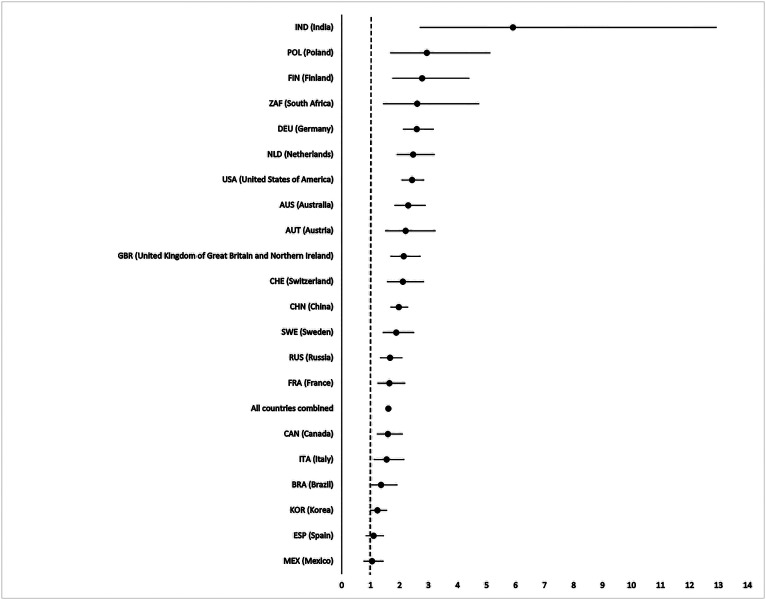
Thinking about God promotes greater acceptance of Artificial intelligence (AI)-based recommendations. Eight preregistered experiments ( = 2,462) reveal that when God is salient, people are more willing to consider AI-based recommendations than when God is not salient. Studies 1 and 2a to 2d demonstrate across a wide variety of contexts, from choosing entertainment and food to mutual funds and dental procedures, that God salience reduces reliance on human recommenders and heightens willingness to consider AI recommendations. Studies 3 and 4 demonstrate that the reduced reliance on humans is driven by a heightened feeling of smallness when God is salient, followed by a recognition of human fallibility. Study 5 addresses the similarity in mysteriousness between God and AI as an alternative, but unsupported, explanation. Finally, study 6 ( = 53,563) corroborates the experimental results with data from 21 countries on the usage of robo-advisors in financial decision-making.
思考上帝会促进对人工智能(AI)推荐的更大接受度。八项预先注册的实验(=2462)表明,当上帝凸显时,人们更愿意考虑基于 AI 的推荐,而不是当上帝不凸显时。研究 1 和 2a 至 2d 在从娱乐和食品选择到共同基金和牙科手术等各种背景下证明,上帝凸显降低了对人类推荐者的依赖,并提高了对 AI 推荐的意愿。研究 3 和 4 表明,对人类的依赖减少是由当上帝凸显时感到自己渺小引起的,随之而来的是对人类易错性的认识。研究 5 探讨了上帝和 AI 之间神秘感的相似性,作为一种替代但未经证实的解释。最后,研究 6(=53563)用来自 21 个国家在金融决策中使用机器人顾问的数据验证了实验结果。