Medical Data Analytics Centre, The Chinese University of Hong Kong, Hong Kong, People's Republic of China.
State Key Laboratory of Digestive Disease, Institute of Digestive Disease, The Chinese University of Hong Kong, Hong Kong, People's Republic of China.
Gut. 2023 Nov 24;72(12):2364-2371. doi: 10.1136/gutjnl-2023-330269.
We aimed to test the hypothesis that automated fibrosis score calculation and electronic reminder messages could increase the detection of advanced liver disease in patients with type 2 diabetes.
In this pragmatic randomised controlled trial at five general medical or diabetes clinics in Hong Kong and Malaysia, we randomly assigned patients in a 1:1 ratio to the intervention group with Fibrosis-4 index and aspartate aminotransferase-to-platelet ratio index automatically calculated based on routine blood tests, followed by electronic reminder messages to alert clinicians of abnormal results, or the control group with usual care. The primary outcome was the proportion of patients with increased fibrosis scores who received appropriate care (referred for hepatology care or specific fibrosis assessment) within 1 year.
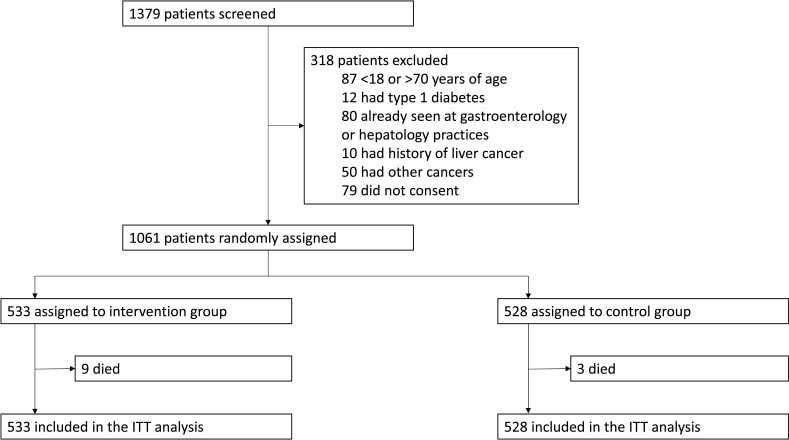
Between May 2020 and Oct 2021, 1379 patients were screened, of whom 533 and 528 were assigned to the intervention and control groups, respectively. A total of 55 out of 165 (33.3%) patients with increased fibrosis scores in the intervention group received appropriate care, compared with 4 of 131 (3.1%) patients in the control group (difference 30.2% (95% CI 22.4% to 38%); p<0.001). Overall, 11 out of 533 (2.1%) patients in the intervention group and 1 out of 528 (0.2%) patients in the control group were confirmed to have advanced liver disease (difference 1.9% (95% CI 0.61% to 3.5%); p=0.006).
Automated fibrosis score calculation and electronic reminders can increase referral of patients with type 2 diabetes and abnormal fibrosis scores at non-hepatology settings.
NCT04241575.
我们旨在检验假设,即自动纤维化评分计算和电子提醒信息可以增加 2 型糖尿病患者中晚期肝病的检出率。
在香港和马来西亚的五家普通医疗或糖尿病诊所进行的这项实用随机对照试验中,我们将患者以 1:1 的比例随机分配至干预组,接受基于常规血液检查的 Fibrosis-4 指数和天冬氨酸氨基转移酶与血小板比值指数自动计算,随后电子提醒消息将提醒临床医生注意异常结果,或对照组接受常规护理。主要结局是在 1 年内接受适当治疗(转至肝病科治疗或进行特定纤维化评估)的纤维化评分增加患者比例。
在 2020 年 5 月至 2021 年 10 月期间,共筛选了 1379 名患者,其中 533 名和 528 名患者分别被分配至干预组和对照组。干预组中 165 名纤维化评分增加的患者中有 55 名(33.3%)接受了适当治疗,而对照组中 131 名纤维化评分增加的患者中有 4 名(3.1%)(差异为 30.2%(95%CI 22.4% 至 38%);p<0.001)。总体而言,干预组中有 11 名(2.1%)患者和对照组中有 1 名(0.2%)患者被确诊为晚期肝病(差异为 1.9%(95%CI 0.61% 至 3.5%);p=0.006)。
自动纤维化评分计算和电子提醒可以增加非肝病环境中 2 型糖尿病和异常纤维化评分患者的转诊率。
NCT04241575。