Department of Chiropractic, Université du Québec à Trois-Rivières, 3351 Boul. des Forges, Trois-Rivières, QC, G8Z 4M3, Canada.
Research Group on Neuromusculoskeletal Disorders, Université du Québec à Trois-Rivières, 3351 Boul. des Forges, Trois-Rivières, QC, G8Z 4M3, Canada.
Chiropr Man Therap. 2023 Aug 7;31(1):24. doi: 10.1186/s12998-023-00493-1.
Spinal manipulative therapy (SMT) clinical effects are believed to be linked to its force-time profile characteristics. Previous studies have revealed that the force measured at the patient-table interface is most commonly greater than the one applied at the clinician-patient interface. The factors explaining this force amplification remains unclear.
To determine the difference between the force applied to a cadaveric specimen's thoracic spine and the resulting force measured by a force-sensing table, as well as to evaluate the relationship between this difference and both the SMT force-time characteristics and the specimens' characteristics.
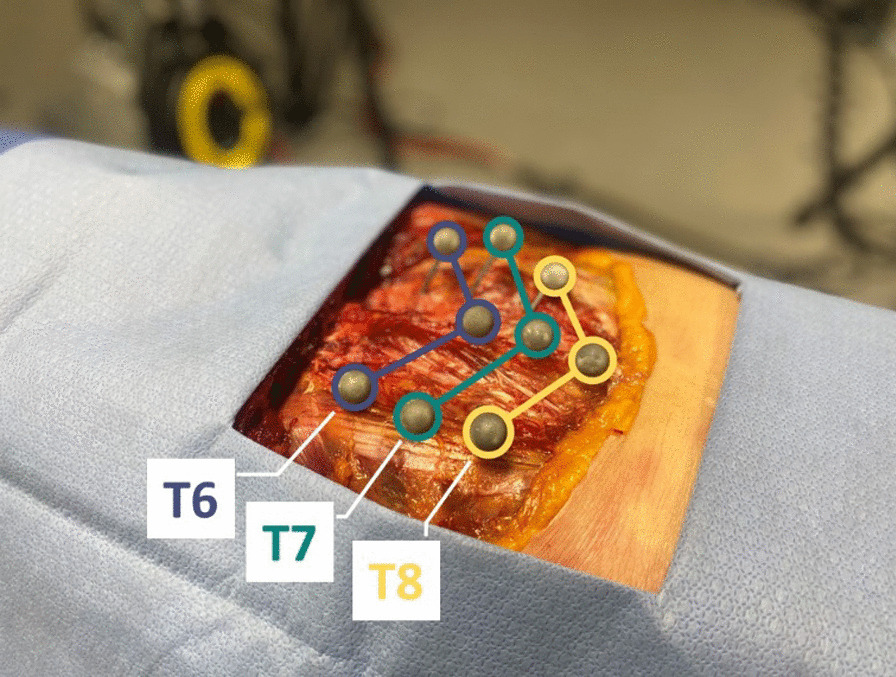
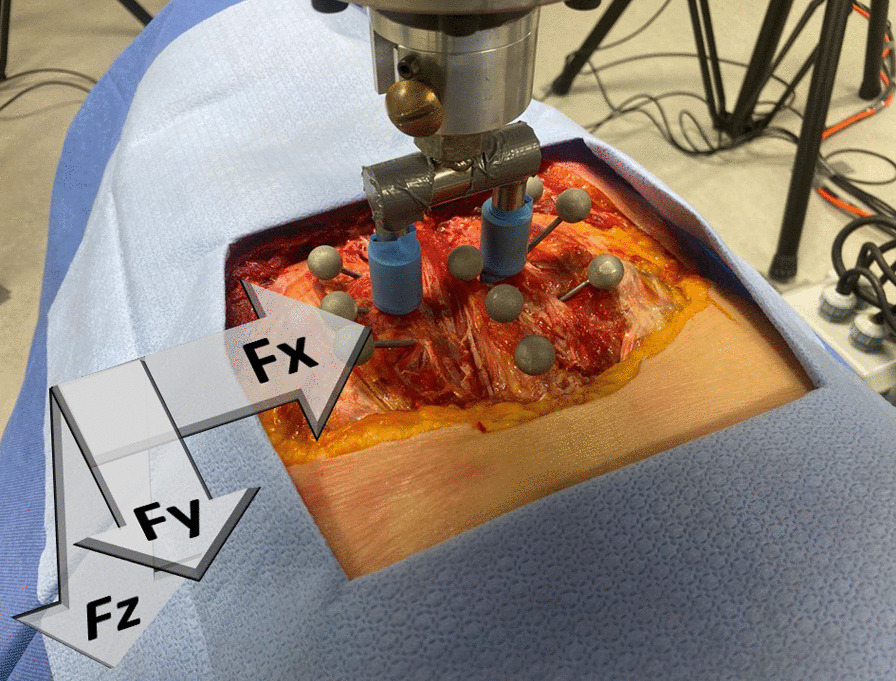
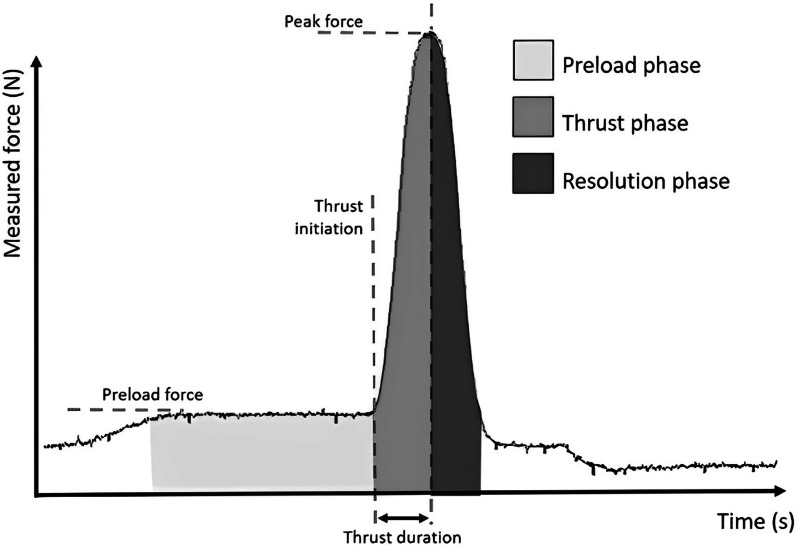
Twenty-five SMTs with different force-time profiles were delivered by an apparatus at the T7 vertebra of nine human cadaveric specimens lying prone on a treatment table equipped with a force plate. The difference between the force applied by the apparatus and the resulting force measured by the force plate was calculated in absolute force (F) and as the percentage of the applied force (F). Kinematics markers were inserted into T6 to T8 spinous and transverse processes to evaluate vertebral displacements during the SMT thrusts. Mixed-effects linear models were run to evaluate the variance in F and F explained by SMT characteristics (peak force, thrust duration and force application rate), T6 to T8 relative and total displacements, and specimens' characteristics (BMI, height, weight, kyphosis angle, thoracic thickness).
Sixty percent of the trials showed lower force measured at the force plate than the one applied at T7. F¸ was significantly predicted (R = 0.54) by peak force, thrust duration, thoracic thickness and T6-T7 relative displacement in the z-axis (postero-anterior). F was significantly predicted (R = 0.56) by force application rate, thoracic thickness and total T6 displacements. For both dependant variables, thoracic thickness showed the highest R out of all predictors.
Difference in force between the clinician-patient and the patient-table interfaces is influenced by SMT force-time characteristics and by thoracic thickness. How these differences in force are associated with vertebral displacements remains unclear. Although further studies are needed, clinicians should consider thorax thickness as a possible modulator of forces being transmitted through it during prone SMT procedures.
人们认为脊柱手法治疗(SMT)的临床效果与其力-时曲线特征有关。先前的研究表明,在患者-治疗床界面上测量的力通常大于在治疗师-患者界面上施加的力。解释这种力放大的因素尚不清楚。
确定施加于尸体胸段脊柱的力与力感应台测量的力之间的差异,并评估这种差异与 SMT 力-时特征以及标本特征之间的关系。
25 次不同力-时曲线特征的 SMT 通过一个装置施加于 9 个俯卧于配备力板的治疗床的人体尸体标本的 T7 椎体。计算装置施加的力与力板测量的力之间的差异,差异以绝对值(F)和施加力的百分比(F)表示。在 SMT 推力过程中,将运动学标记物插入 T6 到 T8 的棘突和横突,以评估椎体位移。运行混合效应线性模型,以评估 F 和 F 的方差,其中 F 和 F 由 SMT 特征(峰值力、推力持续时间和力施加率)、T6 到 T8 的相对和总位移以及标本特征(BMI、身高、体重、后凸角、胸厚)解释。
60%的试验显示力板测量的力低于 T7 处施加的力。F¸显著预测(R=0.54)由峰值力、推力持续时间、胸厚和 T6-T7 在 z 轴(前后)的相对位移决定。F 显著预测(R=0.56)由力施加率、胸厚和 T6 总位移决定。对于这两个因变量,胸厚是所有预测因素中 R 值最高的。
治疗师-患者和患者-治疗床界面之间的力差异受 SMT 力-时特征和胸厚的影响。这些力差异与椎体位移的关系尚不清楚。尽管需要进一步的研究,但临床医生在进行俯卧式 SMT 时,应考虑胸厚作为可能调节力通过其传递的因素。