Khan Asma A, Gutlapalli Sai Dheeraj, Sohail Mehvish, Patel Priyansh, Midha Sidharth, Shukla Surmai, Dhamija Divyanshu, Bello Adedamola O, Elshaikh Abeer O
Medical School, California Institute of Behavioral Neurosciences & Psychology, Fairfield, USA.
Internal Medicine, Richmond University Medical Center Affiliated with Mount Sinai Health System and Icahn School of Medicine, New York, USA.
Cureus. 2023 Jul 7;15(7):e41520. doi: 10.7759/cureus.41520. eCollection 2023 Jul.
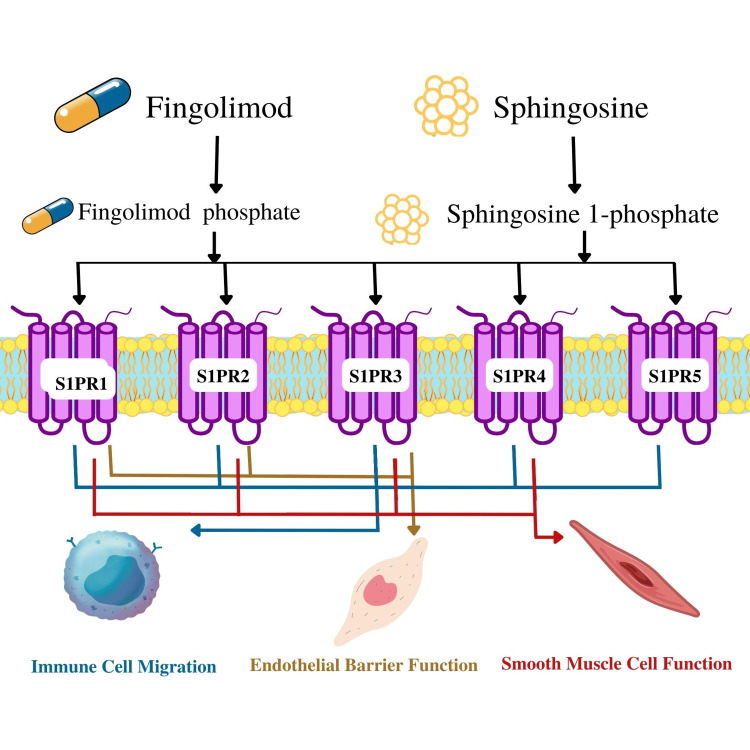
Multiple sclerosis is a neurological disorder categorized by inflammatory processes with a high prevalence worldwide. It affects both motor and sensory pathways and is also associated with the visual pathway. Fingolimod is a commonly used drug for relapsing-remitting multiple sclerosis. It is a sphingosine 1-phosphate modulator acting on its receptors for immune cell accumulation, neuronal function, embryological development, vascular permeability, smooth muscle cell function, and endothelial barrier maintenance. This review aims to understand the processes, mechanisms, risks, and management of fingolimod-associated macular edema. Due to the anti-inflammatory properties of fingolimod, it decreases various cytokines, including interleukin (IL)-1B and IL-6, spike wave, and spike amplitude, in electrophysiological activities and decreases insoluble receptors for advanced glycation end product ligand. A daily dosage of 0.5 mg of fingolimod has an increased association with macular edema. The serious adverse events of fingolimod are lymphopenia, cardiovascular events, ocular events, and carcinoma. Fingolimod decreases brain volume and increases vascular permeability, resulting in increased macular volume and damage to the blood-retinal barrier, which causes an increased risk for macular edema. Cystoid macular edema is more common in older individuals suffering from comorbidities affecting the retina, such as diabetes, or those undergoing ophthalmological surgeries. This review also highlights the importance of regular ophthalmology examinations on patients consuming fingolimod both in the initial stages and chronic use. The treatment options for macular edema include nonsteroidal anti-inflammatory drugs, acetazolamide, triamcinolone, ketorolac, corticosteroids, and intravitreal procedures.
多发性硬化症是一种神经系统疾病,其特征为炎症过程,在全球范围内具有较高的患病率。它会影响运动和感觉通路,也与视觉通路有关。芬戈莫德是一种常用于复发缓解型多发性硬化症的药物。它是一种鞘氨醇-1-磷酸调节剂,作用于其受体,影响免疫细胞聚集、神经元功能、胚胎发育、血管通透性、平滑肌细胞功能和内皮屏障维持。本综述旨在了解芬戈莫德相关黄斑水肿的过程、机制、风险及管理。由于芬戈莫德的抗炎特性,它可降低各种细胞因子,包括白细胞介素(IL)-1B和IL-6、电生理活动中的尖波和尖峰振幅,并减少晚期糖基化终产物配体的不溶性受体。每日服用0.5毫克芬戈莫德与黄斑水肿的关联增加。芬戈莫德的严重不良事件包括淋巴细胞减少、心血管事件、眼部事件和癌症。芬戈莫德会减少脑容量并增加血管通透性,导致黄斑体积增加和血视网膜屏障受损,从而增加黄斑水肿的风险。囊样黄斑水肿在患有影响视网膜的合并症(如糖尿病)的老年人或接受眼科手术的患者中更为常见。本综述还强调了在初始阶段和长期使用芬戈莫德的患者中定期进行眼科检查的重要性。黄斑水肿的治疗选择包括非甾体类抗炎药、乙酰唑胺、曲安奈德、酮咯酸、皮质类固醇和玻璃体腔内手术。