Yin Weining, Golliher Hannah L, Ferguson Amy J, Kimbell Julia S, Livraghi-Butrico Alessandra, Rogers Troy D, Grubb Barbara R, Kimple Adam J, Ostrowski Lawrence E
Marsico Lung Institute, University of North Carolina at Chapel Hill, Chapel Hill, NC, United States.
Department of Otolaryngology-Head and Neck Surgery, University of North Carolina at Chapel Hill, Chapel Hill, NC, United States.
Front Mol Biosci. 2023 Jul 24;10:1221796. doi: 10.3389/fmolb.2023.1221796. eCollection 2023.
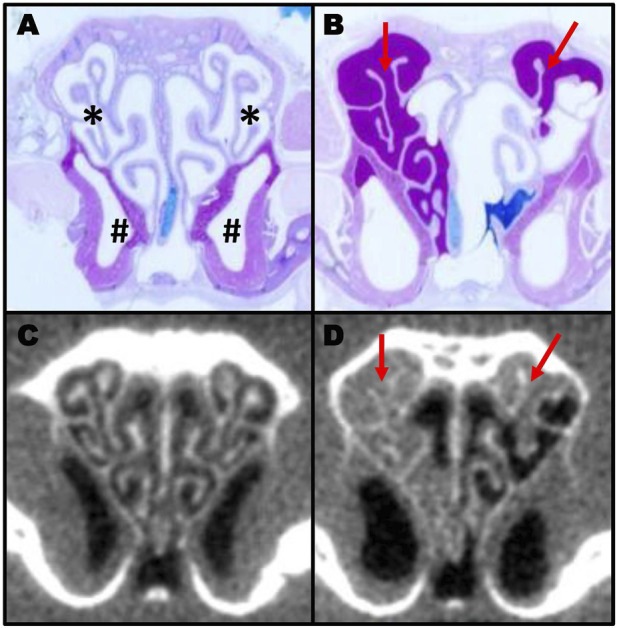
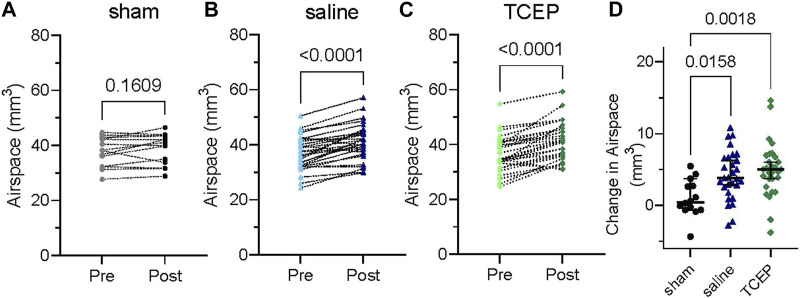
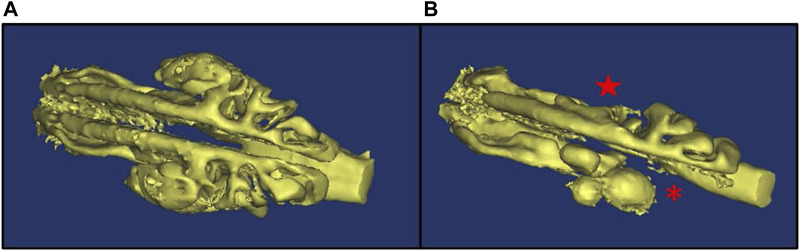
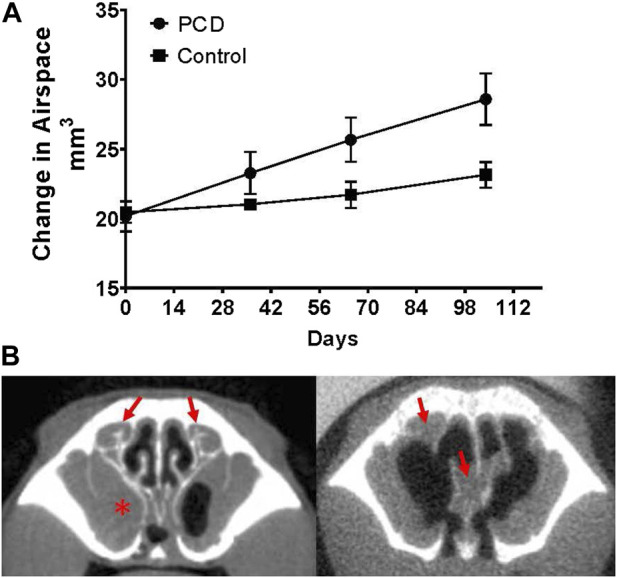
Genetic defects in motile cilia cause primary ciliary dyskinesia (PCD), a rare disease with no specific therapeutics. Individuals with PCD often have impaired fertility and laterality defects and universally suffer from upper and lower airway diseases. Chronic rhinosinusitis is a universal feature of PCD, and mucus accumulation and subsequent infections of the sinonasal cavity cause significant morbidity in individuals with PCD. Despite this, there are no approved treatments that specifically target mucus. The goals of this study were to determine whether computed tomography (CT) imaging could be used to quantify mucus accumulation and whether the use of a mucolytic agent to reduce disulfide cross-links present in mucins would improve the effectiveness of nasal lavage at removing mucus in a murine model of PCD. Adult mice with a deletion of the axonemal dynein Dnaic1 were imaged using CT scanning to characterize mucus accumulation. The animals were then treated by nasal lavage with saline, with/without the disulfide-reducing agent tris(2-carboxyethyl)phosphine. Post-treatment CT scans were used to quantify improvement in the sinonasal cavity. Mucus accumulation in the nasal cavity was readily quantified by CT. Compared to sham-treated control animals, nasal lavage with/without a mucolytic agent resulted in a significant reduction of accumulated mucus ( < 0.01). Treatment with the mucolytic agent showed a greater reduction of accumulated mucus than treatment with saline alone. The results suggest that inclusion of a mucolytic agent may increase the effectiveness of nasal lavage at reducing mucus burden in PCD.
运动性纤毛的基因缺陷会导致原发性纤毛运动障碍(PCD),这是一种罕见疾病,尚无特效疗法。患有PCD的个体通常生育能力受损且存在身体左右不对称缺陷,普遍患有上、下呼吸道疾病。慢性鼻窦炎是PCD的一个普遍特征,鼻窦腔中的黏液积聚及随后的感染给PCD患者带来了严重的发病问题。尽管如此,目前尚无专门针对黏液的获批治疗方法。本研究的目的是确定计算机断层扫描(CT)成像是否可用于量化黏液积聚,以及使用黏液溶解剂减少黏蛋白中存在的二硫键交联是否会提高鼻腔灌洗在PCD小鼠模型中清除黏液的效果。使用CT扫描对成年轴丝动力蛋白Dnaic1缺失的小鼠进行成像,以表征黏液积聚情况。然后对这些动物进行鼻腔灌洗治疗,灌洗液为生理盐水,添加或不添加二硫键还原剂三(2-羧乙基)膦。治疗后的CT扫描用于量化鼻窦腔的改善情况。通过CT很容易对鼻腔中的黏液积聚进行量化。与假手术处理的对照动物相比,使用或不使用黏液溶解剂进行鼻腔灌洗均可显著减少积聚的黏液(<0.01)。使用黏液溶解剂治疗比单独使用生理盐水治疗能更显著地减少积聚的黏液。结果表明,加入黏液溶解剂可能会提高鼻腔灌洗在减轻PCD患者黏液负担方面的效果。