Childhood Cancer Research Unit, Department of Women's and Children's Health, Karolinska Institutet, Stockholm, Sweden.
Department of Oncology-Pathology, Karolinska Institutet, Stockholm, Sweden.
Invest New Drugs. 2023 Oct;41(5):688-698. doi: 10.1007/s10637-023-01386-z. Epub 2023 Aug 9.
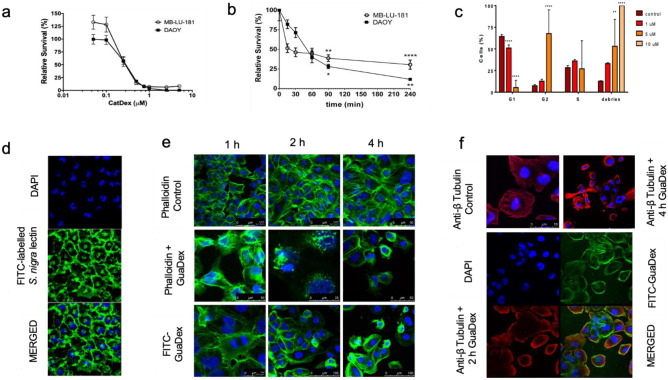
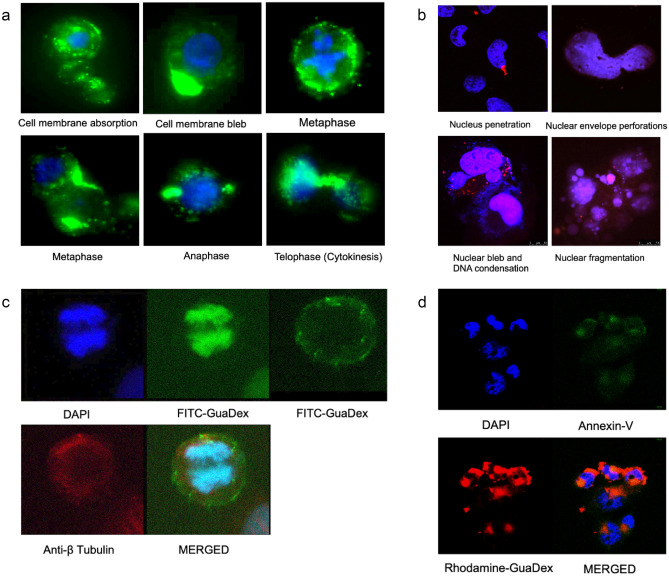
Medulloblastoma (MB) is the most common pediatric brain tumor. The therapy frequently causes serious side effects, and new selective therapies are needed. MB expresses hyper sialylation, a possible target for selective therapy. The cytotoxic efficacy of a poly guanidine conjugate (GuaDex) incubated with medulloblastoma cell cultures (DAOY and MB-LU-181) was investigated. The cells were incubated with 0.05-8 µM GuaDex from 15 min to 72 h. A fluorometric cytotoxicity assay (FMCA) measured the cytotoxicity. Labeled GuaDex was used to study tumor cell interaction. FITC-label Sambucus nigra confirmed high expression of sialic acid (Sia). Immunofluorescence microscopy was used to visualize the cell F-actin and microtubules. The cell interactions were studied by confocal and fluorescence microscopy. Annexin-V assay was used to detect apoptosis. Cell cycle analysis was done by DNA content determination. A wound-healing migration assay determined the effects on the migratory ability of DAOY cells after GuaDex treatment. IC for GuaDex was 223.4 -281.1 nM. FMCA showed potent growth inhibition on DAOY and MB-LU-181 cells at 5 uM GuaDex after 4 h of incubation. GuaDex treatment induced G2/M phase cell cycle arrest. S. nigra FITC-label lectin confirmed high expression of Sia on DAOY medulloblastoma cells. The GuaDex treatment polymerized the cytoskeleton (actin filaments and microtubules) and bound to DNA, inducing condensation. The Annexin V assay results were negative. Cell migration was inhibited at 0.5 µM GuaDex concentration after 24 h of incubation. GuaDex showed potent cytotoxicity and invasion-inhibitory effects on medulloblastoma cells at low micromolar concentrations. GuaDex efficacy was significant and warrants further studies.
髓母细胞瘤(MB)是最常见的小儿脑肿瘤。这种治疗方法经常会导致严重的副作用,因此需要新的选择性治疗方法。MB 表达超唾液酸化,这可能是选择性治疗的一个靶点。研究了聚胍衍生物(GuaDex)与髓母细胞瘤细胞培养物(DAOY 和 MB-LU-181)孵育后的细胞毒性作用。将细胞与 0.05-8μM 的 GuaDex 孵育 15 分钟至 72 小时。荧光细胞毒性测定法(FMCA)测量细胞毒性。用标记的 GuaDex 研究肿瘤细胞相互作用。FITC 标记的接骨木证实了唾液酸(Sia)的高表达。免疫荧光显微镜用于观察细胞 F-肌动蛋白和微管。通过共聚焦和荧光显微镜研究细胞相互作用。用 Annexin-V 测定法检测细胞凋亡。通过 DNA 含量测定进行细胞周期分析。划痕愈合迁移测定法确定 GuaDex 处理后 DAOY 细胞迁移能力的变化。GuaDex 的 IC 为 223.4-281.1nM。FMCA 显示在 5μM GuaDex 孵育 4 小时后,对 DAOY 和 MB-LU-181 细胞具有很强的生长抑制作用。GuaDex 处理诱导 DAOY 细胞的 G2/M 期细胞周期阻滞。接骨木的 FITC 标记凝集素证实了 DAOY 髓母细胞瘤细胞上 Sia 的高表达。GuaDex 处理使细胞骨架(肌动蛋白丝和微管)聚合并与 DNA 结合,诱导 DNA 浓缩。Annexin V 测定的结果为阴性。孵育 24 小时后,在 0.5μM GuaDex 浓度下,细胞迁移受到抑制。GuaDex 在低微摩尔浓度下对髓母细胞瘤细胞具有很强的细胞毒性和侵袭抑制作用。GuaDex 的疗效显著,值得进一步研究。