Palliative Care, Pain Therapy and Rehabilitation Unit, Fondazione IRCCS Istituto Nazionale dei Tumori, Milano, Italy.
Biostatistics for Clinical Research, Fondazione IRCCS Istituto Nazionale dei Tumori, Milano, Italy.
Cancer Med. 2023 Sep;12(17):18317-18326. doi: 10.1002/cam4.6429. Epub 2023 Aug 9.
Assessing the incidence of Medication Related Osteonecrosis of the Jaw (MRONJ) in cancer patients with bone metastases receiving Denosumab (Dmab) and identifying potential risk factors.
A retrospective observational study on consecutive cancer patients with bone metastases, who received at least one dose of Dmab and one follow-up visit. MRONJ crude cumulative incidence (CCI) was estimated considering death without MRONJ as competing event. Multiple regression models were used to study the association between MRONJ incidence and potential risk factors: age, cancer diagnosis, previous bisphosphonates, dental treatments before starting Dmab, extraction or other dental treatment during Dmab, chemotherapy, hormone therapy, and antiangiogenic (AA) agents concurrent use.
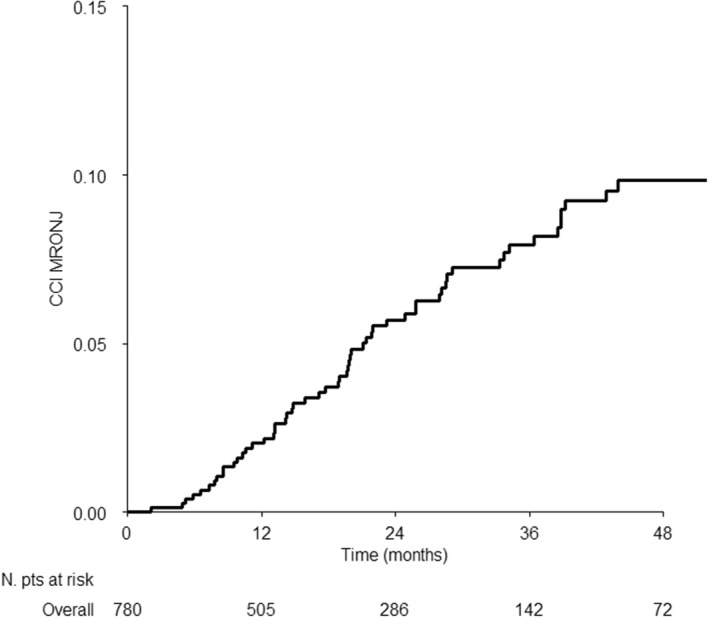
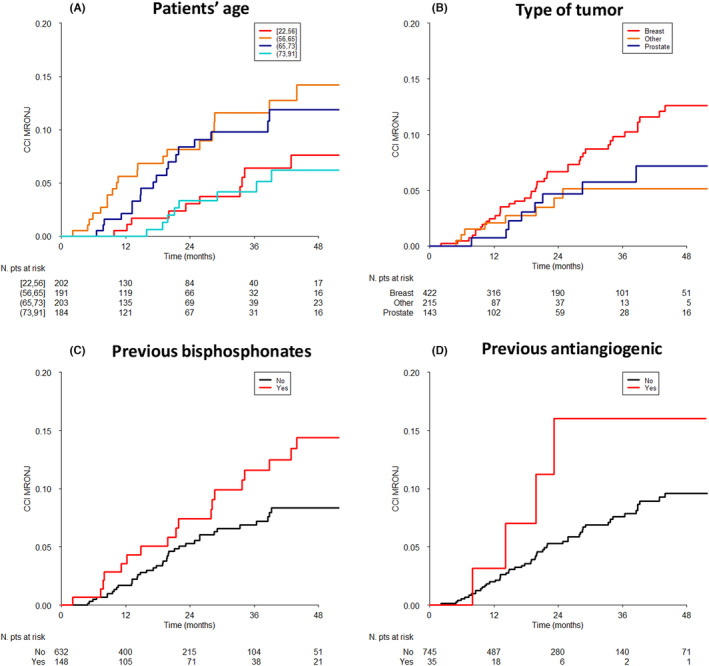
On 780 patients included (median follow-up 17 months), 54% and 18% had, respectively, breast and prostate cancer. The mean number of Dmab administration was 12. Fifty-six patients developed MRONJ with a 24- and a 48-month crude cumulative incidence of 5.7% (95% Cl: 4.2%-7.8%) and 9.8% (95% CI: 7.6%-12.7%), respectively. Higher MRONJ incidence was significantly associated with middle aged group (>56 and ≤73), both at univariate and multivariate analysis (p = 0.029 and 0.0106). Dental treatments (Hazard Ratio [HR] = 3.67; p = 0.0001), dental extractions (HR = 23.40; p < 0.0001), and previous BP administration (HR = 2.62; p = 0.0024) were significantly associated with higher MRONJ incidence at multivariate Cox analysis. Although not statistically significant, MRONJ incidence was lower for patients receiving chemotherapy or hormone therapy and higher for those receiving AAs.
The results confirm a clinically relevant incidence of Dmab-induced MRONJ. Dental treatments, especially extraction, during and before Dmab, constitute a serious risk factor. The role of AA concurrent administration deserves further investigations.
评估接受地舒单抗(Dmab)治疗的伴有骨转移的癌症患者中药物相关性颌骨坏死(MRONJ)的发生率,并确定潜在的危险因素。
对接受至少一剂地舒单抗并进行了一次随访的连续伴有骨转移的癌症患者进行回顾性观察性研究。考虑到无 MRONJ 的死亡为竞争事件,估计了 MRONJ 粗累积发生率(CCI)。使用多回归模型研究了 MRONJ 发生率与潜在危险因素之间的关系:年龄、癌症诊断、先前使用双膦酸盐、开始使用地舒单抗前的牙科治疗、地舒单抗期间的拔牙或其他牙科治疗、化疗、激素治疗和抗血管生成(AA)药物的同时使用。
在纳入的 780 例患者中(中位随访时间为 17 个月),分别有 54%和 18%患有乳腺癌和前列腺癌。地舒单抗的平均给药次数为 12 次。56 例患者发生了 MRONJ,在 24 个月和 48 个月时的粗累积发生率分别为 5.7%(95%CI:4.2%-7.8%)和 9.8%(95%CI:7.6%-12.7%)。较高的 MRONJ 发生率在单变量和多变量分析中均与中年组(>56 岁且≤73 岁)显著相关(p=0.029 和 0.0106)。牙科治疗(危险比[HR]=3.67;p=0.0001)、拔牙(HR=23.40;p<0.0001)和先前使用双膦酸盐(HR=2.62;p=0.0024)在多变量 Cox 分析中与更高的 MRONJ 发生率显著相关。尽管没有统计学意义,但接受化疗或激素治疗的患者的 MRONJ 发生率较低,而接受 AA 治疗的患者的发生率较高。
结果证实了地舒单抗引起的 MRONJ 发生率具有临床相关性。在接受地舒单抗治疗期间和之前的牙科治疗,特别是拔牙,是一个严重的危险因素。同时使用 AA 的作用值得进一步研究。