Lee June, Hong Seok Beom, Kim Yong Han, Kim Hwan Wook, Kim Do Yeon
Department of Thoracic and Cardiovascular Surgery, Seoul St. Mary's Hospital, College of Medicine, The Catholic University of Korea, Seoul, Republic of Korea.
J Thorac Dis. 2023 Jul 31;15(7):3979-3983. doi: 10.21037/jtd-23-255. Epub 2023 Jul 6.
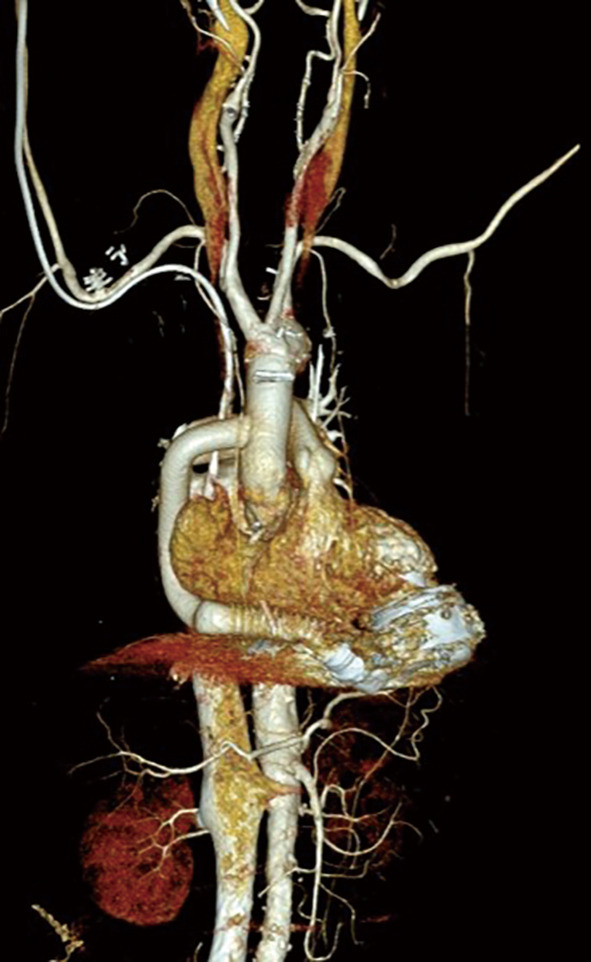
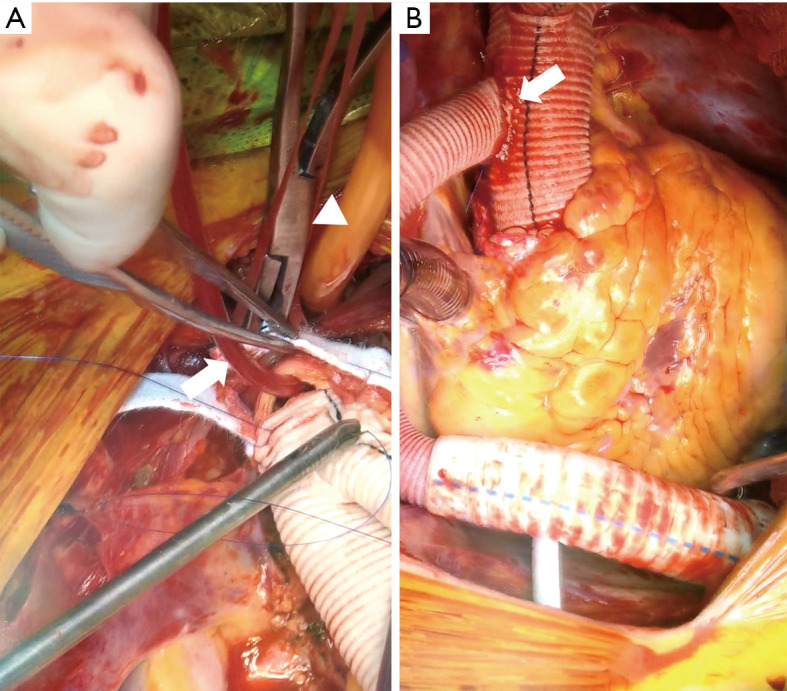
Implantation of the left ventricular assist device (LVAD) has emerged as a widely employed therapeutic approach for specifically chosen individuals suffering from severe heart failure. Stroke is a well-known complication of LVAD implantation. Concomitant aortic surgeries in patients requiring LVAD implantation to avoid outflow graft anastomosis to a severe atherosclerotic aorta are unknown. We illustrate a successful LVAD implantation with hemiarch replacement for severe aortic atherosclerosis to decrease the risk of postoperative stroke. A 72-year-old male patient with advanced heart failure has chosen to undergo LVAD treatment. Preoperative examinations detected severe atherosclerosis in the ascending aorta. It was determined that clamping the ascending aorta and directly connecting the outflow graft could increase the risk of stroke after surgery. Therefore, it was decided to replace the diseased ascending aorta entirely. The HeartMate 3 was implanted under cardiopulmonary bypass (CPB) using right axillary artery cannulation. And moderate hypothermia and bilateral antegrade cerebral perfusion were utilized to perform hemiarch replacement. Subsequently, the outflow graft was connected to an artificial ascending aortic graft. The patient did not exhibit any specific complications, such as neurological abnormalities, after the surgery. Based on our observations, it appears that LVAD implantation combined with aortic replacement could be a viable option for specific patients, particularly those who have a perioperative stroke risk due to aortic atherosclerosis.
植入左心室辅助装置(LVAD)已成为一种广泛应用于特定严重心力衰竭患者的治疗方法。中风是LVAD植入术众所周知的并发症。在需要植入LVAD以避免流出道移植物与严重动脉粥样硬化的主动脉吻合的患者中进行同期主动脉手术的情况尚不清楚。我们展示了一例成功的LVAD植入术,同时进行半弓置换以治疗严重的主动脉粥样硬化,从而降低术后中风的风险。一名72岁晚期心力衰竭男性患者选择接受LVAD治疗。术前检查发现升主动脉严重动脉粥样硬化。经判断,夹闭升主动脉并直接连接流出道移植物会增加术后中风的风险。因此,决定完全替换病变的升主动脉。使用右腋动脉插管在体外循环(CPB)下植入HeartMate 3。并采用中度低温和双侧顺行性脑灌注进行半弓置换。随后,将流出道移植物连接到人工升主动脉移植物上。术后患者未出现任何特殊并发症,如神经功能异常。基于我们的观察,对于特定患者,尤其是那些因主动脉粥样硬化而有围手术期中风风险的患者,LVAD植入联合主动脉置换可能是一种可行的选择。