Rubin David T, Salese Leonardo, Cohen Mitchell, Kotze Paulo G, Woolcott John C, Su Chinyu, Mundayat Rajiv, Paulissen Jerome, Torres Joana, Long Millie D
University of Chicago Medicine Inflammatory Bowel Disease Center, Chicago, IL, USA.
Pfizer Inc, Collegeville, PA, USA Former employee of Pfizre.
Therap Adv Gastroenterol. 2023 Aug 7;16:17562848231189122. doi: 10.1177/17562848231189122. eCollection 2023.
Tofacitinib is an oral small molecule Janus kinase inhibitor for the treatment of ulcerative colitis (UC).
To assess colectomy incidence rates (IRs) and baseline characteristics for the presence of identified colectomy risk factors among patients in the tofacitinib OCTAVE UC clinical program.
This analysis evaluated patients in the 8-week OCTAVE Induction 1 and 2, 52-week OCTAVE Sustain, and OCTAVE Open (open-label, long-term extension) studies.
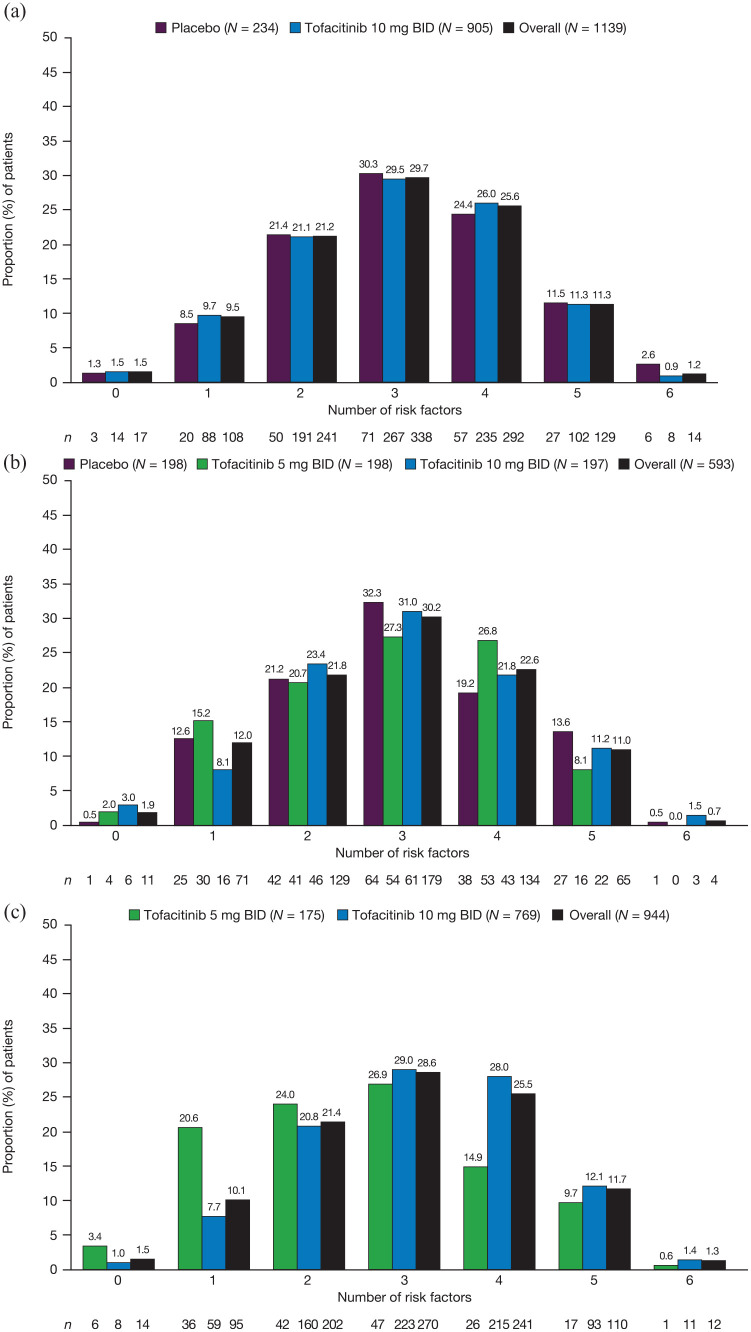
IRs [95% confidence interval (CI)] for colectomy were analyzed. Baseline risk factors based on clinical guidelines: aged <40 years at diagnosis, extensive colitis, severe endoscopic disease [Mayo endoscopic subscore (MES) = 3], hospitalization for UC within 12 months, C-reactive protein (CRP) >3 mg/L, and serum albumin <3.5 g/dL. Baseline risk factors were evaluated in patients who underwent colectomy by study and summarized descriptively.
Over a maximum of 7.8 years of tofacitinib exposure, 14 patients underwent colectomy: 3/1139 (0.3%) in OCTAVE Induction 1 and 2 [tofacitinib 10 mg twice daily (BID): = 2; placebo: = 1], 3/593 (0.5%) in OCTAVE Sustain (placebo: = 3), and 8/944 (0.8%) in OCTAVE Open (tofacitinib 10 mg BID: = 8). Colectomy IR per 100 patient-years for all patients who received ⩾1 tofacitinib dose was 0.34 (95% CI: 0.16-0.63). All patients who underwent colectomy had ⩾1 risk factor and prior tumor necrosis factor inhibitor (TNFi) failure, among which the most common risk factors were a MES of 3 ( = 13), CRP >3 mg/L ( = 11), and aged <40 years at diagnosis ( = 9).
Among patients with moderate to severe UC receiving tofacitinib, colectomies were infrequent; all patients undergoing colectomy had prior TNFi failure, and most had multiple additional risk factors. This provides important information to discuss with patients and inform management decisions.
NCT01465763; NCT01458951; NCT01458574; and NCT01470612.
托法替布是一种口服小分子Janus激酶抑制剂,用于治疗溃疡性结肠炎(UC)。
评估托法替布治疗溃疡性结肠炎的OCTAVE临床项目中患者的结肠切除术发生率(IRs)以及已确定的结肠切除术风险因素的基线特征。
该分析评估了为期8周的OCTAVE诱导1期和2期、为期52周的OCTAVE维持期以及OCTAVE开放期(开放标签、长期扩展)研究中的患者。
分析结肠切除术的IRs[95%置信区间(CI)]。基于临床指南的基线风险因素:诊断时年龄<40岁、广泛性结肠炎、严重内镜疾病[梅奥内镜亚评分(MES)=3]、12个月内因UC住院、C反应蛋白(CRP)>3mg/L以及血清白蛋白<3.5g/dL。通过研究对接受结肠切除术的患者的基线风险因素进行评估并进行描述性总结。
在托法替布最长7.8年的暴露期内,14例患者接受了结肠切除术:OCTAVE诱导1期和2期有3/1139例(0.3%)[托法替布10mg每日两次(BID):=2;安慰剂:=1],OCTAVE维持期有3/593例(0.5%)(安慰剂:=3),OCTAVE开放期有8/944例(0.8%)(托法替布10mg BID:=8)。所有接受≥1剂托法替布治疗的患者每100患者年的结肠切除术IR为0.34(95%CI:0.16 - 0.63)。所有接受结肠切除术的患者都有≥1个风险因素且先前肿瘤坏死因子抑制剂(TNFi)治疗失败,其中最常见的风险因素是MES为3(=13)、CRP>3mg/L(=11)以及诊断时年龄<40岁(=9)。
在接受托法替布治疗的中度至重度UC患者中,结肠切除术并不常见;所有接受结肠切除术的患者先前TNFi治疗均失败,且大多数还有多个其他风险因素。这为与患者讨论并为管理决策提供了重要信息。
NCT01465763;NCT01458951;NCT01458574;以及NCT01470612。