Ladeveze Simon, Zurek Paul J, Kaminski Tomasz S, Emond Stephane, Hollfelder Florian
Department of Biochemistry, University of Cambridge, 80 Tennis Court Road, Cambridge CB21GA, U.K.
ACS Catal. 2023 Jul 21;13(15):10232-10243. doi: 10.1021/acscatal.3c01609. eCollection 2023 Aug 4.
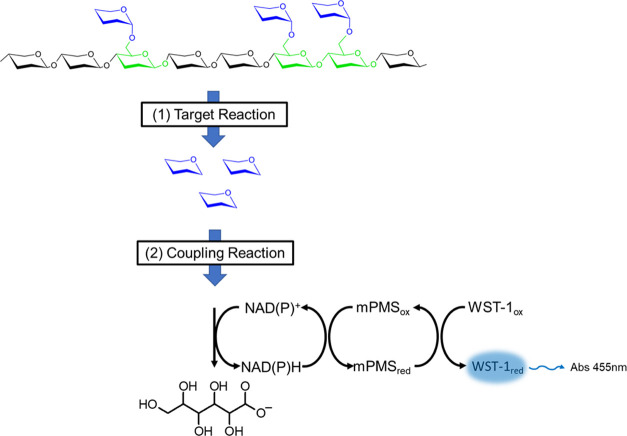
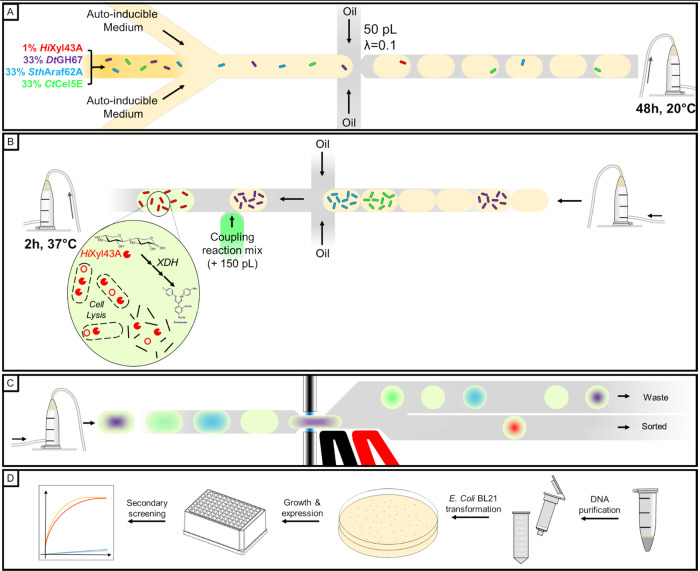
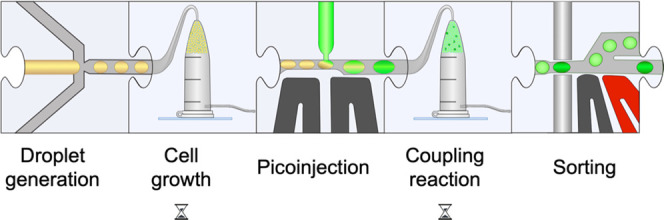
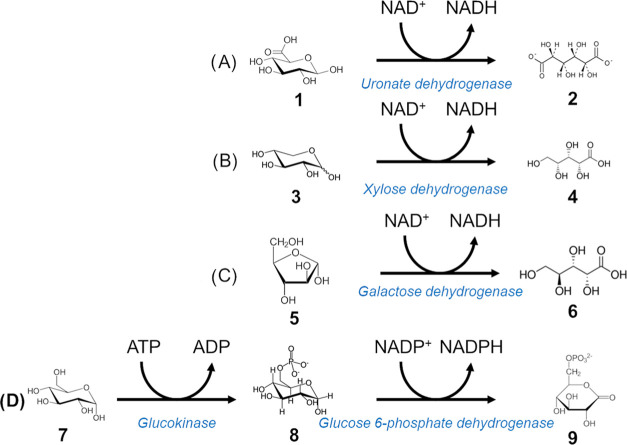
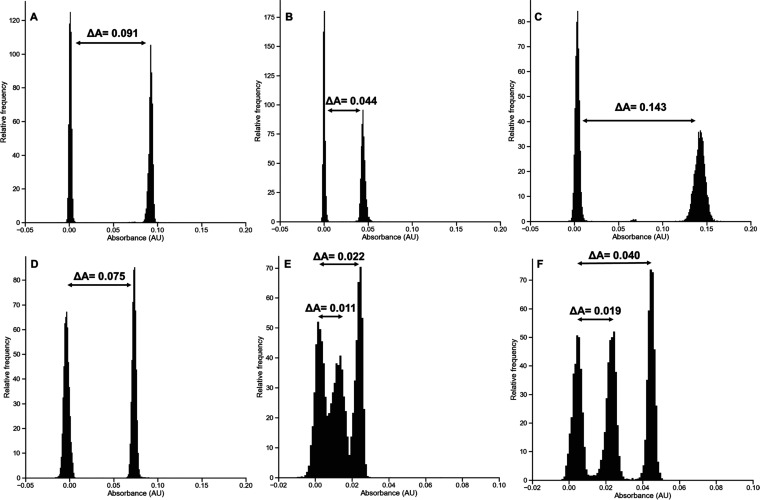
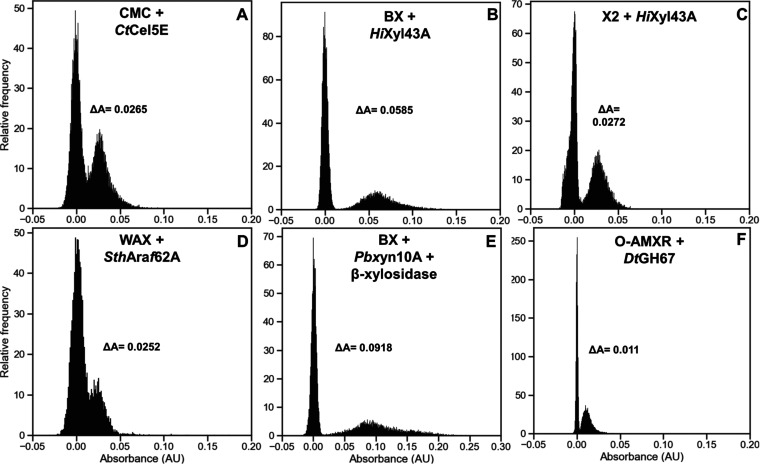
Enzyme discovery and directed evolution are the two major contemporary approaches for the improvement of industrial processes by biocatalysis in various fields. Customization of catalysts for improvement of single enzyme reactions or de novo reaction development is often complex and tedious. The success of screening campaigns relies on the fraction of sequence space that can be sampled, whether for evolving a particular enzyme or screening metagenomes. Ultrahigh-throughput screening (uHTS) based on in vitro compartmentalization in water-in-oil emulsion of picoliter droplets generated in microfluidic systems allows screening rates >1 kHz (or >10 per day). Screening for carbohydrate-active enzymes (CAZymes) catalyzing biotechnologically valuable reactions in this format presents an additional challenge because the released carbohydrates are difficult to monitor in high throughput. Activated substrates with large optically active hydrophobic leaving groups provide a generic optical readout, but the molecular recognition properties of sugars will be altered by the incorporation of such fluoro- or chromophores and their typically higher reactivity, as leaving groups with lowered p values compared to native substrates make the observation of promiscuous reactions more likely. To overcome these issues, we designed microdroplet assays in which optically inactive carbohydrate products are made visible by specific cascades: the primary reaction of an unlabeled substrate leads to an optical signal downstream. Successfully implementing such assays at the picoliter droplet scale allowed us to detect glucose, xylose, glucuronic acid, and arabinose as final products of complex oligosaccharide degradation by glycoside hydrolases by absorbance measurements. Enabling the use of uHTS for screening CAZyme reactions that have been thus far elusive will chart a route toward faster and easier development of specific and efficient biocatalysts for biovalorization, directing enzyme discovery by challenging catalysts for reaction with natural rather than model substrates.
酶的发现和定向进化是当代通过生物催化改善各领域工业过程的两种主要方法。定制用于改善单酶反应或从头开发新反应的催化剂通常复杂且繁琐。筛选活动的成功取决于可采样的序列空间比例,无论是用于进化特定酶还是筛选宏基因组。基于微流控系统中产生的皮升液滴的油包水乳液中的体外区室化的超高通量筛选(uHTS),其筛选速率>1 kHz(或每天>10次)。以这种形式筛选催化具有生物技术价值反应的碳水化合物活性酶(CAZymes)带来了额外的挑战,因为释放的碳水化合物难以进行高通量监测。带有大的光学活性疏水离去基团的活化底物提供了一种通用的光学读数,但糖的分子识别特性会因掺入此类氟或发色团及其通常更高的反应性而改变,因为与天然底物相比,具有较低p值的离去基团使混杂反应的观察更有可能。为了克服这些问题,我们设计了微滴分析方法,其中通过特定的级联反应使光学无活性的碳水化合物产物可见:未标记底物的初级反应会导致下游产生光学信号。在皮升液滴规模上成功实施此类分析方法,使我们能够通过吸光度测量检测到葡萄糖、木糖、葡萄糖醛酸和阿拉伯糖,它们是糖苷水解酶降解复杂寡糖的最终产物。使uHTS能够用于筛选迄今为止难以捉摸的CAZyme反应,将为更快、更轻松地开发用于生物炼制的特异性和高效生物催化剂指明一条道路,通过挑战催化剂与天然而非模型底物反应来指导酶的发现。