Medical School of Yan'an University, Yan'an, Shaanxi, China.
Affiliated Hospital of Yan'an University, Yan'an, Shaanxi, China.
Medicine (Baltimore). 2023 Aug 11;102(32):e34755. doi: 10.1097/MD.0000000000034755.
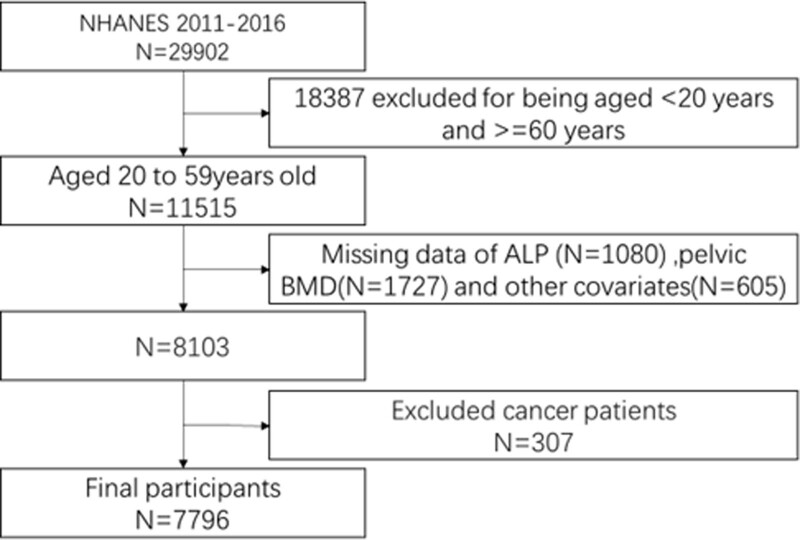
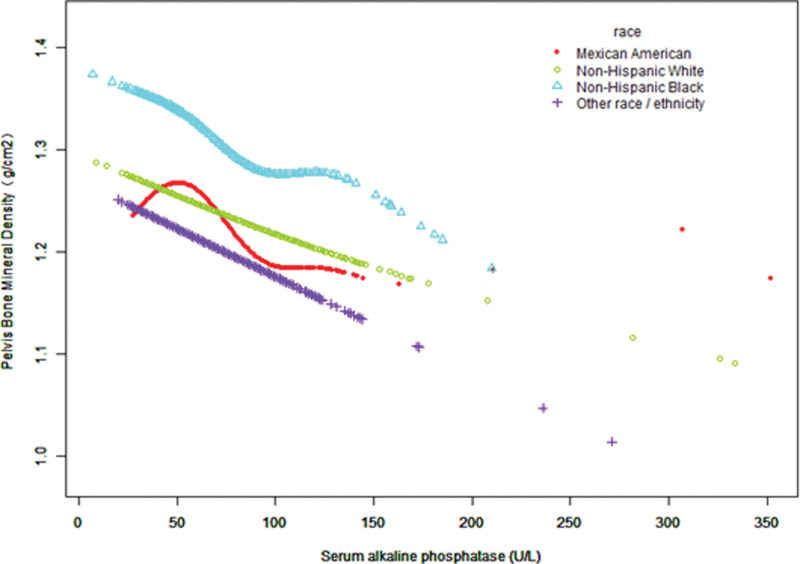
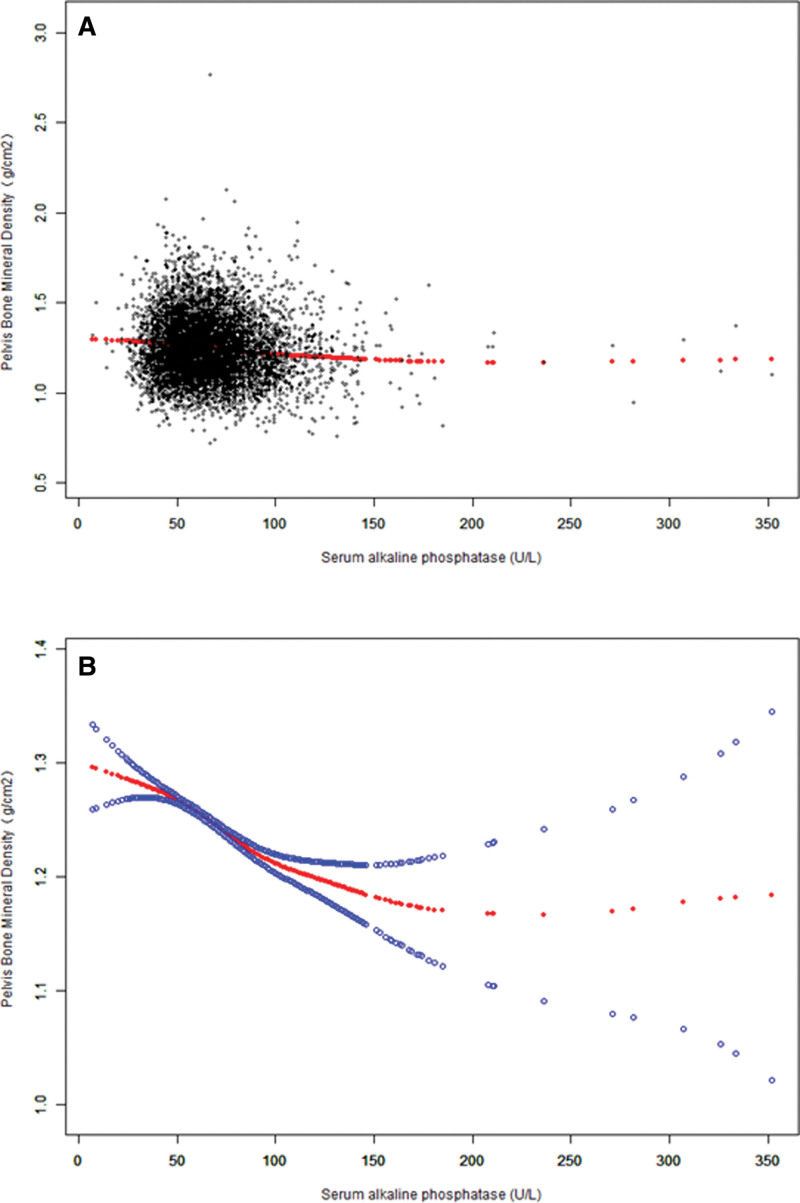
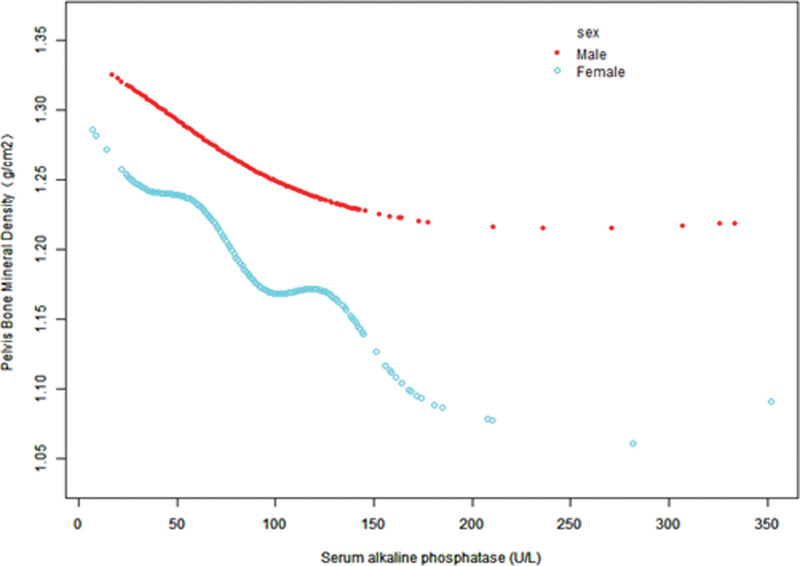
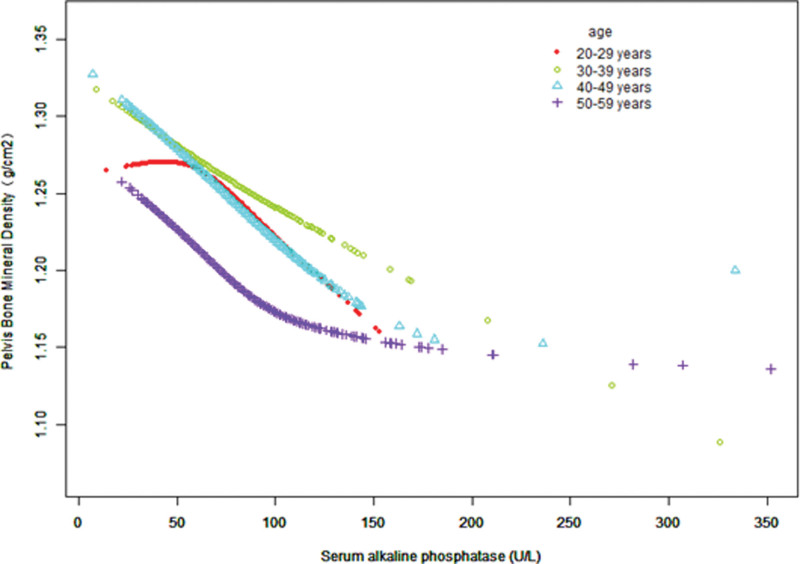
Serum alkaline phosphatase (ALP) plays an important role in bone metabolism. However, the association between serum ALP and bone mineral density (BMD) remains inconclusive. Therefore, this study aimed to explore the relationship between serum ALP levels and pelvic BMD in young adults. We conducted a cross-sectional study using data from the National Health and Nutrition Examination Survey conducted from 2011 to 2016. Serum ALP levels and pelvic BMD were analyzed as independent and dependent variables, respectively. Weighted multivariate linear regression models and stratified analysis by age, sex, and race/ethnicity were applied after controlling for confounding factors to assess the relationship between serum ALP and pelvic BMD. Smooth curve fitting and threshold effect analysis were used to describe the nonlinear relationship between the 2 variables. A total of 7796 participants (4063 males and 3733 females) aged 20 to 59 years were included in this study. When serum ALP was represented as a continuous variable and fully adjusted in the regression model, ALP was significantly negatively correlated with pelvic BMD (β = -0.0008, 95% confidence interval: -0.0010 to -0.0006, P < .000001); this significant negative correlation persisted when ALP was transformed into a categorical variable, and was consistent in subgroup analyses. Additionally, smooth curve fitting and threshold effect analysis showed a persistent negative correlation between serum ALP and pelvic BMD, with a saturation effect at 97 U/L. Our results revealed a negative correlation between serum ALP levels and pelvic BMD in young adults. Monitoring serum ALP levels could help in the early detection of risks for bone metabolic disorders such as osteoporosis.
血清碱性磷酸酶(ALP)在骨骼代谢中起着重要作用。然而,血清 ALP 与骨密度(BMD)之间的关系仍不确定。因此,本研究旨在探讨年轻成年人血清 ALP 水平与骨盆 BMD 之间的关系。我们使用了 2011 年至 2016 年进行的全国健康与营养调查的数据进行了一项横断面研究。血清 ALP 水平和骨盆 BMD 分别作为独立和依赖变量进行分析。在控制混杂因素后,应用加权多元线性回归模型和按年龄、性别和种族/民族分层分析来评估血清 ALP 与骨盆 BMD 之间的关系。采用平滑曲线拟合和阈值效应分析来描述这两个变量之间的非线性关系。本研究共纳入了 7796 名年龄在 20 至 59 岁的参与者(男性 4063 名,女性 3733 名)。当血清 ALP 作为连续变量表示并在回归模型中充分调整时,ALP 与骨盆 BMD 呈显著负相关(β=-0.0008,95%置信区间:-0.0010 至-0.0006,P<0.000001);当 ALP 转换为分类变量时,这种显著的负相关仍然存在,且在亚组分析中是一致的。此外,平滑曲线拟合和阈值效应分析显示血清 ALP 与骨盆 BMD 之间存在持续的负相关关系,在 97 U/L 时达到饱和效应。我们的研究结果表明,年轻成年人的血清 ALP 水平与骨盆 BMD 呈负相关。监测血清 ALP 水平有助于早期发现骨质疏松等骨骼代谢紊乱的风险。