Department of Intensive Care Medicine, Maastricht University Medical Centre, Maastricht, The Netherlands.
Department of Internal Medicine, Rijnstate Hospital, Arnhem, The Netherlands.
Ann Med. 2023;55(2):2244873. doi: 10.1080/07853890.2023.2244873.
There is growing awareness that sex differences are associated with different patient outcomes in a variety of diseases. Studies investigating the effect of patient sex on sepsis-related mortality remain inconclusive and mainly focus on patients with severe sepsis and septic shock in the intensive care unit. We therefore investigated the association between patient sex and both clinical presentation and 30-day mortality in patients with the whole spectrum of sepsis severity presenting to the emergency department (ED) who were admitted to the hospital.
In our multi-centre cohort study, we retrospectively investigated adult medical patients with sepsis in the ED. Multivariable analysis was used to evaluate the association between patient sex and all-cause 30-day mortality.
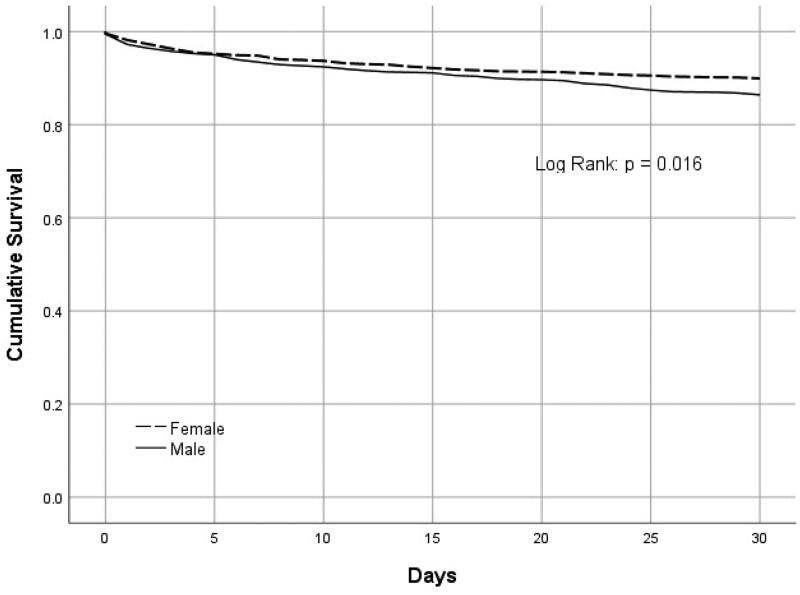
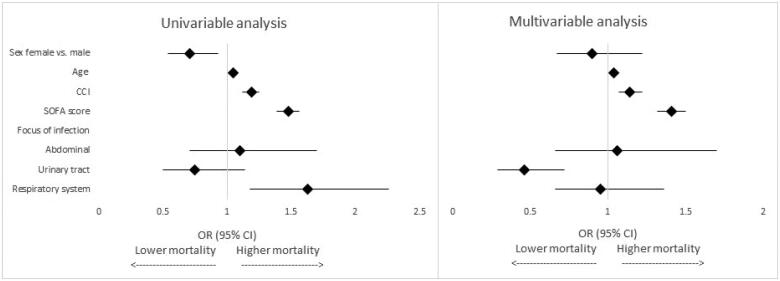
Of 2065 patients included, 47.6% were female. Female patients had significantly less comorbidities, lower Sequential Organ Failure Assessment score and abbreviated Mortality Emergency Department Sepsis score, and presented less frequently with thrombocytopenia and fever, compared to males. For both sexes, respiratory tract infections were predominant while female patients more often had urinary tract infections. Females showed lower 30-day mortality (10.1% vs. 13.6%; = .016), and in-hospital mortality (8.0% vs. 11.1%; = .02) compared to males. However, a multivariable logistic regression model showed that patient sex was not an independent predictor of 30-day mortality (OR 0.90; 95% CI 0.67-1.22; = .51).
Females with sepsis presenting to the ED had fewer comorbidities, lower disease severity, less often thrombocytopenia and fever and were more likely to have a urinary tract infection. Females had a lower in-hospital and 30-day mortality compared to males, but sex was not an independent predictor of 30-day mortality. The lower mortality in female patients may be explained by differences in comorbidity and clinical presentation compared to male patients.KEY MESSAGESOnly limited data exist on sex differences in sepsis patients presenting to the emergency department with the whole spectrum of sepsis severity.Female sepsis patients had a lower incidence of comorbidities, less disease severity and a different source of infection, which explains the lower 30-day mortality we found in female patients compared to male patients.We found that sex was not an independent predictor of 30-day mortality; however, the study was probably underpowered to evaluate this outcome definitively.
越来越多的人意识到,性别差异与各种疾病的不同患者结局有关。研究表明,患者性别对脓毒症相关死亡率的影响仍不确定,主要集中在重症监护病房的严重脓毒症和脓毒性休克患者。因此,我们研究了患者性别与急诊科(ED)就诊的所有严重程度脓毒症患者的临床特征和 30 天死亡率之间的关系。
在我们的多中心队列研究中,我们回顾性调查了 ED 中患有脓毒症的成年内科患者。采用多变量分析评估患者性别与全因 30 天死亡率之间的关系。
在纳入的 2065 例患者中,47.6%为女性。与男性相比,女性患者合并症较少,序贯器官衰竭评估(SOFA)评分和简化死亡率急诊脓毒症评分(mSOFA)较低,血小板减少和发热的发生率较低。对于男性和女性,呼吸道感染是主要感染部位,而女性尿路感染更为常见。女性 30 天死亡率(10.1%比 13.6%; = 0.016)和住院死亡率(8.0%比 11.1%; = 0.02)较低。然而,多变量逻辑回归模型显示,患者性别不是 30 天死亡率的独立预测因素(OR 0.90;95%CI 0.67-1.22; = 0.51)。
ED 就诊的脓毒症女性患者合并症较少,疾病严重程度较低,血小板减少和发热较少,尿路感染更常见。与男性相比,女性住院和 30 天死亡率较低,但性别不是 30 天死亡率的独立预测因素。与男性患者相比,女性患者较低的死亡率可能是由于合并症和临床表现的差异。
关于急诊科就诊的所有严重程度脓毒症患者的性别差异,仅有有限的数据。脓毒症女性患者的合并症发生率较低,疾病严重程度较低,感染源不同,这解释了我们发现女性患者的 30 天死亡率低于男性患者的原因。我们发现性别不是 30 天死亡率的独立预测因素;然而,评估这一结果的研究可能没有足够的效力。