Xu Yujun, Shi Xiaoliang, Wang Weifeng, Zhang Lin, Cheung Shinghu, Rudolph Marion, Brega Nicoletta, Dong Xiaowei, Qian Lili, Wang Liwei, Yuan Shaohua, Tan Daniel Shao Weng, Wang Kai
Department of Imaging Interventional Therapy, Shandong Provincial Hospital, Cheeloo College of Medicine, Shandong University; Department of Imaging Interventional Therapy, Shandong Provincial Hospital Affiliated to Shandong First Medical University, 250021, Jinan, China.
OrigiMed Co. Ltd, 201114, Shanghai, China.
NPJ Precis Oncol. 2023 Aug 11;7(1):75. doi: 10.1038/s41698-023-00427-3.
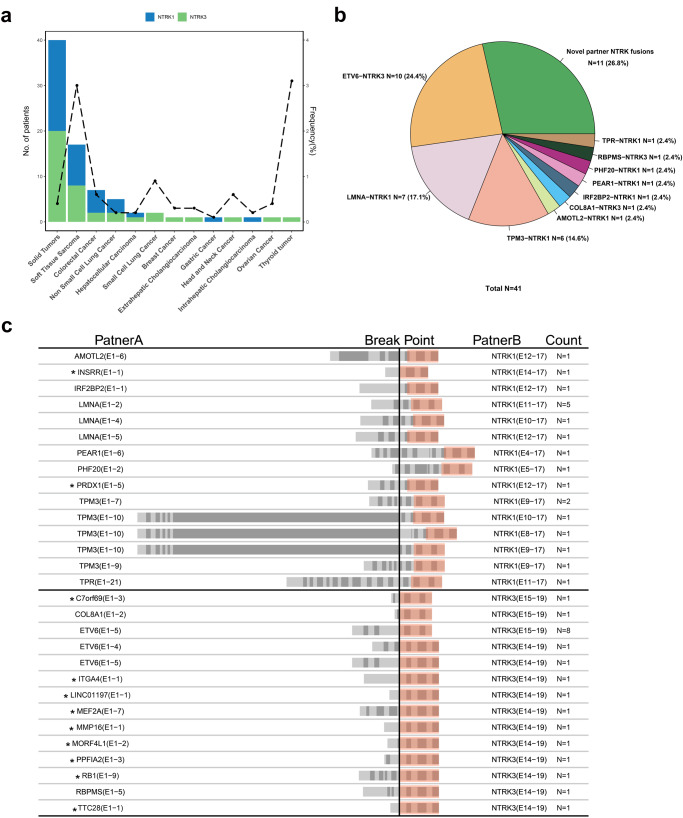
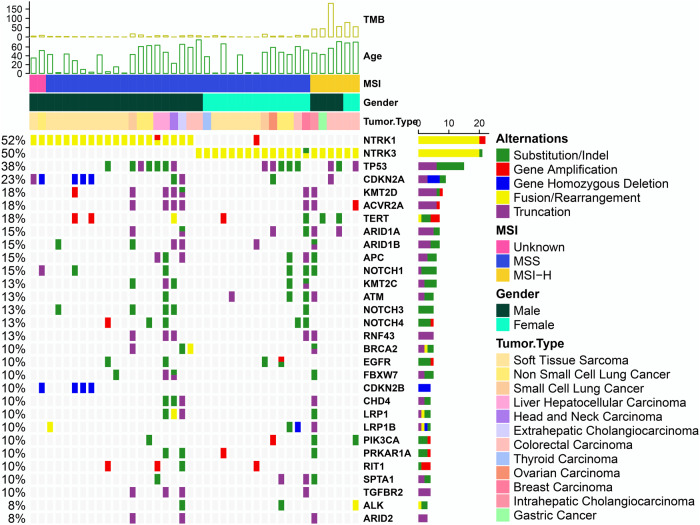
Neurotrophic tyrosine kinase (NTRK) fusions involving NTRK1, NTRK2, and NTRK3 were found in a broad range of solid tumors as driver gene variants. However, the prevalence of NTRK fusions in Chinese solid tumor patients is rarely reported. Based on the next-generation sequencing data from 10,194 Chinese solid tumor patients, we identified approximately 0.4% (40/10,194) of Chinese solid tumor patients with NTRK fusion. NTRK fusions were most frequently detected in soft tissue sarcoma (3.0%), especially in the fibrosarcoma subtype (12.7%). A total of 29 NTRK fusion patterns were identified, of which 11 were rarely reported. NTRK fusion mostly co-occurred with TP53 (38%), CDKN2A (23%), and ACVR2A (18%) and rarely with NTRK amplification (5.0%) and single nucleotide variants (2.5%). DNA-based NTRK fusion sequencing exhibited a higher detection rate than pan-TRK immunohistochemistry (100% vs. 87.5%). Two patients with NTRK fusions showed clinical responses to larotrectinib, supporting the effective response of NTRK fusion patients to TRK inhibitors.
神经营养性酪氨酸激酶(NTRK)融合基因涉及NTRK1、NTRK2和NTRK3,在多种实体瘤中被发现为驱动基因变异。然而,中国实体瘤患者中NTRK融合基因的发生率鲜有报道。基于10194例中国实体瘤患者的二代测序数据,我们发现约0.4%(40/10194)的中国实体瘤患者存在NTRK融合基因。NTRK融合基因在软组织肉瘤中最常被检测到(3.0%),尤其是在纤维肉瘤亚型中(12.7%)。共鉴定出29种NTRK融合模式,其中11种鲜有报道。NTRK融合基因大多与TP53(38%)、CDKN2A(23%)和ACVR2A(18%)共同出现,很少与NTRK扩增(5.0%)和单核苷酸变异(2.5%)共同出现。基于DNA的NTRK融合基因测序检测率高于泛TRK免疫组化(100%对87.5%)。两名NTRK融合基因阳性患者对拉罗替尼显示出临床反应,支持NTRK融合基因阳性患者对TRK抑制剂的有效反应。