Risi Barbara, Cotti Piccinelli Stefano, Gazzina Stefano, Labella Beatrice, Caria Filomena, Damioli Simona, Poli Loris, Padovani Alessandro, Filosto Massimiliano
Department of Clinical and Experimental Sciences, University of Brescia, 25121 Brescia, Italy.
Unit of Neurology, ASST Spedali Civili, 25123 Brescia, Italy.
J Clin Med. 2023 Jul 31;12(15):5036. doi: 10.3390/jcm12155036.
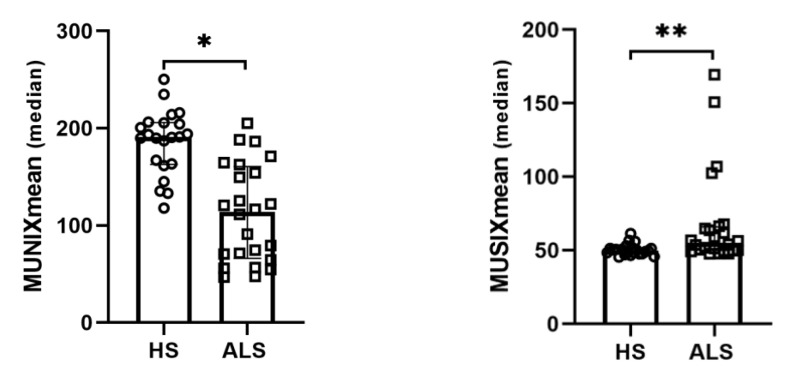
The MUNIX technique allows us to estimate the number and size of surviving motor units (MUs). Previous studies on ALS found correlations between MUNIX and several clinical measures, but its potential role as a predictor of disease progression rate (DPR) has not been thoroughly evaluated to date. We aimed to investigate MUNIX's ability to predict DPR at a six-month follow up.
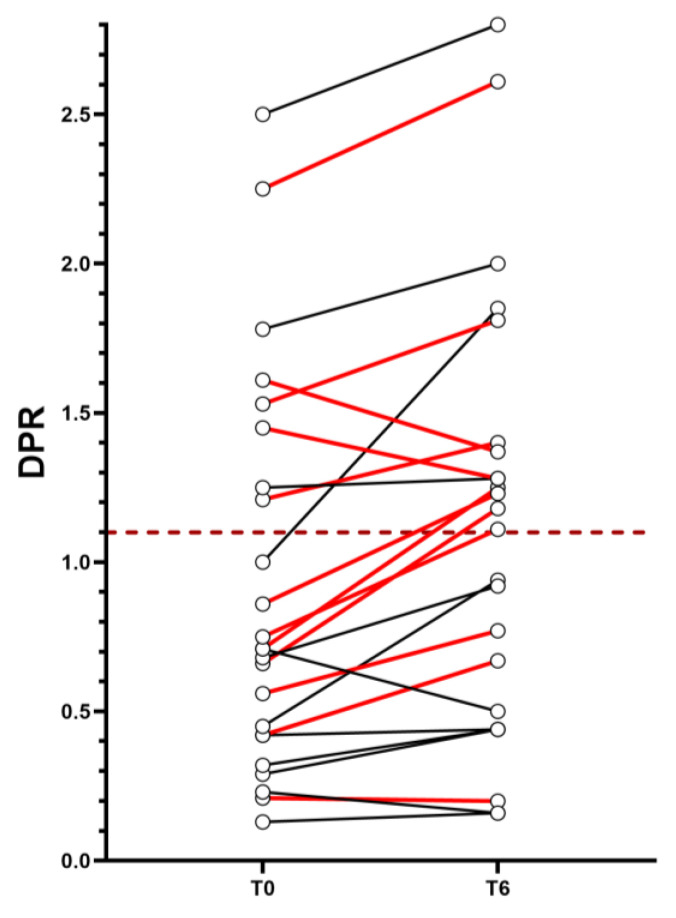
24 ALS patients with short disease duration (<24 months from symptoms' onset) were enrolled and divided according to their baseline DPR into two groups (normal [DPR-N] and fast [DPR-F] progressors). MUNIX values were obtained from five muscles (TA, APB, ADM, FDI, Trapezius) and averaged for each subject.
MUNIX was found to predict DPR at follow up in a multivariable linear regression model; namely, patients with lower MUNIX values were at risk of showing greater DPR scores at follow up. The result was replicated in a simple logistic regression analysis, with the dichotomic category "MUNIX-Low" as the independent variable and the outcome "DPR-F" as the dependent variable.
our results pave the way for the use of the MUNIX method as a prognostic tool in early ALS, enabling patients' stratification according to their rates of future decline.
MUNIX技术使我们能够估计存活运动单位(MU)的数量和大小。先前关于肌萎缩侧索硬化症(ALS)的研究发现MUNIX与几种临床指标之间存在相关性,但迄今为止,其作为疾病进展率(DPR)预测指标的潜在作用尚未得到充分评估。我们旨在研究MUNIX在六个月随访中预测DPR的能力。
纳入24例病程较短(症状出现后<24个月)的ALS患者,并根据其基线DPR分为两组(正常进展者[DPR-N]和快速进展者[DPR-F])。从五块肌肉(胫骨前肌、拇短展肌、小指展肌、第一骨间背侧肌、斜方肌)获取MUNIX值,并计算每个受试者的平均值。
在多变量线性回归模型中发现MUNIX可预测随访时的DPR;也就是说,MUNIX值较低的患者在随访时出现更高DPR评分的风险更大。在简单逻辑回归分析中重复了该结果,将二分变量“MUNIX低”作为自变量,将结果“DPR-F”作为因变量。
我们的结果为将MUNIX方法用作早期ALS的预后工具铺平了道路,能够根据患者未来的衰退率进行分层。