Salisu Sani, Ruhaiyem Nur Intan Raihana, Eisa Taiseer Abdalla Elfadil, Nasser Maged, Saeed Faisal, Younis Hussain A
School of Computer Sciences, Universiti Sains Malaysia, Gelugor 11800, Malaysia.
Department of Information Technology, Federal University Dutse, Dutse 720101, Nigeria.
Diagnostics (Basel). 2023 Aug 4;13(15):2593. doi: 10.3390/diagnostics13152593.
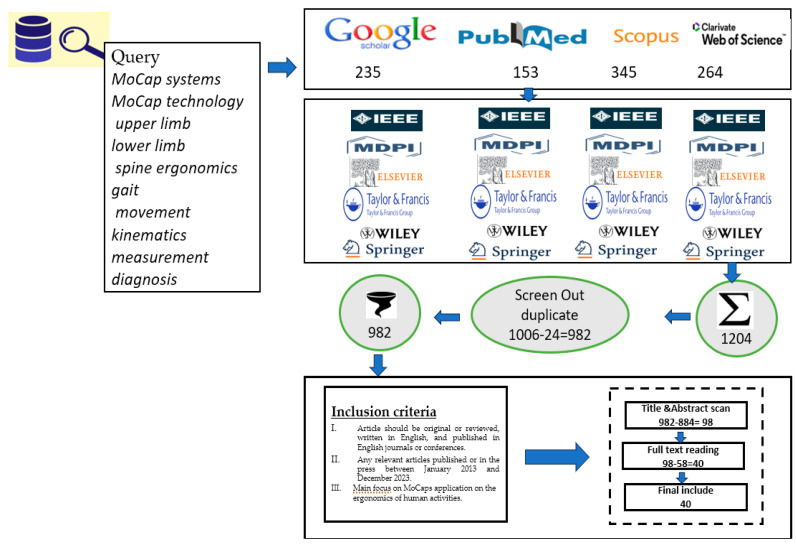
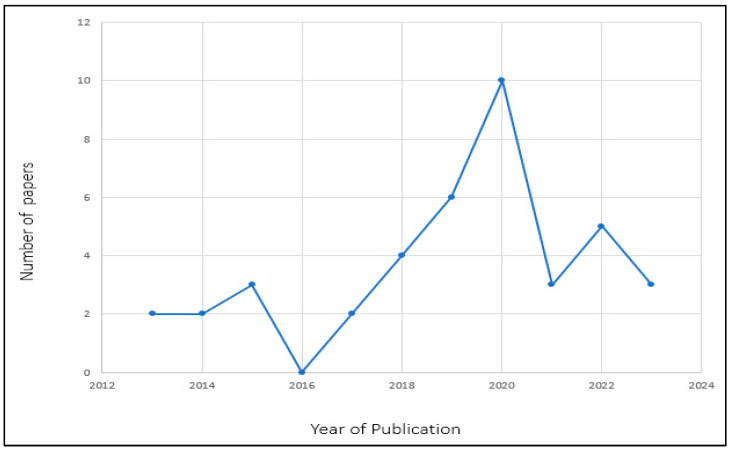
Muscular skeletal disorder is a difficult challenge faced by the working population. Motion capture (MoCap) is used for recording the movement of people for clinical, ergonomic and rehabilitation solutions. However, knowledge barriers about these MoCap systems have made them difficult to use for many people. Despite this, no state-of-the-art literature review on MoCap systems for human clinical, rehabilitation and ergonomic analysis has been conducted. A medical diagnosis using AI applies machine learning algorithms and motion capture technologies to analyze patient data, enhancing diagnostic accuracy, enabling early disease detection and facilitating personalized treatment plans. It revolutionizes healthcare by harnessing the power of data-driven insights for improved patient outcomes and efficient clinical decision-making. The current review aimed to investigate: (i) the most used MoCap systems for clinical use, ergonomics and rehabilitation, (ii) their application and (iii) the target population. We used preferred reporting items for systematic reviews and meta-analysis guidelines for the review. Google Scholar, PubMed, Scopus and Web of Science were used to search for relevant published articles. The articles obtained were scrutinized by reading the abstracts and titles to determine their inclusion eligibility. Accordingly, articles with insufficient or irrelevant information were excluded from the screening. The search included studies published between 2013 and 2023 (including additional criteria). A total of 40 articles were eligible for review. The selected articles were further categorized in terms of the types of MoCap used, their application and the domain of the experiments. This review will serve as a guide for researchers and organizational management.
肌肉骨骼疾病是劳动人口面临的一项艰巨挑战。动作捕捉(MoCap)用于记录人体运动,以提供临床、人体工程学和康复解决方案。然而,关于这些动作捕捉系统的知识壁垒使得许多人难以使用它们。尽管如此,尚未有关于用于人体临床、康复和人体工程学分析的动作捕捉系统的最新文献综述。使用人工智能的医学诊断应用机器学习算法和动作捕捉技术来分析患者数据,提高诊断准确性,实现疾病早期检测并促进个性化治疗方案。它通过利用数据驱动的见解来改善患者预后和进行高效临床决策,从而彻底改变了医疗保健。本综述旨在研究:(i)临床、人体工程学和康复中最常用的动作捕捉系统,(ii)它们的应用以及(iii)目标人群。我们在综述中使用了系统评价和荟萃分析的首选报告项目指南。通过谷歌学术、PubMed、Scopus和科学网搜索相关已发表文章。通过阅读摘要和标题对获得的文章进行审查,以确定其纳入资格。相应地,信息不足或不相关的文章被排除在筛选之外。搜索包括2013年至2023年发表的研究(包括其他标准)。共有40篇文章符合综述要求。所选文章进一步按照使用的动作捕捉类型、其应用和实验领域进行分类。本综述将为研究人员和组织管理提供指导。