Avramopoulos Aggelos, Reis Heribert, Tzeli Demeter, Zaleśny Robert, Papadopoulos Manthos G
Department of Physics, University of Thessaly, 35100 Lamia, Greece.
Institute of Chemical Biology, National Hellenic Research Foundation, 11635 Athens, Greece.
Molecules. 2023 Jul 26;28(15):5646. doi: 10.3390/molecules28155646.
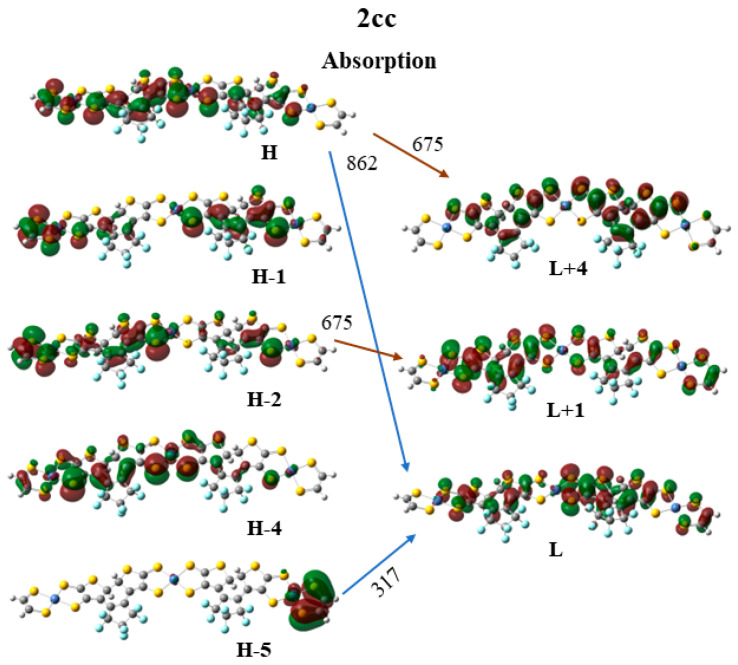
The first-, second-, and third-order molecular nonlinear optical properties, including two-photon absorption of a series of derivatives, involving two dithienylethene (DTE) groups connected by several molecular linkers (bis(ethylene-1,2-dithiolato)Ni- (NiBDT), naphthalene, quasilinear oligothiophene chains), are investigated by employing density functional theory (DFT). These properties can be efficiently controlled by DTE switches, in connection with light of appropriate frequency. NiBDT, as a linker, is associated with a greater contrast, in comparison to naphthalene, between the first and second hyperpolarizabilities of the "open-open" and the "closed-closed" isomers. This is explained by invoking the low-lying excited states of NiBDT. It is shown that the second hyperpolarizability can be used as an index, which follows the structural changes induced by photochromism. Assuming a Förster type transfer mechanism, the intramolecular excited-state energy transfer (EET) mechanism is studied. Two important parameters related to this are computed: the electronic coupling (V) between the donor and acceptor fragments as well as the overlap between the absorption and emission spectra of the donor and acceptor groups. NiBDT as a linker is associated with a low electronic coupling, V, value. We found that V is affected by molecular geometry. Our results predict that the linker strongly influences the communication between the open-closed DTE groups. The sensitivity of the molecular nonlinear optical properties could assist with identification of molecular isomers.
采用密度泛函理论(DFT)研究了一系列衍生物的一阶、二阶和三阶分子非线性光学性质,包括双光子吸收,这些衍生物含有通过几个分子连接基(双(乙烯 - 1,2 - 二硫醇)镍(NiBDT)、萘、准线性低聚噻吩链)连接的两个二噻吩乙烯(DTE)基团。结合适当频率的光,这些性质可通过DTE开关有效控制。与萘相比,作为连接基的NiBDT在“开 - 开”和“闭 - 闭”异构体的第一超极化率和第二超极化率之间具有更大的对比度。这是通过调用NiBDT的低激发态来解释的。结果表明,第二超极化率可作为一个指标,它随光致变色引起的结构变化而变化。假设福斯特型转移机制,研究了分子内激发态能量转移(EET)机制。计算了与此相关的两个重要参数:供体和受体片段之间的电子耦合(V)以及供体和受体基团的吸收光谱与发射光谱之间的重叠。作为连接基的NiBDT具有较低的电子耦合V值。我们发现V受分子几何形状影响。我们的结果预测,连接基强烈影响开 - 闭DTE基团之间的通信。分子非线性光学性质的敏感性有助于识别分子异构体。