
静息及运动后 QRS-T 夹角在稳定型冠心病患者中的诊断价值。
The diagnostic utility of the basal and post-exercise QRS-T angle in patients with stable coronary artery disease.
机构信息
Department of Cardiology, Health Sciences University, Bursa City Hospital, Bursa, Turkey.
Department of Cardiology, Health Sciences University, Bursa Yüksek Ihtisas Training and Research Hospital, Bursa, Turkey.
出版信息
Ann Noninvasive Electrocardiol. 2023 Sep;28(5):e13082. doi: 10.1111/anec.13082. Epub 2023 Aug 11.
BACKGROUND
To evaluate the diagnostic utility of basal and post-exercise QRS-T angle in patients with stable coronary artery disease (CAD).
METHODS
This cross-sectional and observational study analyzed 190 patients with stable angina. The QRS-T angle is measured on the 12-lead electrocardiograms at baseline and just after stopping the treadmill stress test in patients undergoing conventional coronary angiography (CAG). The pre- and post-exercise QRS-T angle and ΔQRS-T angle were analyzed.
RESULTS
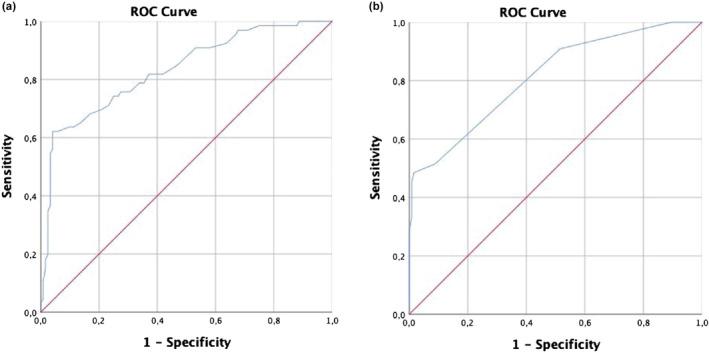
Of the 190 patients, 66 (34.7%) were assigned to group 1 (patients with coronary lesion) and 124 (65.3%) to group 2 (patients without coronary lesion) after CAG. There was no statistically significant difference in QRS-T angle between groups at baseline (pre-exercise) (30.7 ± 17 vs. 27.8 ± 12.8, p = .233). The QRS-T angle value was significantly higher in group 1 than in group 2 (68.8 ± 40.3 vs. 22.7 ± 21.5, p = .01) after exercise (post-exercise). The ΔQRS-T angle was also significantly higher in group 1 than in group 2 (38.1 ± 37.6 vs. -5.1 ± 22.9, p = .01). Receiver operating characteristic curve revealed that the cut-off value of QRS-T angle (post-exercise) for the coronary obstruction was >51.5° with 81% of sensitivity and 66% of specificity (AUC: 0.832, p = .001, CI: 0.769-0.894). Duke treadmill score for coronary stenosis was >1.5 with 77% of sensitivity and 69% of specificity (AUC: 0.814, p = .001, CI: 0.749-0.878).
CONCLUSION
It could be proposed that post-exercise QRS-T angle and Δ QRS-T angle are significantly associated with coronary obstruction in patients with stable angina and appear to be more sensitive than the Duke treadmill score and traditional electrocardiographic parameters.
背景
评估静息和运动后 QRS-T 夹角在稳定性冠心病患者中的诊断价值。
方法
本横断面观察性研究纳入了 190 例稳定性心绞痛患者。在常规冠状动脉造影(CAG)的患者中,在静息和停止跑步机运动试验后,在 12 导联心电图上测量 QRS-T 夹角。分析静息和运动后的 QRS-T 夹角和ΔQRS-T 夹角。
结果
190 例患者中,66 例(34.7%)患者 CAG 后被分为 1 组(有冠状动脉病变患者),124 例(65.3%)患者被分为 2 组(无冠状动脉病变患者)。静息(运动前)时两组间 QRS-T 夹角无统计学差异(30.7±17 与 27.8±12.8,p=0.233)。运动后 1 组的 QRS-T 夹角值显著高于 2 组(68.8±40.3 与 22.7±21.5,p=0.01)。1 组的ΔQRS-T 夹角也显著高于 2 组(38.1±37.6 与-5.1±22.9,p=0.01)。受试者工作特征曲线显示,冠状动脉阻塞的 QRS-T 夹角(运动后)截断值>51.5°,具有 81%的敏感性和 66%的特异性(AUC:0.832,p=0.001,CI:0.769-0.894)。冠状动脉狭窄的杜克跑步机评分>1.5,具有 77%的敏感性和 69%的特异性(AUC:0.814,p=0.001,CI:0.749-0.878)。
结论
可以提出,静息和运动后 QRS-T 夹角和ΔQRS-T 夹角与稳定性心绞痛患者的冠状动脉阻塞显著相关,并且似乎比杜克跑步机评分和传统心电图参数更敏感。
 Zotero 插件