Cho Bo-Hyun, O'Halloran Alissa, Pike Jamison
Centers for Disease Control and Prevention, Atlanta, GA, United States.
Vaccine X. 2023 Jun 5;14:100326. doi: 10.1016/j.jvacx.2023.100326. eCollection 2023 Aug.
As most public health decisions are made at the local level, public health interventions implemented at the local level may vary by their own unique circumstances, such as demographic composition or the availability of resources. Our objective is to estimate and characterize county-level flu vaccine uptakes among Medicare-covered adults aged ≥65 years.
The flu vaccine uptake was estimated from Medicare Fee-for-Service claims for those who continuously enrolled during the 2018-2019 flu season. County-level characteristics were obtained from Centers for Disease Control and Prevention (CDC)'s Minority Health Social Vulnerability Index and Behavioral Risk Factor Surveillance System data as well as Health Resources and Services Administration's Area Health Resources File. A generalized linear regression was used to assess the relationship between selected characteristics and uptake.
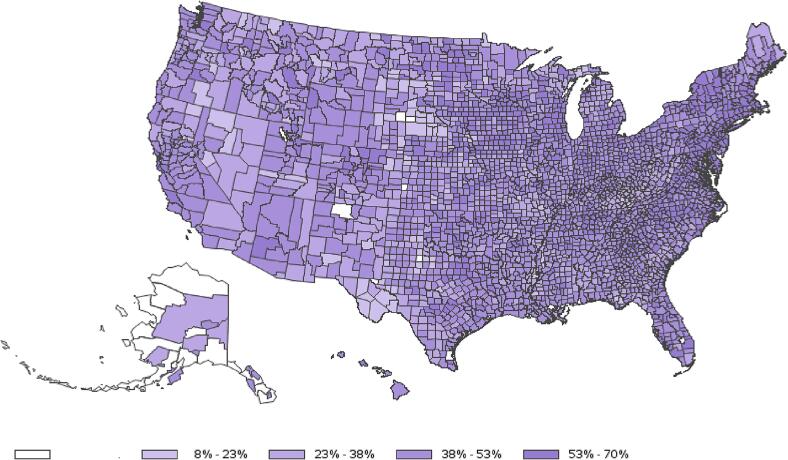
A total of 30,265,047 beneficiaries from 3,125 counties were identified, of which 53% received a flu vaccination during the 2018-2019 flu season. For 3,006 counties with more than 500 Medicare beneficiaries, the mean county-level uptake was estimated to be 47.7%. The mean uptakes in counties designated as a health professional shortage area (HPSA) (42.6% and 48.4%, respectively), were lower than the uptakes for the non-HPSA counties (53.8%). Metro counties (53.2%) showed higher uptakes than non-metro counties (44.2%). Regression analysis results showed that the percent of working adults aged 18-64 years and female were positively associated, while the percent of Black and Hispanic adults were negatively associated. Proportions of persons with limited proficiency of English, college education or above, single parent families, multi-unit housing, and living in group quarters were positively associated and significant.
The results confirmed that county-level flu vaccine uptakes are low, reflect persistent racial disparities in vaccine uptake, and that Medicare populations in medically underserved communities with lower socioeconomic status need more attention in improving flu vaccine uptake.
由于大多数公共卫生决策是在地方层面做出的,因此在地方层面实施的公共卫生干预措施可能因其独特情况而有所不同,例如人口构成或资源可用性。我们的目标是估计并描述65岁及以上医疗保险覆盖成年人的县级流感疫苗接种率。
根据2018 - 2019流感季节持续参保者的医疗保险按服务收费索赔数据估算流感疫苗接种率。县级特征数据来自疾病控制和预防中心(CDC)的少数族裔健康社会脆弱性指数、行为风险因素监测系统数据以及卫生资源与服务管理局的地区卫生资源文件。采用广义线性回归评估选定特征与接种率之间的关系。
共识别出来自3125个县的30265047名受益人,其中53%在2018 - 2019流感季节接种了流感疫苗。对于有500多名医疗保险受益人的3006个县,县级平均接种率估计为47.7%。被指定为卫生专业人员短缺地区(HPSA)的县的平均接种率(分别为42.6%和48.4%)低于非HPSA县(53.8%)。大都市县(53.2%)的接种率高于非大都市县(44.2%)。回归分析结果显示,18 - 64岁在职成年人的百分比和女性与接种率呈正相关,而黑人和西班牙裔成年人的百分比与接种率呈负相关。英语水平有限、大学及以上学历、单亲家庭、多单元住房以及居住在集体宿舍的人群比例与接种率呈正相关且具有显著性。
结果证实县级流感疫苗接种率较低,反映出疫苗接种方面持续存在的种族差异,并表明社会经济地位较低、医疗服务不足社区的医疗保险人群在提高流感疫苗接种率方面需要更多关注。