Kapsetaki Stefania E, Basile Anthony J, Compton Zachary T, Rupp Shawn M, Duke Elizabeth G, Boddy Amy M, Harrison Tara M, Sweazea Karen L, Maley Carlo C
Arizona Cancer Evolution Center, Arizona State University, Tempe, AZ, USA.
Center for Biocomputing, Security and Society, Biodesign Institute, Arizona State University, Tempe, AZ, USA.
bioRxiv. 2023 Aug 2:2023.07.31.551378. doi: 10.1101/2023.07.31.551378.
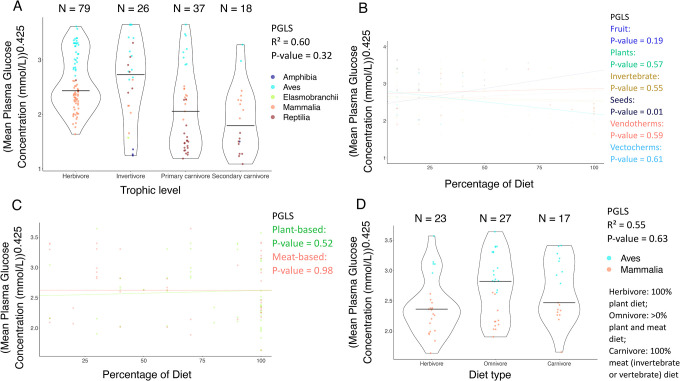
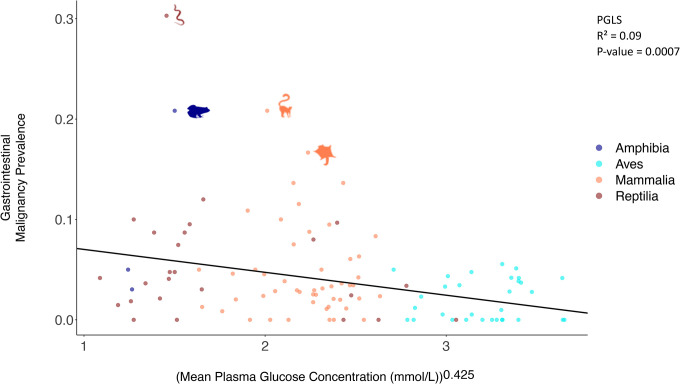
Could diet and mean plasma glucose concentration (MPGluC) explain the variation in cancer prevalence across species? We collected diet, MPGluC, and neoplasia data for 160 vertebrate species from existing databases. We found that MPGluC negatively correlates with cancer and neoplasia prevalence, mostly of gastrointestinal organs. Trophic level positively correlates with cancer and neoplasia prevalence even after controlling for species MPGluC. Most species with high MPGluC (50/78 species = 64.1%) were birds. Most species in high trophic levels (42/53 species = 79.2%) were reptiles and mammals. Our results may be explained by the evolution of insulin resistance in birds which selected for loss or downregulation of genes related to insulin-mediated glucose import in cells. This led to higher MPGluC, intracellular caloric restriction, production of fewer reactive oxygen species and inflammatory cytokines, and longer telomeres contributing to longer longevity and lower neoplasia prevalence in extant birds relative to other vertebrates.
饮食和平均血浆葡萄糖浓度(MPGluC)能否解释不同物种间癌症患病率的差异?我们从现有数据库中收集了160种脊椎动物的饮食、MPGluC和肿瘤形成数据。我们发现,MPGluC与癌症及肿瘤形成患病率呈负相关,主要是胃肠道器官的患病率。即使在控制了物种的MPGluC之后,营养级与癌症及肿瘤形成患病率仍呈正相关。大多数MPGluC较高的物种(50/78种 = 64.1%)是鸟类。大多数处于高营养级的物种(42/53种 = 79.2%)是爬行动物和哺乳动物。我们的结果可能是由于鸟类胰岛素抵抗的进化,这种进化导致与胰岛素介导的细胞葡萄糖摄取相关的基因丢失或下调。这导致了更高的MPGluC、细胞内热量限制、更少的活性氧和炎性细胞因子产生,以及更长的端粒,相对于其他脊椎动物,这使得现存鸟类的寿命更长,肿瘤形成患病率更低。