Barretos Cancer Hospital, Barretos, SP, Brazil.
Molecular Oncology Research Center, Barretos Cancer Hospital, Teaching and Research Institute, Barretos, SP, Brazil.
Breast Cancer Res Treat. 2023 Nov;202(1):57-65. doi: 10.1007/s10549-023-07011-0. Epub 2023 Aug 14.
Neoadjuvant chemotherapy (NACT) is the mainstay of treatment of stages II and III triple-negative breast cancer (TNBC). This study aims to evaluate if the addition of carboplatin to NACT is associated with an increase in the pathological complete response (pCR) rates in TNBC.
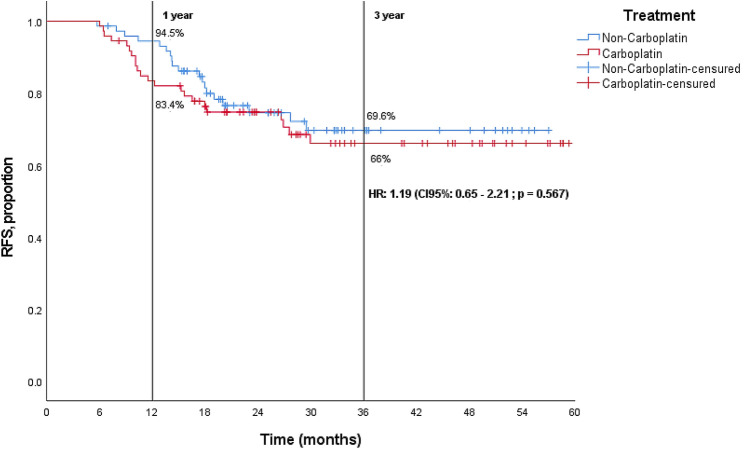
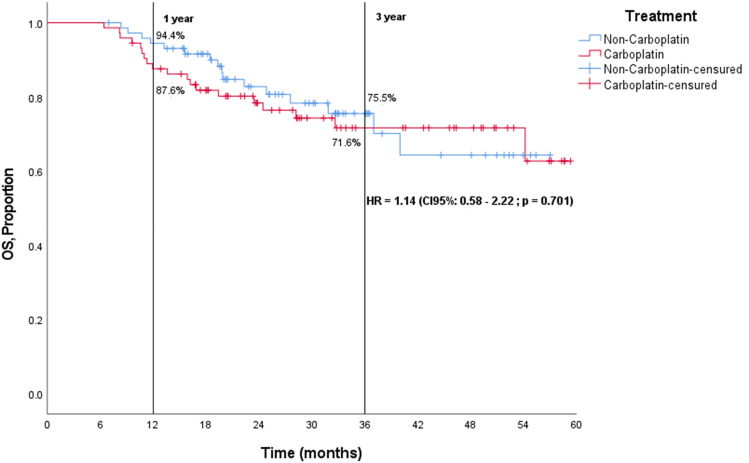
We conducted an open-label phase II randomized clinical trial in a single center in Brazil. Patients with stage II and III TNBC were randomized to receive standard NACT with or without carboplatin. All the patients received doxorubicin (60 mg/m) plus cyclophosphamide (600 mg/m) both intravenously (i.v.) q21 days for four cycles. Patients were then randomized for additional treatment with weekly (wk) paclitaxel (80 mg/m i.v., for 12 cycles) plus wk carboplatin AUC 1.5 (experimental arm) or without wk carboplatin (control arm). Randomization was stratified according to gBRCA status, age, and AJCC 8th edition clinical stage (II vs. III). The primary endpoint was the pathologic complete response (pCR) rate. Secondary endpoints included recurrence-free survival and overall survival.
Between 2017 and 2021, 146 patients were randomized, 73 on each arm. The median age was 45 years. Most patients (66.4%) had locally advanced stage III disease, 67.1% had T3/T4 tumors, and 56.2% had clinically positive axillary lymph nodes. Germline BRCA status was available for all patients, and 19.9% had pathogenic BRCA1/2 variants. The pCR rate (ypT0ypN0) was numerically increased by 13.7%, being 43.8% (31 of 73 patients) in the experimental and 30.1% (22 of 73 patients) in the control arm, not meeting the prespecified goal of increasing the pCR in 15% (p-value = 0.08). Survival outcomes are immature.
The addition of carboplatin to standard NACT in stages II and III TNBC was associated with a non-statistically significant numerical increase in the pCR rate. Follow-up for survival outcomes and translational research initiatives are ongoing.
新辅助化疗(NACT)是 II 期和 III 期三阴性乳腺癌(TNBC)的主要治疗方法。本研究旨在评估在 NACT 中加入卡铂是否与 TNBC 的病理完全缓解(pCR)率增加相关。
我们在巴西的一家单中心进行了一项开放标签的 II 期随机临床试验。II 期和 III 期 TNBC 患者被随机分为接受标准 NACT 加或不加卡铂。所有患者均接受静脉内(i.v.)多柔比星(60mg/m)加环磷酰胺(600mg/m),每 21 天一次,共 4 个周期。然后,患者被随机分为接受每周(wk)紫杉醇(80mg/m i.v.,共 12 个周期)加 wk 卡铂 AUC 1.5(实验组)或不加 wk 卡铂(对照组)的额外治疗。随机分组根据 gBRCA 状态、年龄和 AJCC 第 8 版临床分期(II 期与 III 期)进行分层。主要终点是病理完全缓解(pCR)率。次要终点包括无复发生存率和总生存率。
2017 年至 2021 年,共有 146 名患者被随机分配,每组 73 名。中位年龄为 45 岁。大多数患者(66.4%)患有局部晚期 III 期疾病,67.1%有 T3/T4 肿瘤,56.2%有临床阳性腋窝淋巴结。所有患者均有胚系 BRCA 状态,19.9%有致病性 BRCA1/2 变异。pCR 率(ypT0ypN0)数值增加了 13.7%,实验组为 43.8%(73 名患者中的 31 名),对照组为 30.1%(73 名患者中的 22 名),未达到增加 15%的预设目标(p 值=0.08)。生存结果不成熟。
在 II 期和 III 期 TNBC 中,标准 NACT 加卡铂与 pCR 率的非统计学显著数值增加相关。正在进行生存结果和转化研究计划的随访。