Department of Pathobiology, University of Guelph, Guelph, Ontario N1G 2W1, Canada.
Department of Food Science, Ontario Agricultural College, University of Guelph, Guelph, Ontario N1G 2W1, Canada; Adaptation Physiology Group, Wageningen University, The Netherlands.
Poult Sci. 2023 Oct;102(10):102907. doi: 10.1016/j.psj.2023.102907. Epub 2023 Jul 3.
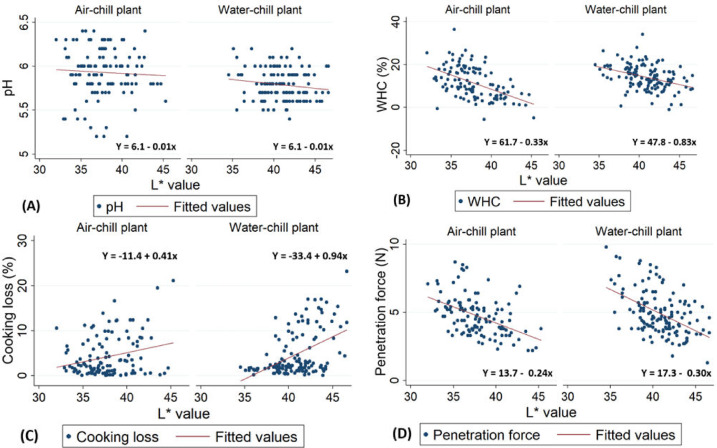
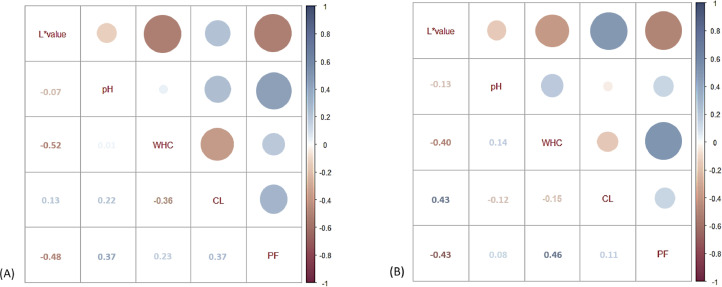
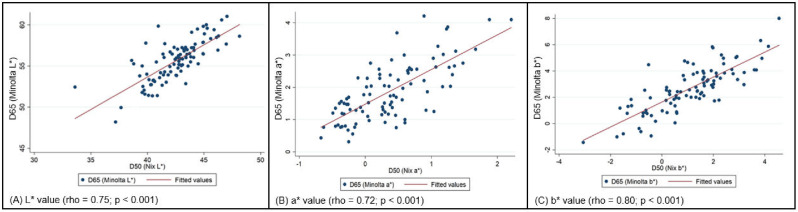
The aims of this study were to i) estimate the occurrence of pale, soft, and exudative (PSE) meat in modern commercial Ontario broiler flocks, ii) determine the effects of the chilling method (water vs. air) on PSE meat, and iii) investigate a new inexpensive colorimeter (10% of the price of traditional color meters), the Nix Color Sensor, as an objective color measurement of chicken meat. Between June 2019 to March 2020, a total of 17 different broiler flocks were processed. The color of 1,700 boneless skinless Pectoralis major muscles was randomly measured (100/flock), where 255 samples were also measured for pH, water-holding capacity (WHC), cooking loss, and penetration force. In addition, a traditional Minolta colorimeter was used to measure random 95 samples from a single water-chilled flock and subsequently compared the values obtained with the Nix Color Sensor. Strong correlations of L* values (rho = 0.75; P < 0.001), a* values (rho = 0.72; P < 0.001), and b* values (rho = 0.80; P < 0.001) were observed. When an L* value of 43 was used as the cut-off for the Nix, 12.5% of fillets were classified as PSE meat. Statistical differences (P < 0.05) were observed between the air and water-chill methods for L*, pH, and WHC. However, there were no significant differences observed between the 2 methods for cooking loss and penetration force values. The study indicated that PSE meat is still a challenge in Ontario broilers, and that the L*, pH, and WHC of breast meat (all indicate meat quality) are affected by the chilling method. In addition, the Nix was found to be an affordable, objective, and convenient sensor for measuring chicken meat color.
i)估计现代安大略省商业肉鸡群中苍白、柔软和渗出性(PSE)肉的发生率;ii)确定冷却方法(水冷却与空气冷却)对 PSE 肉的影响;iii)研究一种新的廉价比色计(传统比色计价格的 10%),即 Nix 颜色传感器,作为鸡肉颜色的客观测量。2019 年 6 月至 2020 年 3 月,共处理了 17 个不同的肉鸡群。随机测量了 1700 块去骨去皮胸大肌的颜色(每群 100 块),其中 255 块样品还测量了 pH 值、持水力(WHC)、蒸煮损失和穿刺力。此外,还使用传统的美能达比色计随机测量了单个水冷鸡群的 95 个样本,随后比较了 Nix 颜色传感器获得的值。L值(rho=0.75;P<0.001)、a值(rho=0.72;P<0.001)和 b值(rho=0.80;P<0.001)之间存在很强的相关性。当 Nix 的 L值为 43 时,12.5%的鱼片被归类为 PSE 肉。空气冷却和水冷却方法之间在 L*、pH 值和 WHC 方面存在统计学差异(P<0.05)。然而,两种方法在蒸煮损失和穿刺力值方面没有显著差异。研究表明,PSE 肉在安大略省肉鸡中仍然是一个挑战,并且胸肉的 L*、pH 值和 WHC(均表明肉质)受到冷却方法的影响。此外,Nix 被发现是一种经济实惠、客观和方便的鸡肉颜色传感器。