Department of Psychology, Carnegie Mellon University, 5000 Forbes Ave, Pittsburgh, PA, 15213, USA.
Psychon Bull Rev. 2024 Feb;31(1):104-121. doi: 10.3758/s13423-023-02355-6. Epub 2023 Aug 14.
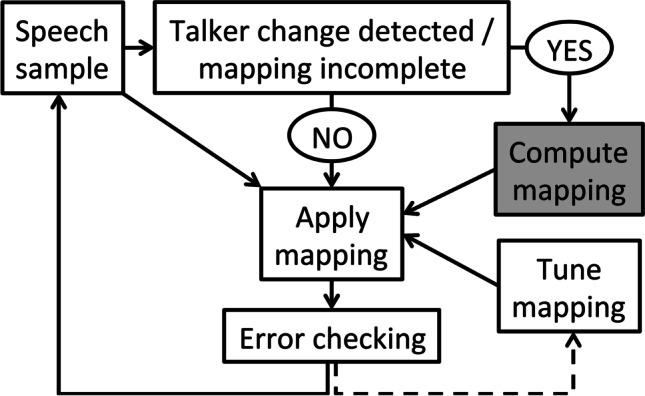
Though listeners readily recognize speech from a variety of talkers, accommodating talker variability comes at a cost: Myriad studies have shown that listeners are slower to recognize a spoken word when there is talker variability compared with when talker is held constant. This review focuses on two possible theoretical mechanisms for the emergence of these processing penalties. One view is that multitalker processing costs arise through a resource-demanding talker accommodation process, wherein listeners compare sensory representations against hypothesized perceptual candidates and error signals are used to adjust the acoustic-to-phonetic mapping (an active control process known as contextual tuning). An alternative proposal is that these processing costs arise because talker changes involve salient stimulus-level discontinuities that disrupt auditory attention. Some recent data suggest that multitalker processing costs may be driven by both mechanisms operating over different time scales. Fully evaluating this claim requires a foundational understanding of both talker accommodation and auditory streaming; this article provides a primer on each literature and also reviews several studies that have observed multitalker processing costs. The review closes by underscoring a need for comprehensive theories of speech perception that better integrate auditory attention and by highlighting important considerations for future research in this area.
尽管听众可以轻松识别来自各种说话者的语音,但适应说话者的变化是有代价的:众多研究表明,与说话者保持不变相比,当说话者变化时,听众识别口语单词的速度会变慢。本篇综述主要关注两种可能的理论机制,这些机制解释了这些处理惩罚的出现。一种观点认为,多说话者处理成本是通过资源需求的说话者适应过程产生的,在该过程中,听众将感觉表示与假设的感知候选者进行比较,并使用错误信号来调整声学到语音的映射(一种称为上下文调谐的主动控制过程)。另一种观点认为,这些处理成本的出现是因为说话者的变化涉及到明显的刺激水平不连续性,从而破坏了听觉注意力。一些最近的数据表明,多说话者处理成本可能是由在不同时间尺度上运行的两种机制驱动的。要充分评估这一说法,需要对说话者适应和听觉流进行基础理解;本文提供了对这两个文献的介绍,并回顾了几项观察到多说话者处理成本的研究。该综述最后强调了需要更全面的语音感知理论来更好地整合听觉注意力,并强调了该领域未来研究的重要考虑因素。