Division of Diabetes, Metabolism and Endocrinology, Kawasaki Medical School, Kurashiki, Japan.
Front Endocrinol (Lausanne). 2023 Jul 31;14:1221723. doi: 10.3389/fendo.2023.1221723. eCollection 2023.
Immune checkpoint inhibitors (ICIs) cause a variety of immune-related adverse events (irAEs). Among them, thyroid dysfunction is most frequently observed. Patients with irAEs have higher survival rates than those without irAEs, but there is no certainty as to whether the degree of thyroid dysfunction is associated with treatment response or survival with ICIs.
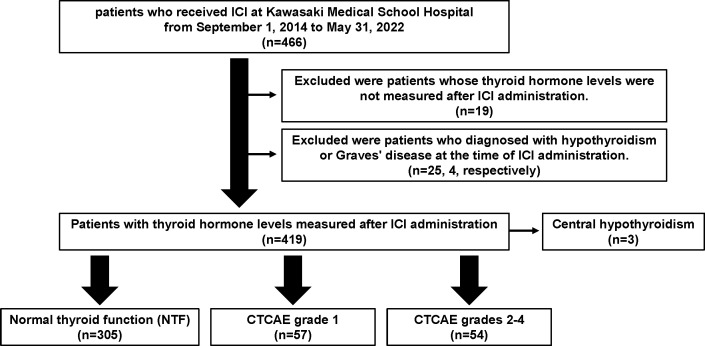
This is a single-center, retrospective, observational study. The study included 466 patients who received ICI at Kawasaki Medical School Hospital from September 1, 2014, to May 31, 2022 and evaluated the degree of abnormal thyroid function and survival and remission rates after treatment with ICIs. Primary hypothyroidism of less than 10 μIU/mL TSH was classified as grade 1, and primary hypothyroidism requiring more than 10 μIU/mL TSH or levothyroxine as grade 2-4.
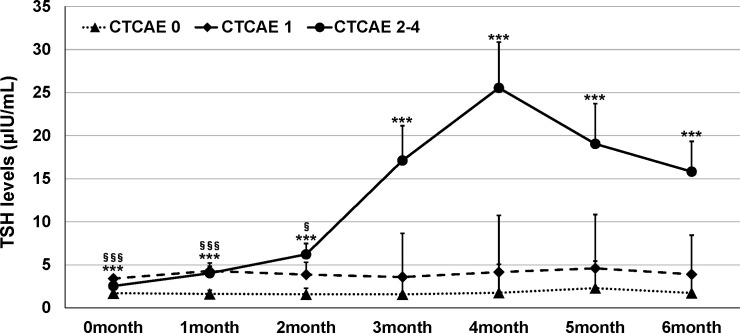
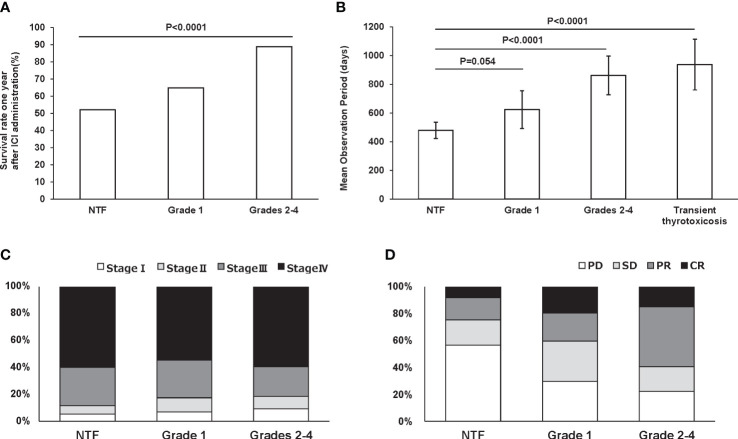
The mean age of the study participants was 68.2 ± 10.3 years, and the percentage of male participants was 72.6%. The frequency of ICI-induced thyroid dysfunction in the study participants was 28.2%. TSH levels were significantly higher in Grade 1 and Grades 2-4 when treated with ICI compared to NTF (p<0.0001). The survival rate at 1 year after ICI administration was significantly higher with 64.9% for grade 1 and 88.9% for grades 2-4 compared to 52.1% for NTF (p<0.0001). Cancer stage at the time of ICI administration did not differ among the groups (p=0.68). Nevertheless, the remission rate assessed by RECIST criteria was significantly higher in grades 2-4 compared to NTF (p<0.0001).
ICI-induced thyroid dysfunction was significantly correlated with survival, mean observation time, and treatment remission rate. It is important to monitor thyroid hormone levels regularly in patients receiving ICIs.
免疫检查点抑制剂(ICIs)会引起多种免疫相关不良反应(irAEs)。其中,甲状腺功能障碍最为常见。患有 irAEs 的患者比没有 irAEs 的患者生存率更高,但尚不确定甲状腺功能障碍的程度是否与 ICI 的治疗反应或生存相关。
这是一项单中心、回顾性、观察性研究。该研究纳入了 2014 年 9 月 1 日至 2022 年 5 月 31 日期间在川崎医科大学医院接受 ICI 治疗的 466 例患者,并评估了治疗后甲状腺功能异常的程度以及 ICI 的生存率和缓解率。TSH<10 μIU/mL 的原发性甲状腺功能减退症被分为 1 级,而需要 TSH>10 μIU/mL 或甲状腺素治疗的原发性甲状腺功能减退症被分为 2-4 级。
研究参与者的平均年龄为 68.2±10.3 岁,男性参与者的比例为 72.6%。研究参与者中 ICI 诱导的甲状腺功能障碍的发生率为 28.2%。与 NTF 相比,ICI 治疗后 1 级和 2-4 级 TSH 水平显著升高(p<0.0001)。ICI 给药后 1 年的生存率,1 级为 64.9%,2-4 级为 88.9%,明显高于 NTF 的 52.1%(p<0.0001)。ICI 给药时的癌症分期在各组之间没有差异(p=0.68)。然而,根据 RECIST 标准评估的缓解率在 2-4 级明显高于 NTF(p<0.0001)。
ICI 诱导的甲状腺功能障碍与生存率、平均观察时间和治疗缓解率显著相关。在接受 ICI 治疗的患者中,定期监测甲状腺激素水平很重要。