Baryshnikova Natalia V, Ilina Anastasia S, Ermolenko Elena I, Uspenskiy Yury P, Suvorov Alexander N
Department of Molecular Microbiology, Institute of Experimental Medicine, St. Petersburg 197376, Russia.
Internal Diseases Department of Stomatological Faculty, Pavlov First St-Petersburg State Medical University, St. Petersburg 197022, Russia.
World J Clin Cases. 2023 Jul 16;11(20):4740-4751. doi: 10.12998/wjcc.v11.i20.4740.
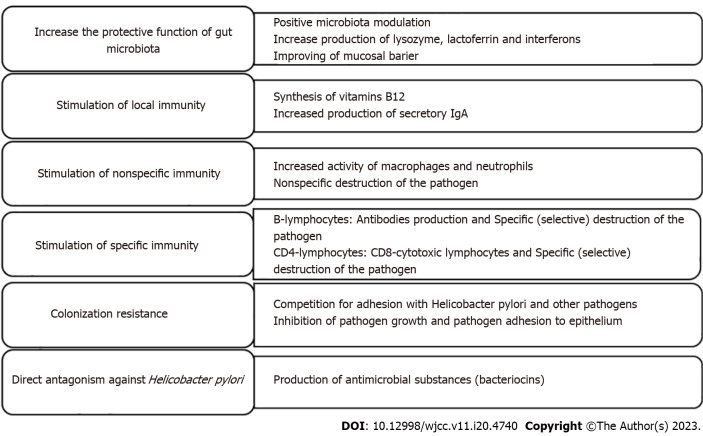
The article discusses various approaches for probiotic treatment of () infection: Probiotics as an adjuvant treatment in the standard eradication therapy; probiotic strains as a monotherapy; and autoprobiotics as a monotherapy. Autoprobiotics refer to indigenous bifidobacteria, lactobacilli, or enterococci isolated from a specific individual, intended to restore his/her microbiota and improve his/her health. The potential mechanisms of probiotic action against include correction of the gut microbiota, immunological effects (enhancement of humoral and cellular immunity, and reduction of oxidative stress), direct antagonistic effects against (such as colonization resistance and bacteriocin synthesis), and stimulation of local immunological protection (strengthening of the mucous protective barrier and reduction of gastric mucosa inflammation). The incorporation of probiotics into comprehensive eradication therapy shows promise in optimizing the treatment of infection. Probiotics can enhance the eradication rates of , reduce the occurrence and severity of side effects, and improve patient compliance. Probiotic or autoprobiotic monotherapy can be considered as an alternative treatment approach in cases of allergic reactions and insufficient effectiveness of antibiotics. We recommend including probiotics as adjunctive medications in anti- regimens. However, further randomized multicenter studies are necessary to investigate the effects of probiotics and autoprobiotics against , in order to gain a better understanding of their mechanisms of action.
本文讨论了益生菌治疗()感染的各种方法:益生菌作为标准根除疗法的辅助治疗;益生菌菌株作为单一疗法;以及自体益生菌作为单一疗法。自体益生菌是指从特定个体分离出的本土双歧杆菌、乳酸杆菌或肠球菌,旨在恢复其微生物群并改善其健康状况。益生菌对抗()的潜在作用机制包括纠正肠道微生物群、免疫效应(增强体液免疫和细胞免疫以及降低氧化应激)、对()的直接拮抗作用(如定植抗性和细菌素合成)以及刺激局部免疫保护(加强粘液保护屏障和减轻胃粘膜炎症)。将益生菌纳入综合根除疗法有望优化()感染的治疗。益生菌可以提高()的根除率,降低副作用的发生率和严重程度,并提高患者的依从性。在发生过敏反应和抗生素疗效不足的情况下,益生菌或自体益生菌单一疗法可被视为一种替代治疗方法。我们建议在抗()方案中加入益生菌作为辅助药物。然而,有必要进行进一步的随机多中心研究,以调查益生菌和自体益生菌对抗()的效果,以便更好地了解它们的作用机制。