Kordsmeyer Tobias L, Thies Yasmin T K, Ekrami Omid, Stern Julia, Schild Christoph, Spoiala Cristina, Claes Peter, Van Dongen Stefan, Penke Lars
Department of Psychology and Leibniz Science Campus, Primate Cognition, University of Goettingen, Gosslerstr. 14, 37073 Goettingen, Germany.
Department of Biology, University of Antwerp, Universiteitsplein 1, 2610 Antwerp, Belgium.
Evol Hum Sci. 2020 Jun 29;2:e35. doi: 10.1017/ehs.2020.36. eCollection 2020.
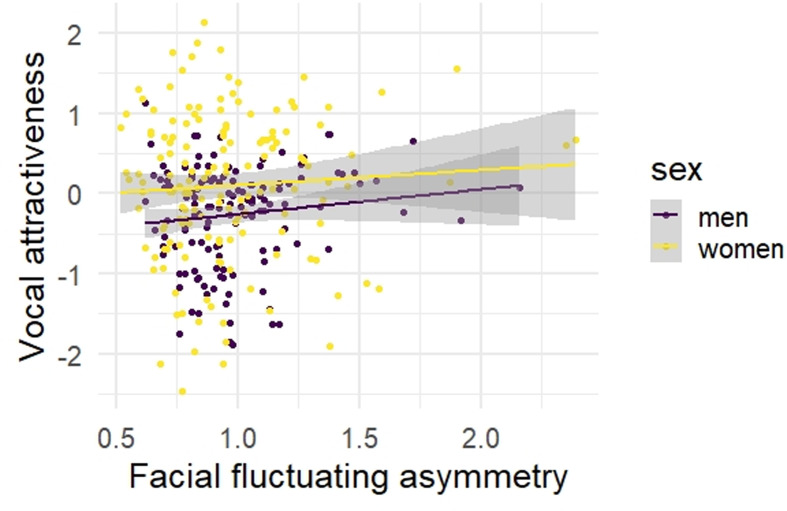
Facial fluctuating asymmetry (FA), presumably a proxy measure of developmental instability, has been proposed to inversely relate to vocal attractiveness, which may convey information on heritable fitness benefits. Using an improved method of measuring facial FA, we sought to replicate two recent studies that showed an inverse correlation of facial FA with vocal attractiveness. In two samples of men ( = 165) and women ( = 157), we investigated the association of automatically measured facial FA based on 3D face scans with male and female observer-rated attractiveness of voice recordings. No significant associations were found for men or women, also when controlling for facial attractiveness, age, and body mass index. Equivalence tests show that effect sizes were significantly smaller than previous meta-analytic effects, providing robust evidence against a link of facial FA with vocal attractiveness. Thus, our study contradicts earlier findings that vocal attractiveness may signal genetic quality in humans via an association with FA.
面部波动不对称性(FA),大概是发育不稳定性的一种替代指标,被认为与嗓音吸引力呈负相关,而嗓音吸引力可能传达有关可遗传的健康益处的信息。我们采用一种改进的测量面部FA的方法,试图重复两项近期研究,这两项研究表明面部FA与嗓音吸引力呈负相关。在两个样本中,一个样本有165名男性,另一个样本有157名女性,我们研究了基于3D面部扫描自动测量的面部FA与男性和女性观察者对语音记录吸引力评分之间的关联。无论是男性还是女性,在控制面部吸引力、年龄和体重指数后,均未发现显著关联。等效性检验表明,效应大小显著小于先前的元分析效应,这为反对面部FA与嗓音吸引力之间的联系提供了有力证据。因此,我们的研究与早期研究结果相矛盾,早期研究结果认为嗓音吸引力可能通过与FA的关联来表明人类的基因质量。