Ker Andrew M, Veen Egbert J D, Maharaj Jashint C, Launay Marine M, Cutbush Kenneth, Gupta Ashish
Greenslopes Private Hospital, Brisbane, QLD, Australia.
Brisbane Private Hospital, Brisbane, QLD, Australia.
JSES Rev Rep Tech. 2021 May 15;1(3):224-228. doi: 10.1016/j.xrrt.2021.04.010. eCollection 2021 Aug.
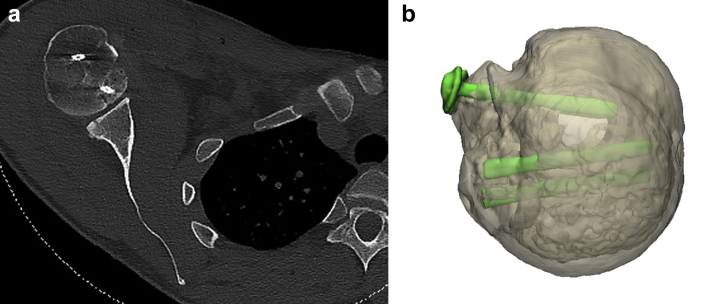
Exposure of the humeral articular surface through an anterior approach to the shoulder for grafting humeral bone defects requires partial or complete detachment of the subscapularis tendon and traditionally is achieved through a subscapularis tenotomy, peel tuberosity osteotomy, or lesser tuberosity osteotomy. This case report presents a technique of performing a pedicled-lesser tuberosity osteotomy to allow adequate access for allograft reconstruction of a large reverse Hill-Sachs lesion after a traumatic posterior dislocation, to restore humeral head sphericity and prevent recurrent glenohumeral joint instability. The inferior subscapularis insertion is left intact leaving a periosteal sleeve and preserving the blood supply to the lesser tuberosity and humeral head, with the aim of improving healing of the osteotomy and preventing graft-related complications, such as resorption. Successful union of the pedicled-lesser tuberosity osteotomy and allograft was seen on a 6-month follow-upcomputed tomography scan, with adequate restoration of subscapularis function.
通过肩部前方入路暴露肱骨关节面以移植肱骨骨缺损,需要部分或完全切断肩胛下肌腱,传统上是通过肩胛下肌腱切断术、剥离结节截骨术或小结节截骨术来实现的。本病例报告介绍了一种进行带蒂小结节截骨术的技术,以便在创伤性后脱位后为大型反向Hill-Sachs损伤的同种异体骨重建提供足够的入路,恢复肱骨头的球形度并防止复发性盂肱关节不稳定。肩胛下肌的下止点保持完整,留下骨膜袖并保留小结节和肱骨头的血供,目的是改善截骨术的愈合并预防与移植相关的并发症,如吸收。在6个月的随访计算机断层扫描中可见带蒂小结节截骨术和同种异体骨成功愈合,肩胛下肌功能得到充分恢复。