Children's Hospital Capital Institute of Pediatrics, Chinese Academy of Medical Sciences and Peking Union Medical College, Beijing 100020, P.R. China.
Department of Pediatrics, Shandong Provincial Hospital Affiliated to Shandong First Medical University, Jinan, Shandong 250021, P.R. China.
Mol Med Rep. 2023 Oct;28(4). doi: 10.3892/mmr.2023.13073. Epub 2023 Aug 18.
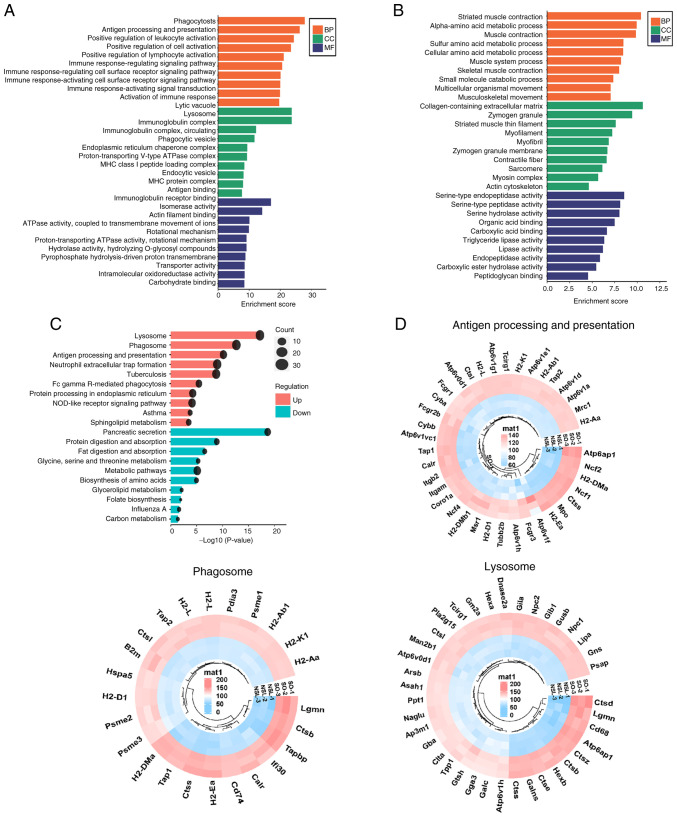
Asthma associated with obesity is a chronic disease that poses a threat to health in children and results in severe wheezing, earlier airway remodeling and increased insensitivity to hormone therapy compared with those who only have asthma. Despite its clinical importance, knowledge on the underlying mechanisms of this disease is limited. The present study aimed to elucidate the pathogenesis of asthma associated with obesity using a murine model. A total of 30 female BALB/c mice were divided into three groups: Normal, mice with asthma and obese mice with asthma. Obese mice with asthma were fed a high‑fat diet to induce obesity. Mice with asthma were sensitized and challenged with ovalbumin (OVA). Obese mice were subjected to OVA sensitization and challenge to develop asthma associated with obesity. Airway remodeling was observed in obese mice with asthma through HE and Masson staining. Proteomic and bioinformatics analyses were conducted on lung tissue from obese mice with asthma and normal mice. A total of 200 proteins were differentially expressed in obese mice with asthma compared with normal mice; of these, 53 and 47% were up‑ and downregulated, respectively. Pathway analysis revealed that asthma associated with obesity primarily affected the 'lysosome', 'phagosome', and 'sphingolipid metabolism' pathways. Gene Set Enrichment Analysis demonstrated the presence of pyroptosis in obese asthmatic mice, along with significant increases in pyroptosis‑-associated factors such as GSDMD and Caspase. High protein expression of orosomucoid‑like 3 (ORMDL3), NOD‑like receptor thermal protein domain associated protein 3 (NLRP3) and Gasdermin‑D (GSDMD) was observed in obese mice with asthma. experiments using HBE cells infected with ORMDL3‑overexpressing lentivirus demonstrated that the overexpression of ORMDL3 led to increased expression of NLRP3, GSDMD and cathepsin D (CTSD). These findings suggested that ORMDL3 may regulate pyroptosis and subsequent airway remodeling in asthma associated with obesity via the CTSD/NLRP3/GSDMD pathway.
肥胖相关性哮喘是一种威胁儿童健康的慢性疾病,与仅患有哮喘的患者相比,其表现为严重的喘息、更早的气道重塑和对激素治疗的不敏感性。尽管其具有临床重要性,但对这种疾病潜在机制的了解有限。本研究旨在使用小鼠模型阐明肥胖相关性哮喘的发病机制。将 30 只雌性 BALB/c 小鼠分为三组:正常组、哮喘组和肥胖哮喘组。肥胖哮喘组给予高脂饮食诱导肥胖。哮喘组小鼠用卵清蛋白(OVA)致敏和激发。肥胖组小鼠用 OVA 致敏和激发以建立肥胖相关性哮喘。通过 HE 和 Masson 染色观察肥胖哮喘小鼠的气道重塑。对肥胖哮喘小鼠和正常小鼠的肺组织进行蛋白质组学和生物信息学分析。与正常小鼠相比,肥胖哮喘小鼠的肺组织中有 200 种蛋白表达差异;其中,上调和下调的蛋白分别占 53%和 47%。通路分析显示,肥胖相关性哮喘主要影响“溶酶体”、“吞噬体”和“鞘脂代谢”通路。基因集富集分析表明,肥胖哮喘小鼠存在细胞焦亡,并且细胞焦亡相关因子如 GSDMD 和 Caspase 显著增加。肥胖哮喘小鼠中观察到粘蛋白样 3(ORMDL3)、NOD 样受体热蛋白结构域相关蛋白 3(NLRP3)和 Gasdermin-D(GSDMD)的高蛋白质表达。用过表达 ORMDL3 的慢病毒感染 HBE 细胞进行实验,结果表明,ORMDL3 的过表达导致 NLRP3、GSDMD 和组织蛋白酶 D(CTSD)的表达增加。这些发现表明,ORMDL3 可能通过 CTSD/NLRP3/GSDMD 通路调节肥胖相关性哮喘中的细胞焦亡和随后的气道重塑。