Division of Molecular Biology and Biochemistry, Gottfried Schatz Research Center, Medical University of Graz, Graz, Austria.
Institute of Chemical Technologies and Analytics, TU Wien, Vienna, Austria.
J Lipid Res. 2023 Sep;64(9):100427. doi: 10.1016/j.jlr.2023.100427. Epub 2023 Aug 16.
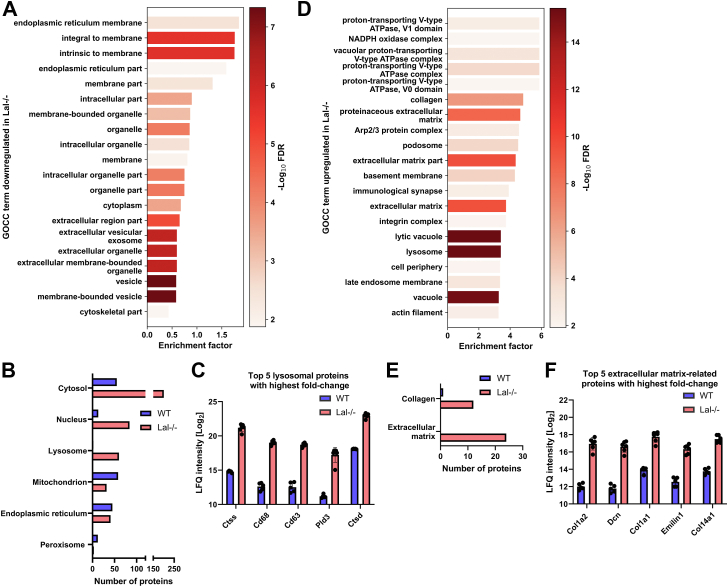
Lysosomal acid lipase (LAL) is the sole lysosomal enzyme responsible for the degradation of cholesteryl esters and triacylglycerols at acidic pH. Impaired LAL activity leads to LAL deficiency (LAL-D), a severe and fatal disease characterized by ectopic lysosomal lipid accumulation. Reduced LAL activity also contributes to the development and progression of non-alcoholic fatty liver disease (NAFLD). To advance our understanding of LAL-related liver pathologies, we performed comprehensive proteomic profiling of livers from mice with systemic genetic loss of LAL (Lal-/-) and from mice with hepatocyte-specific LAL-D (hepLal-/-). Lal-/- mice exhibited drastic proteome alterations, including dysregulation of multiple proteins related to metabolism, inflammation, liver fibrosis, and cancer. Global loss of LAL activity impaired both acidic and neutral lipase activities and resulted in hepatic lipid accumulation, indicating a complete metabolic shift in Lal-/- livers. Hepatic inflammation and immune cell infiltration were evident, with numerous upregulated inflammation-related gene ontology biological process terms. In contrast, both young and mature hepLal-/- mice displayed only minor changes in the liver proteome, suggesting that loss of LAL solely in hepatocytes does not phenocopy metabolic alterations observed in mice globally lacking LAL. These findings provide valuable insights into the mechanisms underlying liver dysfunction in LAL-D and may help in understanding why decreased LAL activity contributes to NAFLD. Our study highlights the importance of LAL in maintaining liver homeostasis and demonstrates the drastic consequences of its global deficiency on the liver proteome and liver function.
溶酶体酸性脂肪酶(LAL)是唯一负责在酸性 pH 值下降解胆固醇酯和三酰基甘油的溶酶体酶。LAL 活性受损会导致 LAL 缺乏症(LAL-D),这是一种严重且致命的疾病,其特征是异位溶酶体脂质积累。LAL 活性降低也会导致非酒精性脂肪性肝病(NAFLD)的发展和进展。为了深入了解 LAL 相关的肝脏病理,我们对全身性遗传缺失 LAL 的小鼠(Lal-/-)和肝细胞特异性 LAL-D 的小鼠(hepLal-/-)的肝脏进行了全面的蛋白质组学分析。Lal-/-小鼠表现出明显的蛋白质组改变,包括与代谢、炎症、肝纤维化和癌症相关的多种蛋白质的失调。LAL 活性的全面丧失会损害酸性和中性脂肪酶的活性,并导致肝脏脂质积累,这表明 Lal-/- 肝脏发生了完全的代谢转变。肝脏炎症和免疫细胞浸润明显,许多上调的炎症相关基因本体生物学过程术语。相比之下,年轻和成熟的 hepLal-/- 小鼠的肝脏蛋白质组仅发生微小变化,这表明仅在肝细胞中缺失 LAL 并不能模拟在全身缺乏 LAL 的小鼠中观察到的代谢改变。这些发现为 LAL-D 中肝脏功能障碍的机制提供了有价值的见解,并可能有助于理解为什么 LAL 活性降低会导致 NAFLD。我们的研究强调了 LAL 在维持肝脏内稳态中的重要性,并表明其在肝脏蛋白质组和肝功能方面的全面缺乏会产生严重后果。