Salinas Nichole D, Ma Rui, Dickey Thayne H, McAleese Holly, Ouahes Tarik, Long Carole A, Miura Kazutoyo, Lambert Lynn E, Tolia Niraj H
Host-Pathogen Interactions and Structural Vaccinology Section, Laboratory of Malaria Immunology and Vaccinology, National Institute of Allergy and Infectious Diseases, National Institutes of Health, Bethesda, MD, USA.
Vaccine Development Unit, Laboratory of Malaria Immunology and Vaccinology, National Institute of Allergy and Infectious Diseases, National Institutes of Health, Bethesda, MD, USA.
NPJ Vaccines. 2023 Aug 18;8(1):124. doi: 10.1038/s41541-023-00709-8.
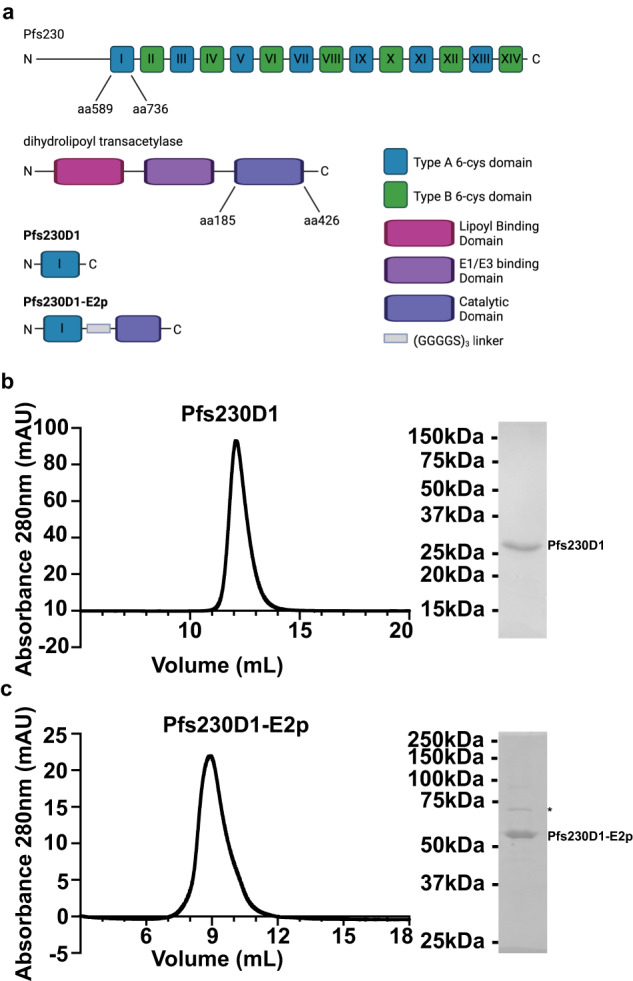
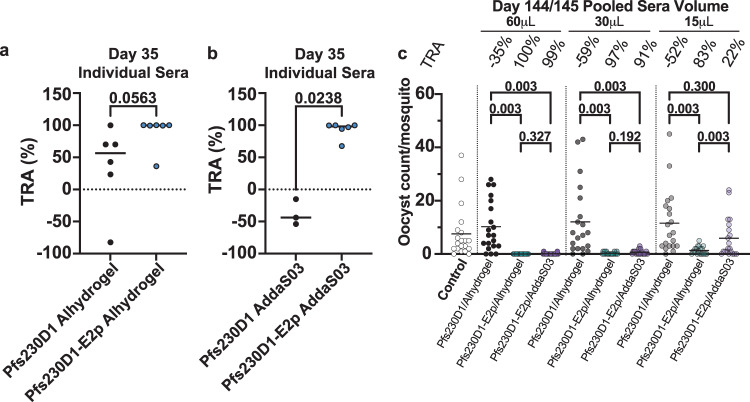
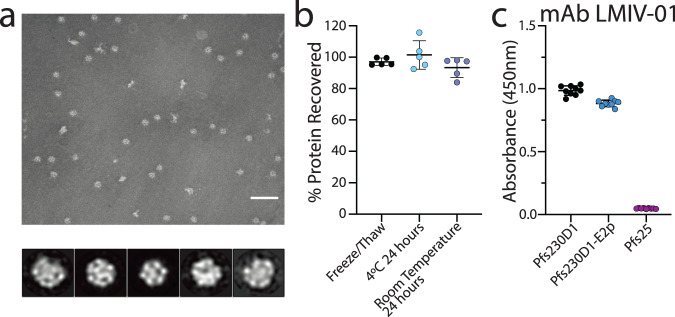
Malaria transmission-blocking vaccines (TBVs) reduce disease transmission by breaking the continuous cycle of infection between the human host and the mosquito vector. Domain 1 (D1) of Pfs230 is a leading TBV candidate and comprises the majority of transmission-reducing activity (TRA) elicited by Pfs230. Here we show that the fusion of Pfs230D1 to a 60-copy multimer of the catalytic domain of dihydrolipoyl acetyltransferase protein (E2p) results in a single-component nanoparticle composed of 60 copies of the fusion protein with high stability, homogeneity, and production yields. The nanoparticle presents a potent human transmission-blocking epitope within Pfs230D1, indicating the antigen is correctly oriented on the surface of the nanoparticle. Two vaccinations of New Zealand White rabbits with the Pfs230D1 nanoparticle elicited a potent and durable antibody response with high TRA when formulated in two distinct adjuvants suitable for translation to human use. This single-component nanoparticle vaccine may play a key role in malaria control and has the potential to improve production pipelines and the cost of manufacturing of a potent and durable TBV.
疟疾传播阻断疫苗(TBVs)通过打破人类宿主与蚊媒之间持续的感染循环来减少疾病传播。Pfs230的结构域1(D1)是一种主要的TBV候选物,并且包含由Pfs230引发的大部分传播减少活性(TRA)。在此我们表明,Pfs230D1与二氢硫辛酰乙酰转移酶蛋白(E2p)催化结构域的60拷贝多聚体融合,产生了一种由60拷贝融合蛋白组成的单组分纳米颗粒,具有高稳定性、均一性和产量。该纳米颗粒在Pfs230D1内呈现出一种有效的人类传播阻断表位,表明抗原在纳米颗粒表面正确定向。当用两种适合转化为人类使用的不同佐剂配制时,用Pfs230D1纳米颗粒对新西兰白兔进行两次免疫接种引发了具有高效TRA的强效且持久的抗体反应。这种单组分纳米颗粒疫苗可能在疟疾控制中发挥关键作用,并且有潜力改善生产流程以及强效且持久的TBV的制造成本。