Rigonato Janaina, Budinich Marko, Murillo Alejandro A, Brandão Manoela C, Pierella Karlusich Juan J, Soviadan Yawouvi Dodji, Gregory Ann C, Endo Hisashi, Kokoszka Florian, Vik Dean, Henry Nicolas, Frémont Paul, Labadie Karine, Zayed Ahmed A, Dimier Céline, Picheral Marc, Searson Sarah, Poulain Julie, Kandels Stefanie, Pesant Stéphane, Karsenti Eric, Bork Peer, Bowler Chris, de Vargas Colomban, Eveillard Damien, Gehlen Marion, Iudicone Daniele, Lombard Fabien, Ogata Hiroyuki, Stemmann Lars, Sullivan Matthew B, Sunagawa Shinichi, Wincker Patrick, Chaffron Samuel, Jaillon Olivier
Génomique Métabolique, Genoscope, Institut de Biologie François Jacob, Commissariat à l'Energie Atomique (CEA), CNRS, Université Evry, Université Paris-Saclay, 91000, Evry, France.
Research Federation for the study of Global Ocean Systems Ecology and Evolution, FR2022/Tara Oceans GOSEE, 3 rue Michel-Ange, 75016, Paris, France.
ISME Commun. 2023 Aug 18;3(1):83. doi: 10.1038/s43705-023-00279-9.
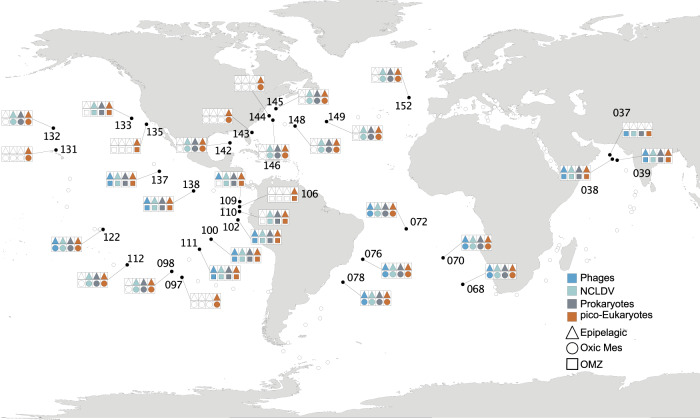
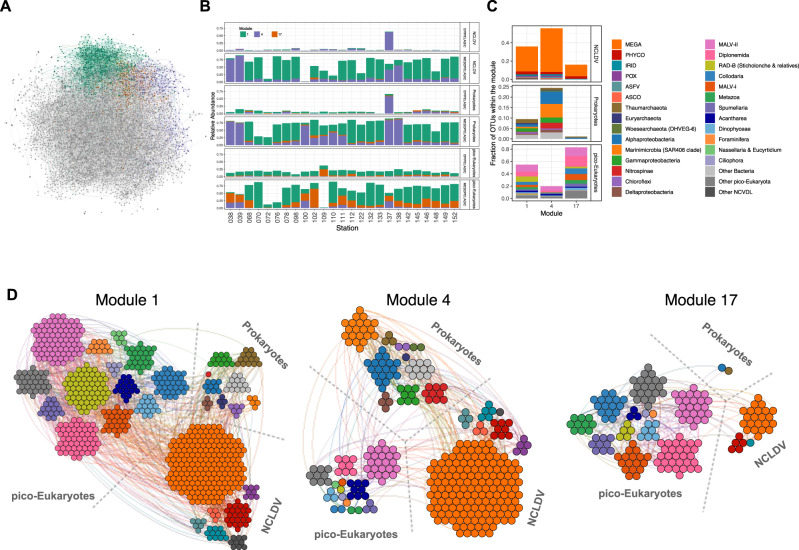
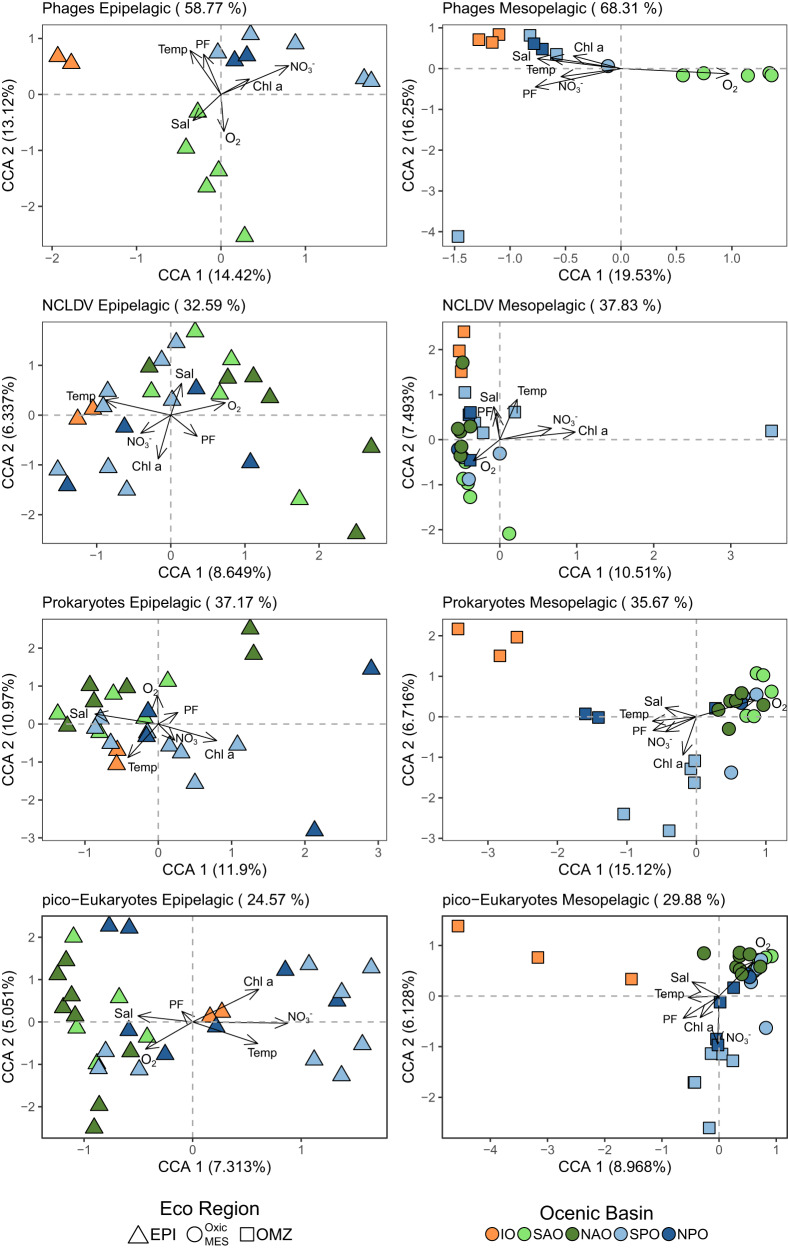
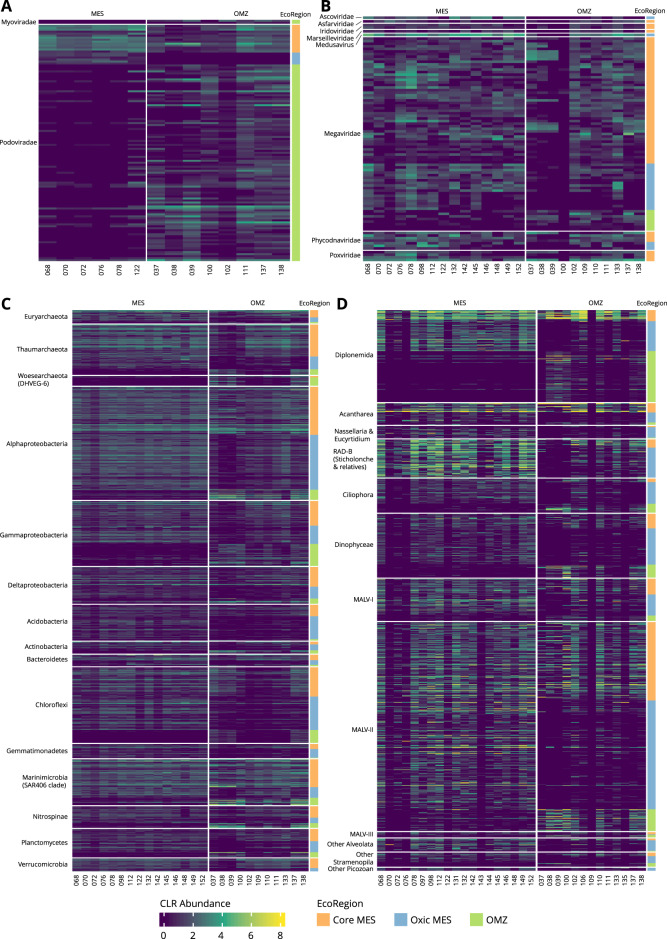
For decades, marine plankton have been investigated for their capacity to modulate biogeochemical cycles and provide fishery resources. Between the sunlit (epipelagic) layer and the deep dark waters, lies a vast and heterogeneous part of the ocean: the mesopelagic zone. How plankton composition is shaped by environment has been well-explored in the epipelagic but much less in the mesopelagic ocean. Here, we conducted comparative analyses of trans-kingdom community assemblages thriving in the mesopelagic oxygen minimum zone (OMZ), mesopelagic oxic, and their epipelagic counterparts. We identified nine distinct types of intermediate water masses that correlate with variation in mesopelagic community composition. Furthermore, oxygen, NO and particle flux together appeared as the main drivers governing these communities. Novel taxonomic signatures emerged from OMZ while a global co-occurrence network analysis showed that about 70% of the abundance of mesopelagic plankton groups is organized into three community modules. One module gathers prokaryotes, pico-eukaryotes and Nucleo-Cytoplasmic Large DNA Viruses (NCLDV) from oxic regions, and the two other modules are enriched in OMZ prokaryotes and OMZ pico-eukaryotes, respectively. We hypothesize that OMZ conditions led to a diversification of ecological niches, and thus communities, due to selective pressure from limited resources. Our study further clarifies the interplay between environmental factors in the mesopelagic oxic and OMZ, and the compositional features of communities.
几十年来,人们一直在研究海洋浮游生物调节生物地球化学循环和提供渔业资源的能力。在阳光照射的(上层)水层和黑暗的深层水域之间,是海洋中一个广阔且异质的部分:中层带。浮游生物组成如何受环境影响在表层海洋已得到充分研究,但在中层海洋的研究却少得多。在这里,我们对在中层海洋氧含量最低区(OMZ)、中层有氧区及其对应的表层区域中蓬勃发展的跨界群落组合进行了比较分析。我们确定了九种不同类型的中间水体,它们与中层群落组成的变化相关。此外,氧气、一氧化氮和颗粒通量共同成为控制这些群落的主要驱动因素。从OMZ出现了新的分类特征,而全球共现网络分析表明,约70%的中层浮游生物类群丰度被组织成三个群落模块。一个模块聚集了来自有氧区域的原核生物、微微型真核生物和核质大DNA病毒(NCLDV),另外两个模块分别富含OMZ原核生物和OMZ微微型真核生物。我们推测,由于有限资源的选择压力,OMZ条件导致了生态位的多样化,进而导致了群落的多样化。我们的研究进一步阐明了中层有氧区和OMZ环境因素之间的相互作用以及群落的组成特征。