Department of Complex Systems, Institute of Computer Science, Czech Academy of Sciences, 182 00, Prague, Czech Republic.
Department of Physiology, Second Faculty of Medicine, Charles University, 150 06, Prague, Czech Republic.
Sci Rep. 2023 Aug 18;13(1):13436. doi: 10.1038/s41598-023-39867-z.
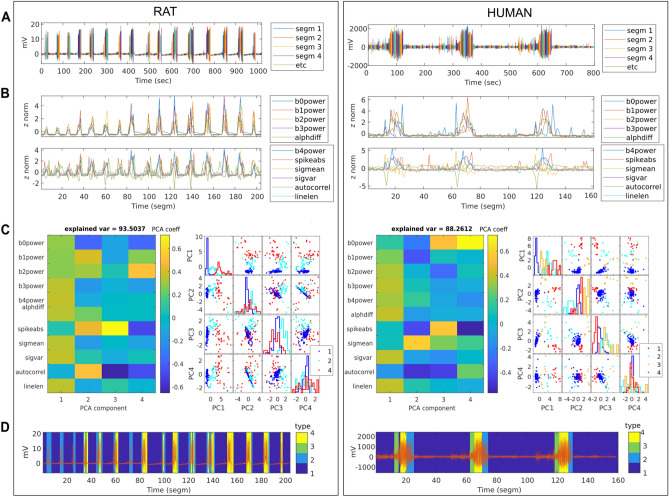
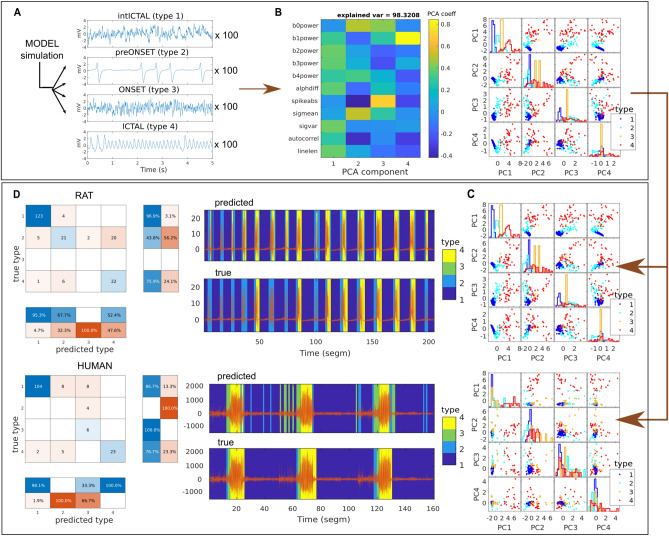
Current advances in epilepsy treatment aim to personalize and responsively adjust treatment parameters to overcome patient heterogeneity in treatment efficiency. For tailoring treatment to the individual and the current brain state, tools are required that help to identify the patient- and time-point-specific parameters of epilepsy. Computational modeling has long proven its utility in gaining mechanistic insight. Recently, the technique has been introduced as a diagnostic tool to predict individual treatment outcomes. In this article, the Wendling model, an established computational model of epilepsy dynamics, is used to automatically classify epileptic brain states in intracranial EEG from patients (n = 4) and local field potential recordings from in vitro rat data (high-potassium model of epilepsy, n = 3). Five-second signal segments are classified to four types of brain state in epilepsy (interictal, preonset, onset, ictal) by comparing a vector of signal features for each data segment to four prototypical feature vectors obtained by Wendling model simulations. The classification result is validated against expert visual assessment. Model-driven brain state classification achieved a classification performance significantly above chance level (mean sensitivity 0.99 on model data, 0.77 on rat data, 0.56 on human data in a four-way classification task). Model-driven prototypes showed similarity with data-driven prototypes, which we obtained from real data for rats and humans. Our results indicate similar electrophysiological patterns of epileptic states in the human brain and the animal model that are well-reproduced by the computational model, and captured by a key set of signal features, enabling fully automated and unsupervised brain state classification in epilepsy.
目前,癫痫治疗的进展旨在个性化和响应式地调整治疗参数,以克服治疗效率方面的患者异质性。为了针对个体和当前大脑状态进行治疗,需要有工具来帮助确定癫痫患者和时间点特异性的参数。计算建模在获得机制见解方面已经证明了其长期以来的实用性。最近,该技术已被引入作为一种诊断工具,以预测个体治疗结果。在本文中,使用 Wendling 癫痫动力学计算模型自动对来自患者(n = 4)的颅内 EEG 和来自体外大鼠数据(高钾癫痫模型,n = 3)的局部场电位记录中的癫痫脑状态进行分类。通过将每个数据段的信号特征向量与通过 Wendling 模型模拟获得的四个原型特征向量进行比较,将 5 秒的信号段分类为癫痫的四种脑状态(间歇期、发作前期、发作期、发作期)。分类结果与专家视觉评估进行了比较。模型驱动的脑状态分类的性能明显优于随机水平(在模型数据上的平均敏感性为 0.99,在大鼠数据上为 0.77,在人类数据上为 0.56,在四向分类任务中)。模型驱动的原型与我们从大鼠和人类实际数据中获得的数据驱动原型具有相似性。我们的结果表明,人类大脑和动物模型中的癫痫状态具有相似的电生理模式,这些模式被计算模型很好地再现,并通过一组关键的信号特征进行捕获,从而能够在癫痫中进行全自动和无监督的脑状态分类。