Department of Functional Chemistry, Kyoto Institute of Technology, Kyoto, 606-8585, Japan.
Laboratory of Cancer Research, University of Science, Vietnam National University Ho Chi Minh City, Ho Chi Minh City, Vietnam.
BMC Complement Med Ther. 2023 Aug 19;23(1):290. doi: 10.1186/s12906-023-04127-0.
Cervical cancer remains a significant global health issue, highlighting the need for effective therapeutic strategies. Given that Sphaerocoryne affinis (SA) has shown potential anti-cancer activity in several cancer types, herein, we investigate the effects of SA fruit (SAF) on human cervical cancer HeLa cells and their underlying mechanisms of action.
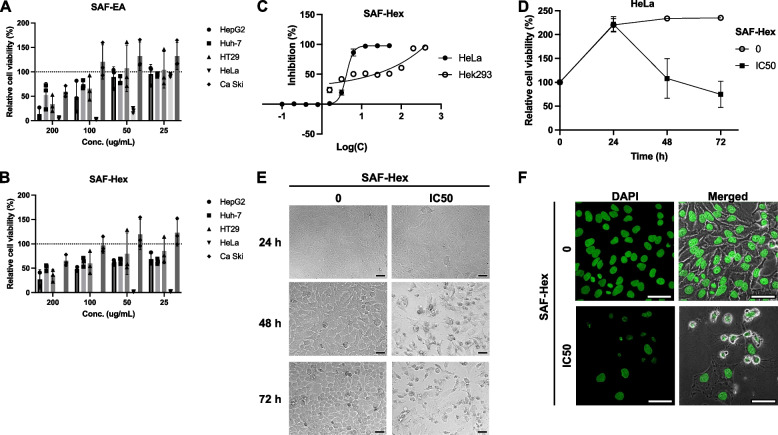
SAF extract cytotoxicity was assessed in various cancer cell lines. The effects of the hexane fraction (SAF-Hex) on HeLa cell viability, cell cycle protein expression, apoptosis, and DNA damage were evaluated using cytotoxicity assays, Western blotting, quantitative PCR, 4',6-diamidino-2-phenylindole (DAPI) staining, and a terminal deoxynucleotidyl transferase dUTP nick end labeling (TUNEL) assay.
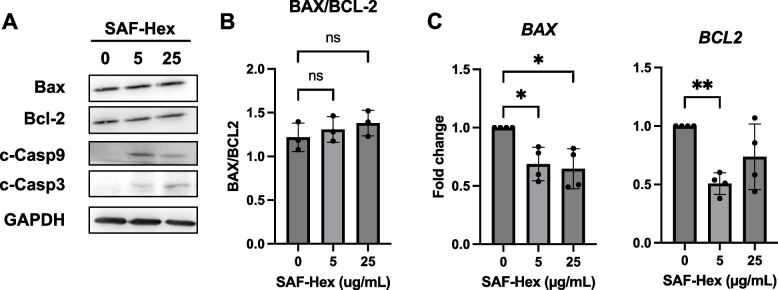
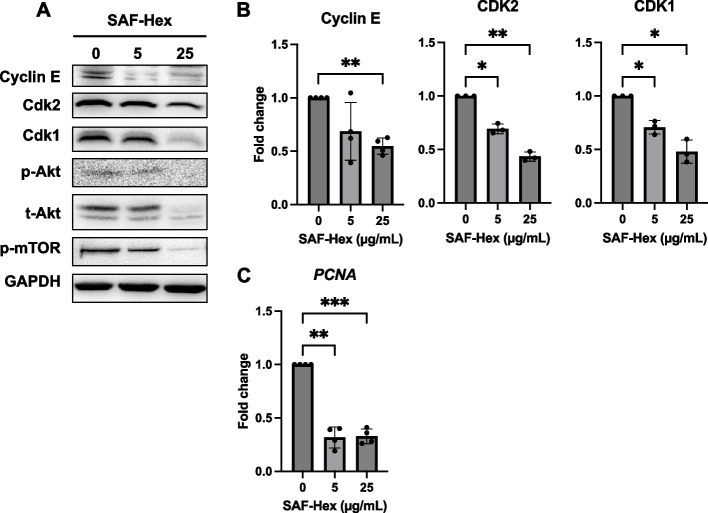
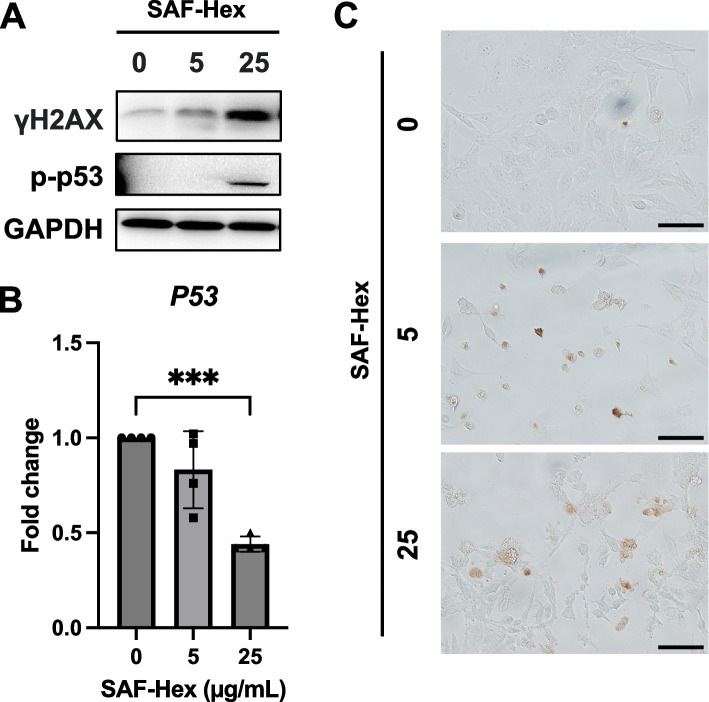
SAF-Hex selectively inhibited HeLa cell viability with an IC50 of 4.20 ± 0.36 µg/mL and a selectivity index of 5.11 ± 0.58. The time-dependent cytotoxicity assay showed decreased cell survival after 48 h of treatment, accompanied by morphological changes and apoptotic bodies in HeLa cells. SAF-Hex also suppressed HeLa cell cycle proteins (Cyclin E, CDK2, and CDK1), reduced PCNA transcription, and diminished AKT and mTOR activation, thus inhibiting cell proliferation. The increased γH2AX expression, DNA fragmentation, and caspases-3 and -9 activation indicated SAF-Hex-induced DNA damage and apoptosis. However, the BAX/BCL-2 ratio remained unchanged, and BAX and BCL2 expression was attenuated.
SAF-Hex effectively inhibits HeLa cell proliferation and induces DNA damage in that cervical cancer cell line activating apoptosis through the intrinsic pathway. Interestingly, the BAX/BCL-2 ratio remained unchanged while BAX and BCL2 transcription was attenuated. Hence, further research is required to explore this unexpected finding and facilitate the development of novel therapies targeting cervical cancer HeLa cells.
宫颈癌仍然是一个重大的全球健康问题,这凸显了需要有效的治疗策略。鉴于球冠海蛇(Sphaerocoryne affinis,SA)在几种癌症类型中表现出潜在的抗癌活性,在此,我们研究了蛇莓果实(SAF)对人宫颈癌 HeLa 细胞的影响及其作用机制。
评估 SAF 提取物对各种癌细胞系的细胞毒性。使用细胞毒性测定、Western blot、定量 PCR、4',6-二脒基-2-苯基吲哚(DAPI)染色和末端脱氧核苷酸转移酶 dUTP 缺口末端标记(TUNEL)试验,评估正己烷部分(SAF-Hex)对 HeLa 细胞活力、细胞周期蛋白表达、细胞凋亡和 DNA 损伤的影响。
SAF-Hex 选择性抑制 HeLa 细胞活力,IC50 为 4.20±0.36μg/mL,选择性指数为 5.11±0.58。时间依赖性细胞毒性试验显示,处理 48 小时后细胞存活率下降,HeLa 细胞出现形态变化和凋亡小体。SAF-Hex 还抑制 HeLa 细胞周期蛋白(Cyclin E、CDK2 和 CDK1),降低 PCNA 转录,并减少 AKT 和 mTOR 激活,从而抑制细胞增殖。γH2AX 表达增加、DNA 片段化以及 caspase-3 和 -9 激活表明 SAF-Hex 诱导了 DNA 损伤和细胞凋亡。然而,BAX/BCL-2 比值保持不变,BAX 和 BCL2 表达减弱。
SAF-Hex 有效抑制 HeLa 细胞增殖,并在该宫颈癌细胞系中诱导 DNA 损伤,通过内在途径激活细胞凋亡。有趣的是,BAX/BCL-2 比值保持不变,而 BAX 和 BCL2 转录减弱。因此,需要进一步研究以探索这一意外发现,并促进针对宫颈癌 HeLa 细胞的新型治疗方法的发展。