Department of Implantology, Peking University School and Hospital of Stomatology, 22 South Zhongguancun Avenue, Haidian District, Beijing, 100081, China.
BMC Oral Health. 2023 Aug 19;23(1):579. doi: 10.1186/s12903-023-03299-y.
Computer-aided design and computer-aided manufacturing (CAD-CAM) materials for prosthetic is gaining popularity in dentistry. However, limited information exists regarding the impact of thickness and roughening treatment on the optical properties of contemporary CAD-CAM restorative materials. This study aimed to quantitatively evaluate the translucency and opalescence of six dental CAD-CAM materials in response to different thicknesses and roughening treatments.
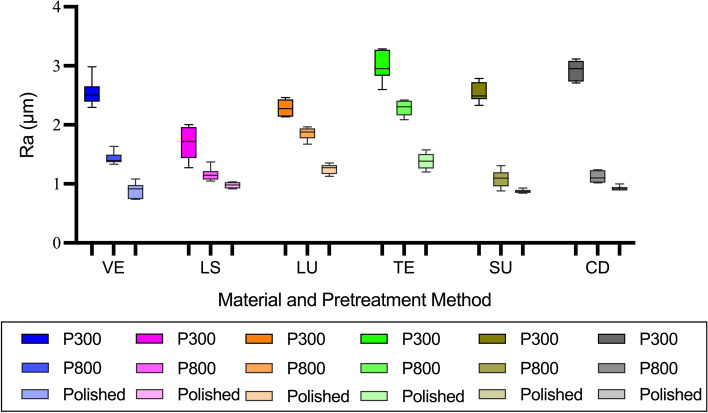
Six dental CAD-CAM materials, lithium disilicate glass-ceramic (IPS e.max CAD, LS), polymer-infiltrated ceramic (VITA Enamic, VE), resin-nano ceramic glass-ceramic (LAVA Ultimate, LU), polymethyl methacrylate (Telio CAD, TE), and two zirconia reinforced lithium silicate (VITA Suprinity, VS, and Celtra Duo, CD), in shade A2 were prepared as 12 × 12mm specimens of four thicknesses (0.5mm, 1.0mm, 1.5mm, and 2.0mm) (N = 240, n = 10). After three different treatments (polished, roughened by SiC P800-grit, and SiC P300-grit), the translucency parameter (TP) and opalescence parameter (OP) were measured with a spectrophotometer (VITA Easyshade V). The surface roughness was analyzed with a shape measurement laser microscope. The data were analyzed using a MANOVA, post hoc Tukey-Kramer test, the t test, and regression analysis (α = .05).
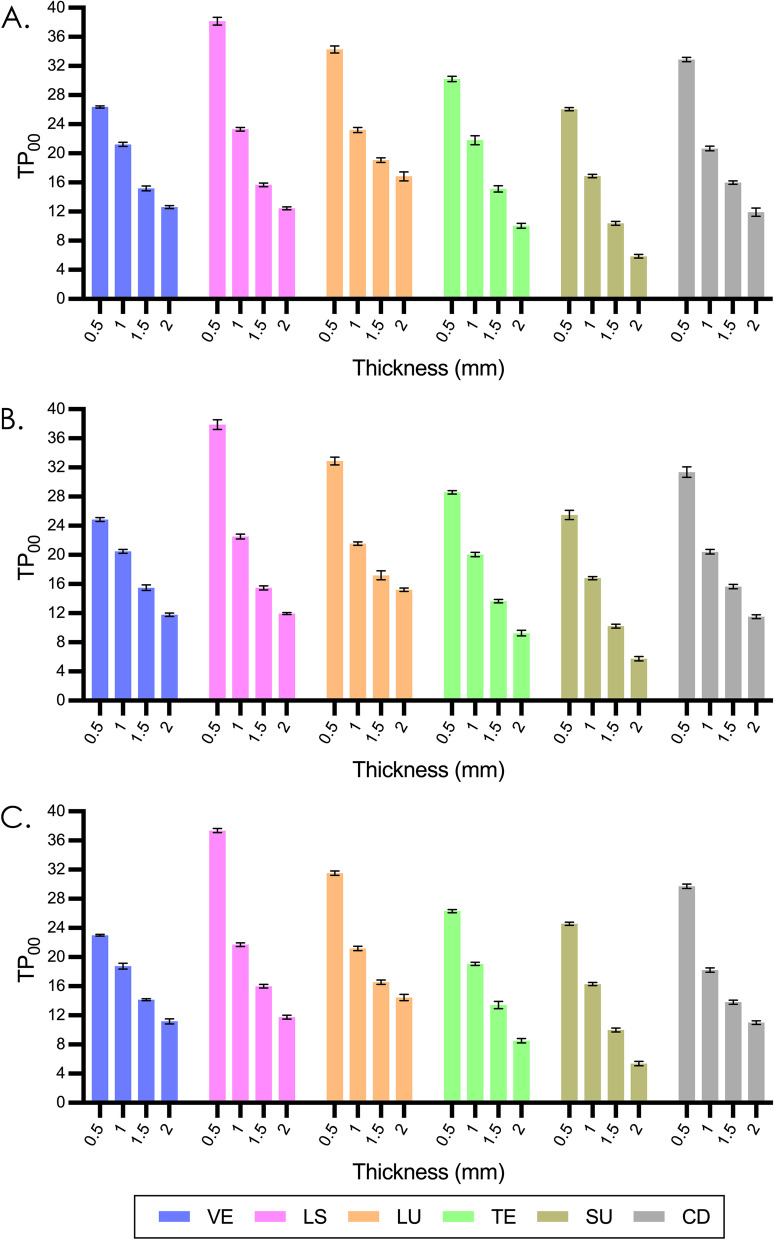
The TP and OP were significantly influenced by material type, thickness and roughening treatment (P < .05). TP showed a continues decline with increasing thicknesses, while the variations of OP were material-dependent. TP ranged from 37.80 (LS in 0.5mm) to 5.66 (VS in 2.0mm), and OP ranged from 5.66 (LU in 0.5mm) to 9.55 (VS in 0.5mm). The variations in TP of all materials between adjacent thicknesses ranged from 2.10 to 15.29, exceeding the acceptable translucency threshold except for LU. Quadratic and logarithmic regression curves exhibited the best fit for TP among the materials. Compared to polished specimens, rougher specimens exhibited lower TP00 and higher OP in all materials except for LS (P < 0.05). Roughening with P300-grit decreased TP and OP by an average of 2.59 and 0.43 for 0.5mm specimens, and 1.26 and 0.25 for 2.0mm specimens, respectively.
Variations in translucency caused by thickness and roughening treatment were perceptible and may be clinically unacceptable. Careful consideration should be given to the selection of CAD-CAM materials based on their distinct optical properties.
用于义齿的计算机辅助设计和计算机辅助制造(CAD-CAM)材料在牙科领域越来越受欢迎。然而,关于厚度和粗化处理对当代 CAD-CAM 修复材料光学性能的影响,相关信息有限。本研究旨在定量评估六种牙科 CAD-CAM 材料对不同厚度和粗化处理的半透明度和乳光性的影响。
将六种牙科 CAD-CAM 材料(锂硅玻璃陶瓷(IPS e.max CAD,LS)、聚合物渗透陶瓷(VITA Enamic,VE)、树脂纳米陶瓷玻璃陶瓷(LAVA Ultimate,LU)、聚甲基丙烯酸甲酯(Telio CAD,TE)以及两种氧化锆增强硅酸锂(VITA Suprinity,VS 和 Celtra Duo,CD),A2 色,制备成 12×12mm 的四个厚度(0.5mm、1.0mm、1.5mm 和 2.0mm)的试件(N=240,n=10)。对试件进行三种不同的处理(抛光、SiC P800 砂纸粗化和 SiC P300 砂纸粗化)后,用分光光度计(VITA Easyshade V)测量半透明度参数(TP)和乳光参数(OP)。用形状测量激光显微镜分析表面粗糙度。采用 MANOVA、事后 Tukey-Kramer 检验、t 检验和回归分析(α=.05)进行数据分析。
材料类型、厚度和粗化处理显著影响 TP 和 OP(P<.05)。TP 随厚度的增加呈持续下降趋势,而 OP 的变化则取决于材料。TP 范围为 37.80(0.5mm 时的 LS)至 5.66(2.0mm 时的 VS),OP 范围为 5.66(0.5mm 时的 LU)至 9.55(0.5mm 时的 VS)。除 LU 外,所有材料相邻厚度之间的 TP 变化范围为 2.10 至 15.29,超过可接受的半透明度阈值。所有材料中,二次和对数回归曲线对 TP 的拟合效果最佳。与抛光试件相比,除 LS 外,所有材料的粗化试件的 TP00 更低,OP 更高(P<.05)。用 P300 砂纸粗化处理 0.5mm 试件时,TP 和 OP 平均降低 2.59 和 0.43,2.0mm 试件时,TP 和 OP 平均降低 1.26 和 0.25。
厚度和粗化处理引起的半透明度变化是明显的,可能在临床不可接受。应根据 CAD-CAM 材料的光学特性,仔细考虑材料的选择。