Rai Laxmisha, Deng Chunrao, Lin Shuyang, Fan Liu
College of Electronic and Information Engineering, Shandong University of Science and Technology, Qingdao, China.
College of Professional and Continuing Education, The Hong Kong Polytechnic University, Kowloon, Hong Kong SAR, China.
Front Psychol. 2023 Aug 4;14:1219478. doi: 10.3389/fpsyg.2023.1219478. eCollection 2023.
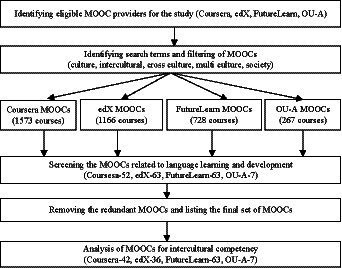
This paper aims to survey language teaching MOOCs that promote intercultural competence (IC). Specifically, the survey aims to identify the keywords most relevant to MOOCs with IC components, the languages taught, the offering countries, and the embedded soft skills. The selection of keywords is important because they can indicate connection between different disciplines. After trialing a broader set of keywords in several rounds of initial search, we identified five keywords that are the most relevant to language education with IC components on MOOCs: culture, intercultural, cross culture, multi culture, and society. Then courses with these five keywords on language learning are selected for further analysis. The results are summarized as follows: (1) Most language teaching MOOCs are found under the keyword "culture," indicating a strong connection between language education and intercultural communication; (2) In terms of the target languages and the offering countries, it is found that English, Chinese, and Spanish are the major languages widely taught in the context of intercultural competence; China, United States, and Ireland are the three countries which offer the highest numbers of MOOCs in this respect; United States, United Kingdom, and Australia are the three countries which offer the highest numbers of MOOCs of different languages. The results indicate that a limited number of languages and offering countries dominate the language learning MOOCs. The study calls for a plurality of languages and cultures to be taught through MOOCs, making more diversified knowledge systems accessible to global audiences. (3) The language teaching MOOCs not only focus on language but also aim to foster five types of soft skills (language learning skills, communication skills, business and entrepreneurship skills, career development skills, and cultural development skills), suggesting that intercultural competence and its related soft skills are usually important components embedded in such MOOCs courses.
本文旨在调查促进跨文化能力(IC)的语言教学慕课。具体而言,该调查旨在确定与具有跨文化能力组成部分的慕课最相关的关键词、所教授的语言、提供课程的国家以及所嵌入的软技能。关键词的选择很重要,因为它们可以表明不同学科之间的联系。在首轮搜索中对更广泛的关键词集进行了几轮试验后,我们确定了五个与慕课上具有跨文化能力组成部分的语言教育最相关的关键词:文化、跨文化、跨文化交际、多元文化和社会。然后选择包含这五个关键词的语言学习课程进行进一步分析。结果总结如下:(1)大多数语言教学慕课是在关键词“文化”下找到的,这表明语言教育与跨文化交际之间有紧密联系;(2)就目标语言和提供课程的国家而言,发现英语、汉语和西班牙语是在跨文化能力背景下广泛教授的主要语言;中国、美国和爱尔兰是在这方面提供慕课数量最多的三个国家;美国、英国和澳大利亚是提供不同语言慕课数量最多的三个国家。结果表明,数量有限的语言和提供课程的国家主导着语言学习慕课。该研究呼吁通过慕课教授多种语言和文化,使全球受众能够接触到更多样化的知识体系。(3)语言教学慕课不仅注重语言,还旨在培养五种软技能(语言学习技能、沟通技能、商业和创业技能、职业发展技能以及文化发展技能),这表明跨文化能力及其相关软技能通常是此类慕课课程中重要的组成部分。