Castelo Matthew, Hansen Bettina E, Paszat Lawrence, Baxter Nancy N, Scheer Adena S
From the Division of General Surgery, Department of Surgery, University of Toronto, Toronto, ON, Canada.
Institute of Health Policy, Management and Evaluation, Dalla Lana School of Public Health, University of Toronto, Toronto, ON, Canada.
Ann Surg Open. 2022 Apr 25;3(2):e159. doi: 10.1097/AS9.0000000000000159. eCollection 2022 Jun.
Determine if axillary staging is associated with survival in elderly women with breast cancer.
Axillary staging in women ≥ 70 years with early-stage breast cancer is controversial. Older randomized evidence has not shown axillary staging improves survival, but recent observational studies have been mixed and widespread de-implementation of the practice has not occurred.
This was a population-based cohort study using the Surveillance, Epidemiology, and End Results registry. Women ≥ 70 years diagnosed with T1-T2 invasive breast cancer from 2005 to 2015 were included. Overlap propensity score weighting was used to adjust for confounders. Overall survival (OS) was determined and hazard ratios (HRs) reported with 95% confidence intervals (CIs). Breast cancer-specific survival (BCSS) was determined using competing risks analysis and subdistribution hazard ratios (sdHRs) reported. Additional adjustment was performed for receipt of chemotherapy and radiotherapy.
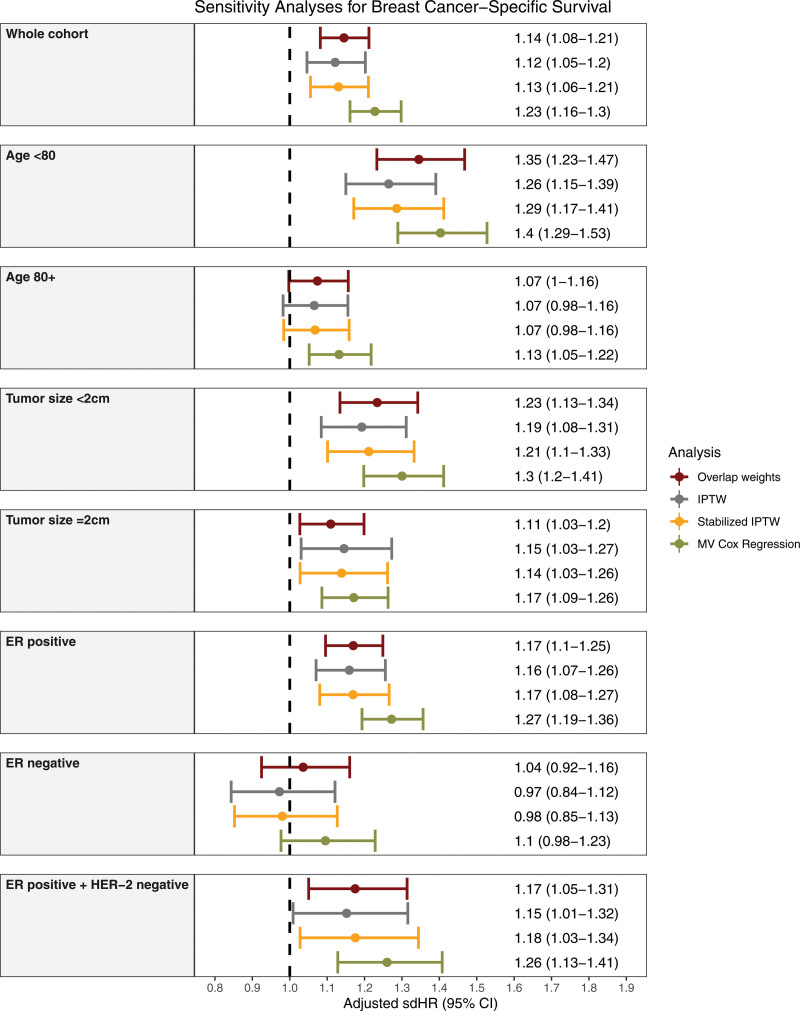
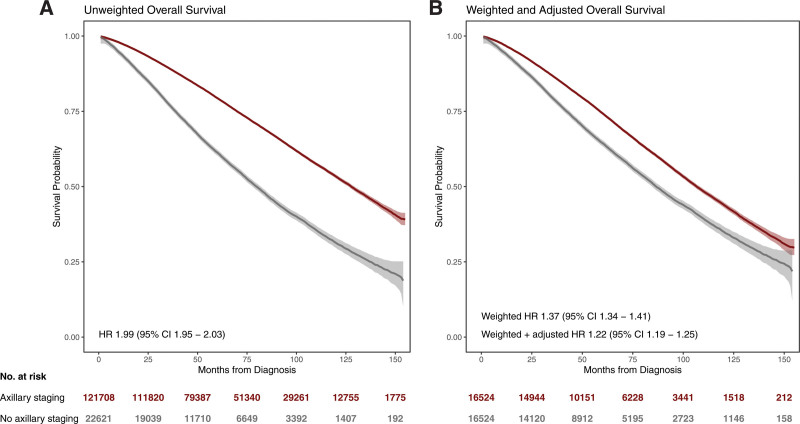
One hundred forty-four thousand three hundred twenty-nine elderly women were included, of whom 22,621 (15.7%) did not undergo axillary staging. After overlap propensity score weighting, baseline characteristics were well balanced between the 2 groups. Women who did not undergo axillary staging were significantly less likely to receive chemotherapy (adjusted relative risk, 0.58; 95% CI, 0.54-0.62) or radiotherapy (adjusted relative risk, 0.53; 95% CI, 0.52-0.54), and had significantly worse OS (adjusted HR, 1.22; 95% CI, 1.19-1.25), and BCSS (adjusted sdHR, 1.14; 95% CI, 1.08-1.21) compared to those that had staging.
These findings suggest elderly women with early-stage breast cancer who do not undergo axillary staging experience worse outcomes. Reasons for this disparity may be multifactorial and require further investigation.
确定腋窝分期是否与老年乳腺癌女性的生存率相关。
70岁及以上早期乳腺癌女性的腋窝分期存在争议。较早的随机证据未显示腋窝分期能提高生存率,但近期的观察性研究结果不一,且该做法尚未普遍停止实施。
这是一项基于人群的队列研究,使用监测、流行病学和最终结果登记处的数据。纳入2005年至2015年诊断为T1-T2期浸润性乳腺癌的70岁及以上女性。采用重叠倾向评分加权法调整混杂因素。确定总生存期(OS)并报告风险比(HR)及95%置信区间(CI)。使用竞争风险分析确定乳腺癌特异性生存期(BCSS)并报告亚分布风险比(sdHR)。对接受化疗和放疗的情况进行了额外调整。
纳入了144329名老年女性,其中22621名(15.7%)未进行腋窝分期。重叠倾向评分加权后,两组的基线特征得到了很好的平衡。未进行腋窝分期的女性接受化疗(调整后相对风险,0.58;95%CI,0.54-0.62)或放疗(调整后相对风险,0.53;95%CI,0.52-0.54)的可能性显著降低,与进行分期的女性相比,其总生存期(调整后HR,1.22;95%CI,1.19-1.25)和乳腺癌特异性生存期(调整后sdHR,1.14;95%CI,1.08-1.21)明显更差。
这些发现表明,未进行腋窝分期的老年早期乳腺癌女性预后较差。这种差异的原因可能是多因素的,需要进一步调查。