
70岁及以上老年乳腺癌女性腋窝淋巴结评估与生存的相关性
Association of Axillary Lymph Node Evaluation With Survival in Women Aged 70 Years or Older With Breast Cancer.
作者信息
Luo Shi-Ping, Zhang Jie, Wu Qi-Sen, Lin Yu-Xiang, Song Chuan-Gui
机构信息
Department of Breast Surgery, Fujian Medical University Union Hospital, Fuzhou, China.
Department of General Surgery, Fujian Medical University Union Hospital, Fuzhou, China.
出版信息
Front Oncol. 2021 Jan 28;10:596545. doi: 10.3389/fonc.2020.596545. eCollection 2020.
BACKGROUND
Survival in elderly patients undergoing sentinel lymph node biopsy (SLNB) and axillary lymph node dissection (ALND) has not been specifically analyzed. This study aimed to explore the association between different types of axillary lymph node (ALN) evaluations and survival of elderly breast cancer patients.
METHODS
A retrospective cohort study was conducted of invasive ductal breast cancer patients 70 years and older in the Surveillance, Epidemiology, and End Results database (2004-2016). Analyses were performed to compare the characteristics and survival outcomes of patients who received surgical lymph node dissection and those who did not. Breast cancer specific survival (BCSS) and overall survival were compared by using Cox proportional hazards regression analysis and propensity score matching (PSM) methods to account for selection bias from covariate imbalance.
RESULTS
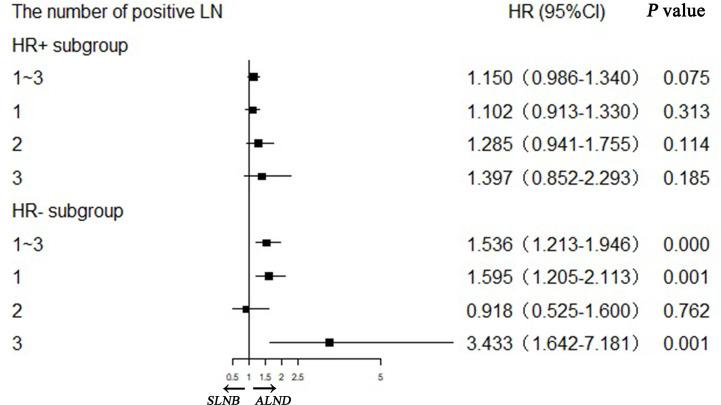
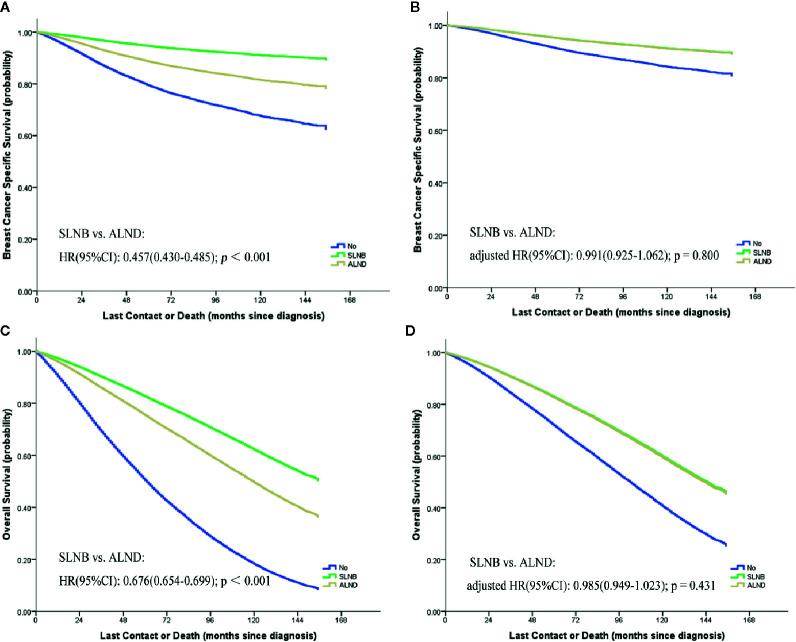
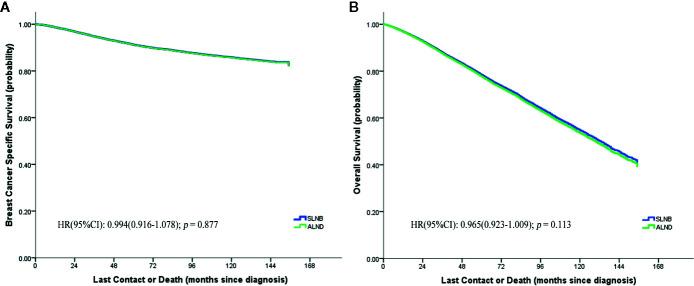
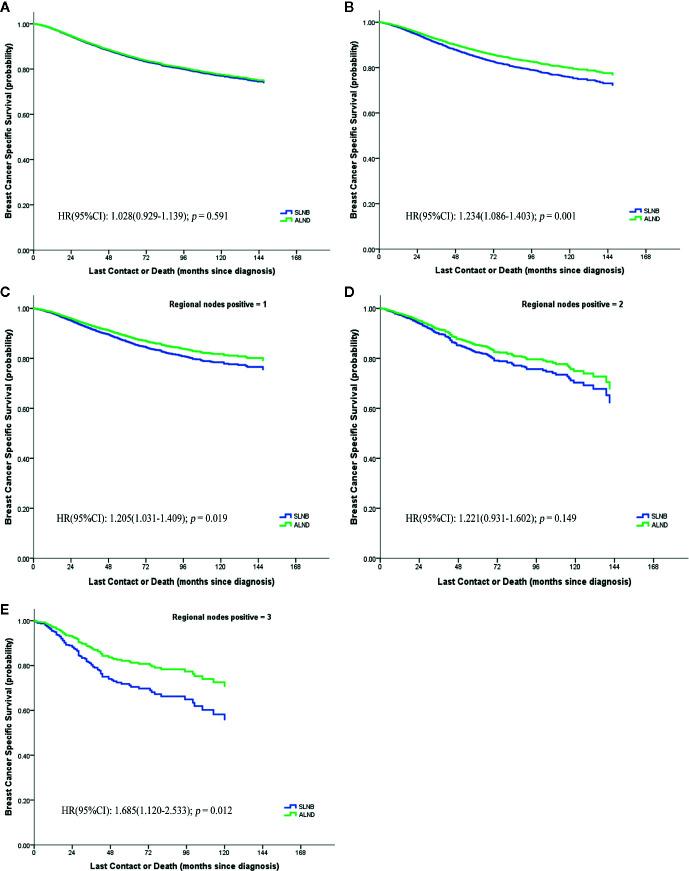
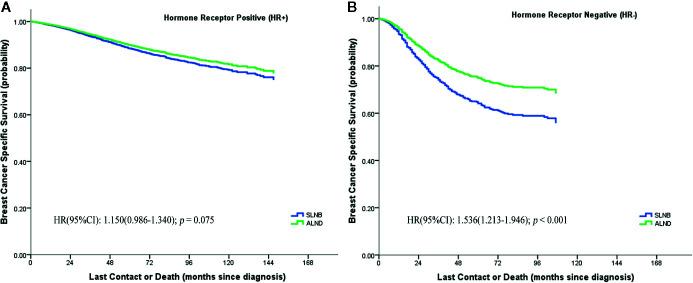
Of the 75,950 patients analyzed, patients without ALN evaluation had a significantly worse prognosis, while there was no significant difference for BCSS between using a sentinel lymph node biopsy (SLNB) and an axillary lymph node dissection (ALND) after adjustment for known covariates [adjusted hazard ratio (HR) = 0.991, 95% confidence interval (CI) = 0.925-1.062, = 0.800]. In the stratification analyses after PSM, the ALND did not show a significant BCSS advantage compared with SLNB in any subgroups except for the pN1 stage or above. Furthermore, after PSM of the pN1 stage patients, SLNB was associated with a significantly worse BCSS in hormone receptor negative (HR-) patients (HR = 1.536, 95%CI = 1.213-1.946, 0.001), but not in the hormone receptor positive (HR+) group (HR = 1.150, 95%CI = 0.986-1.340, = 0.075).
CONCLUSION
In our study, ALND does not yield superior survival compared with SLNB for elderly patients with pN1 stage HR+ breast cancer. Although our findings are limited by the bias associated with retrospective study design, we believe that in the absence of results from randomized clinical trials, our findings should be considered when recommending the omission of ALND for elderly breast cancer patients.
背景
尚未对接受前哨淋巴结活检(SLNB)和腋窝淋巴结清扫(ALND)的老年患者的生存率进行专门分析。本研究旨在探讨不同类型腋窝淋巴结(ALN)评估与老年乳腺癌患者生存率之间的关联。
方法
对监测、流行病学和最终结果数据库(2004 - 2016年)中70岁及以上的浸润性导管癌患者进行回顾性队列研究。进行分析以比较接受手术淋巴结清扫的患者和未接受手术淋巴结清扫的患者的特征及生存结果。采用Cox比例风险回归分析和倾向评分匹配(PSM)方法比较乳腺癌特异性生存(BCSS)和总生存,以解决协变量不平衡导致的选择偏倚问题。
结果
在分析的75950例患者中,未进行ALN评估的患者预后明显较差,而在对已知协变量进行调整后,前哨淋巴结活检(SLNB)和腋窝淋巴结清扫(ALND)之间的BCSS无显著差异[调整后风险比(HR)= 0.991,95%置信区间(CI)= 0.925 - 1.062,P = 0.800]。在PSM后的分层分析中,除pN1期及以上外,在任何亚组中,ALND与SLNB相比均未显示出显著的BCSS优势。此外,在对pN1期患者进行PSM后,SLNB与激素受体阴性(HR-)患者的BCSS显著较差相关(HR = 1.536,95%CI = 1.213 - 1.946,P < 0.001),但在激素受体阳性(HR+)组中并非如此(HR = 1.150,95%CI = 0.986 - 1.340,P = 0.075)。
结论
在我们的研究中,对于pN1期HR+乳腺癌老年患者,ALND与SLNB相比并未产生更好的生存效果。尽管我们的研究结果受到回顾性研究设计相关偏倚的限制,但我们认为在缺乏随机临床试验结果的情况下,在推荐对老年乳腺癌患者省略ALND时应考虑我们的研究结果。
 Zotero 插件