Steffen Marie-Theres, Fuhr Hannah, Joos Stefanie, Koch Roland
Institute for General Medicine and Interprofessional Health Care, Tuebingen, Germany.
Front Med (Lausanne). 2023 Aug 2;10:1231383. doi: 10.3389/fmed.2023.1231383. eCollection 2023.
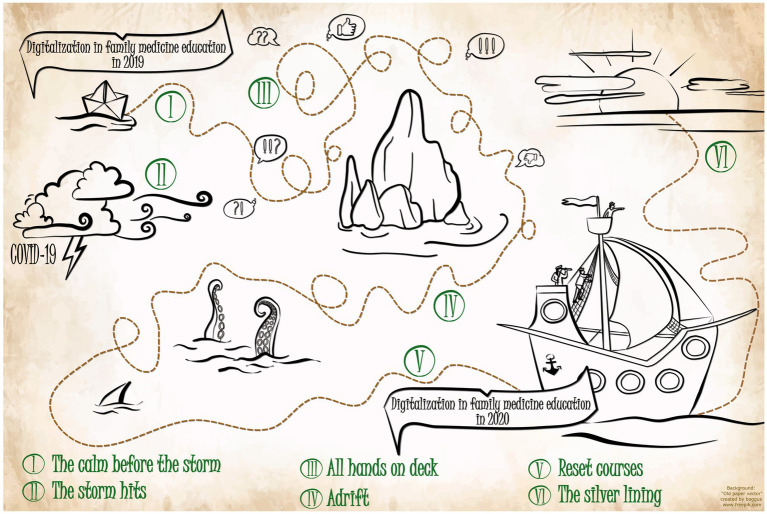
The COVID-19 pandemic has been identified as a catalyst for the digitalization of medical education. Less is known about the specific impact of the pandemic on decentralized, community-based education, such as in General Practitioner practices. The aim of this study is to understand the impact of the digital transformation process, triggered by the COVID-19 pandemic. As, family medicine courses involve both university-based and community-based teaching, this study focuses the mode and quality of instruction and instructors in family medicine teaching. A qualitative interview study was conducted. The participants ( = 12) of a multi-perspective Quality Circle in family medicine teaching were interviewed twice: first, in 2019, about digitalization in family medicine teaching in Tübingen, Germany, not yet aware of the global changes and local transformation that would take place shortly thereafter. Second, in a follow-up interview in 2020 about the transition process and digitalization following the impact of contact restrictions during the pandemic. Grounded Theory was used as a qualitative research approach to analyze the complex processes surrounding this transformation. By analyzing the interviews with various stakeholders of community and university-based teaching, a model for the digital transformation process of family medicine teaching at the University of Tübingen in response to an external stimulus (the pandemic) was developed. It involves six chronological steps: "The calm before the storm," "The storm hits," "All hands on deck," "Adrift," "Reset course," and "The silver lining." This model seeks to understand the process of digital transformation and its impact on the teaching institution (medical faculty of the University of Tübingen, Institute for General Practice and Interprofessional Health Care) and instructors from an integrated perspective and thereby critically revisits prior concepts and opinions on the digitalization of medical teaching. Insights gained are presented as key messages.
新冠疫情已被视为医学教育数字化的催化剂。对于疫情对分散式、基于社区的教育(如全科医生实践)的具体影响,人们了解得较少。本研究的目的是了解由新冠疫情引发的数字化转型过程的影响。由于家庭医学课程涉及大学教学和社区教学,本研究聚焦于家庭医学教学中的教学模式、质量以及教师情况。开展了一项定性访谈研究。对家庭医学教学中一个多视角质量圈的参与者(n = 12)进行了两次访谈:第一次是在2019年,访谈内容是德国图宾根家庭医学教学中的数字化情况,当时他们尚未意识到不久后即将发生的全球变化和本地转型。第二次是在2020年进行的跟进访谈,内容是疫情期间接触限制影响后的转型过程和数字化情况。扎根理论被用作定性研究方法,以分析围绕这一转型的复杂过程。通过分析对社区教学和大学教学的不同利益相关者的访谈,开发了一个图宾根大学家庭医学教学应对外部刺激(疫情)的数字化转型过程模型。它包括六个按时间顺序排列的步骤:“暴风雨前的平静”“暴风雨来袭”“全员行动”“随波逐流”“重新设定航线”和“一线希望”。该模型旨在从综合角度理解数字化转型过程及其对教学机构(图宾根大学医学院、全科医学与跨专业医疗保健研究所)和教师的影响,从而批判性地重新审视此前关于医学教学数字化的概念和观点。所获得的见解以关键信息的形式呈现。