Wang Rui, Wang Zheng-Ming, Xiang Si-Cheng, Jin Zhao-Kai, Zhang Jing-Jing, Zeng Ji-Cheng, Tong Pei-Jian, Lv Shuai-Jie
Guanghua Clinical Medical College, Shanghai University of Traditional Chinese Medicine, Shanghai, China.
Department of Orthopedic Surgery, Shanghai Guanghua Hospital of Integrated Traditional Chinese and Western Medicine, Shanghai, China.
Front Med (Lausanne). 2023 Aug 2;10:1200592. doi: 10.3389/fmed.2023.1200592. eCollection 2023.
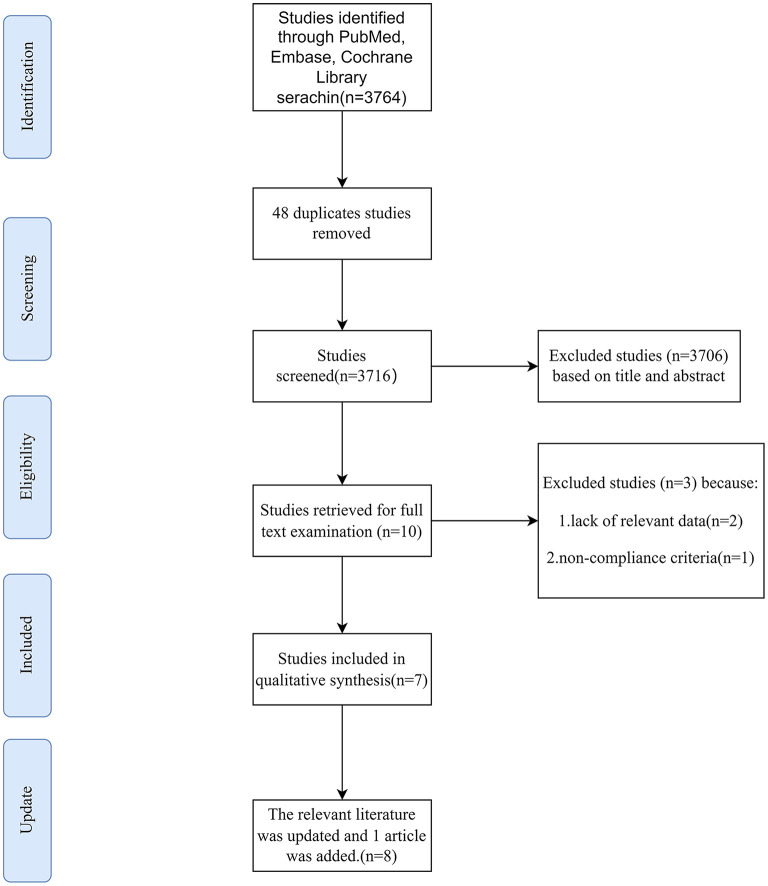
In order to examine the relationship between 25-hydroxyl vitamin D and knee osteoarthritis (KOA), a meta-analysis of 8 randomized controlled trials (RCTs) publications was hereby performed.
For the purpose of finding pertinent research, the databases of PubMed, Embase and the Cochrane Library were searched. Factors including tibial cartilage volume, joint space width (JSW), synovial fluid volume, and Western Ontario and McMaster Universities Arthritis Index (WOMAC) were correspondingly evaluated, and the results were expressed using SMD and 95% confidence intervals (CI).
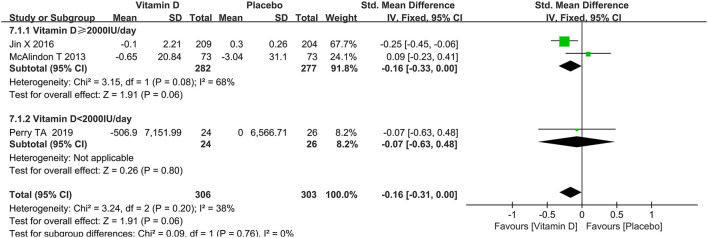
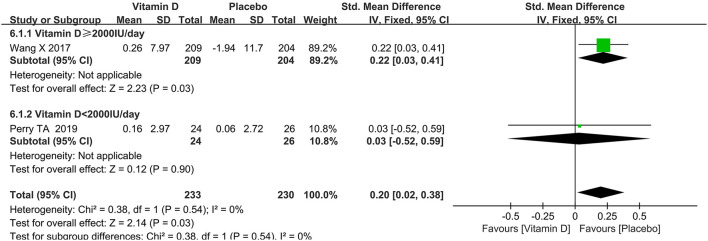
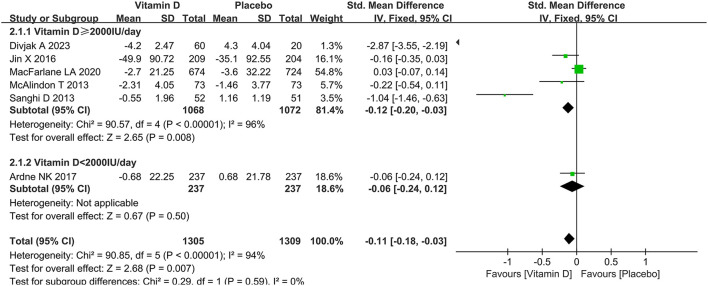
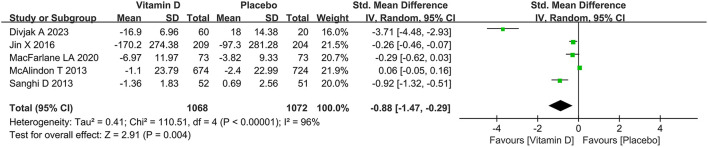
The present meta-analysis evaluated the effects of vitamin D supplementation in patients with knee osteoarthritis, with 3,077 patients included. The results showed that vitamin D administration had a statistically significant impact on the amount of synovial fluid, Visual Analog Scale (VAS) and tibial cartilage. The pain and function scales of the WOMAC scale presented a statistically significant difference, and there was no discernible difference between the vitamin D and placebo groups in the stiffness scale. Additionally, bone marrow lesions and alterations in the diameter of the joint space were not influenced by the administration of vitamin D, and according to a subgroup study, a daily vitamin D supplement containing more than 2,000 IU significantly slowed the development of synovial tissue.
Vitamin D supplementation did benefit those suffering from knee discomfort and knee dysfunction.
https://www.crd.york.ac.uk/prospero/display_record.php?ID=CRD42022332033, identifier: CRD42022332033.
为研究25-羟基维生素D与膝关节骨关节炎(KOA)之间的关系,对8项随机对照试验(RCT)出版物进行荟萃分析。
通过检索PubMed、Embase和Cochrane图书馆数据库以查找相关研究。相应评估包括胫骨软骨体积、关节间隙宽度(JSW)、滑液体积以及西安大略和麦克马斯特大学骨关节炎指数(WOMAC)等因素,结果以标准化均数差(SMD)和95%置信区间(CI)表示。
本荟萃分析评估了补充维生素D对膝关节骨关节炎患者的影响,共纳入3077例患者。结果显示,补充维生素D对滑液量、视觉模拟评分(VAS)和胫骨软骨有统计学显著影响。WOMAC量表的疼痛和功能量表有统计学显著差异,维生素D组和安慰剂组在僵硬量表上无明显差异。此外,补充维生素D对骨髓病变和关节间隙直径改变无影响,亚组研究表明,每日补充超过2000 IU的维生素D可显著减缓滑膜组织的发展。
补充维生素D确实有益于膝关节不适和膝关节功能障碍患者。
https://www.crd.york.ac.uk/prospero/display_record.php?ID=CRD42022332033,标识符:CRD42022332033。