Department of Experimental Pathology, Faculty of Medicine, University of Tsukuba, Tsukuba, Japan.
Ph.D. Program in Human Biology, School of Integrative and Global Majors, University of Tsukuba, Tsukuba, Japan.
Cancer Sci. 2023 Oct;114(10):3972-3983. doi: 10.1111/cas.15934. Epub 2023 Aug 22.
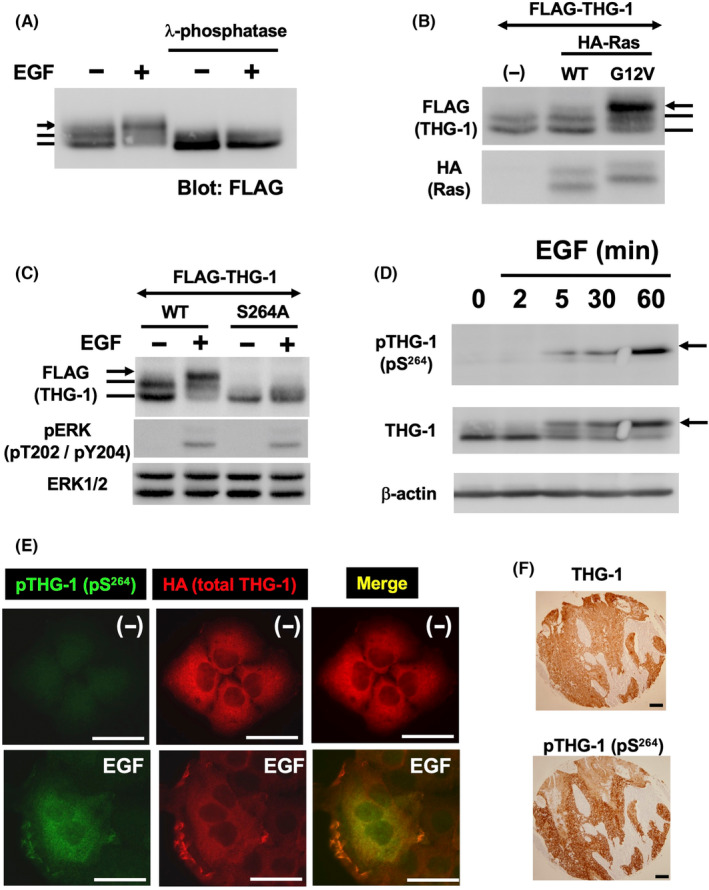
Carcinoma cells possess high proliferative and invasive potentials and exhibit a resilience against stresses, metabolic disorder, and therapeutic efforts. These properties are mainly acquired by genetic alterations including driver gene mutations. However, the detailed molecular mechanisms have not been fully elucidated. Here, we provide a novel mechanism connecting oncogenic signaling and the tumorigenic properties by a transforming growth factor-β1-stimulated clone 22 (TSC-22) family protein, THG-1 (also called as TSC22D4). THG-1 is localized at the basal layer of normal squamous epithelium and overexpressed in squamous cell carcinomas (SCCs). THG-1 knockdown suppressed SCC cell proliferation, invasiveness, and xenograft tumor formation. In contrast, THG-1 overexpression promoted the EGF-induced proliferation and stratified epithelium formation. Furthermore, THG-1 is phosphorylated by the receptor tyrosine kinase (RTK)-RAS-ERK pathway, which promoted the oncogene-mediated tumorigenesis. Moreover, THG-1 involves in the alternative splicing of CD44 variants, a regulator of invasiveness, stemness, and oxidative stress resistance under the RTK pathway. These findings highlight the pivotal roles of THG-1 as a novel effector of SCC tumorigenesis, and the detection of THG-1 phosphorylation by our established specific antibody could contribute to cancer diagnosis and therapy.
癌细胞具有高增殖和侵袭潜能,并表现出对应激、代谢紊乱和治疗努力的抵抗力。这些特性主要是通过包括驱动基因突变在内的遗传改变获得的。然而,其详细的分子机制尚未完全阐明。在这里,我们提供了一个新的机制,通过转化生长因子-β1 刺激的克隆 22(TSC-22)家族蛋白 THG-1(也称为 TSC22D4)将致癌信号与肿瘤发生特性联系起来。THG-1 定位于正常鳞状上皮的基底层,在鳞状细胞癌(SCC)中过表达。THG-1 敲低抑制 SCC 细胞增殖、侵袭和异种移植肿瘤形成。相比之下,THG-1 的过表达促进了 EGF 诱导的增殖和分层上皮形成。此外,THG-1 被受体酪氨酸激酶(RTK)-RAS-ERK 通路磷酸化,促进了致癌基因介导的肿瘤发生。此外,THG-1 涉及 CD44 变体的可变剪接,CD44 变体是 RTK 通路下侵袭性、干性和氧化应激抗性的调节剂。这些发现强调了 THG-1 作为 SCC 肿瘤发生的新型效应物的关键作用,并且我们建立的特异性抗体检测 THG-1 的磷酸化可能有助于癌症的诊断和治疗。