Oduro Joseph Kojo, Oduro Mary Ama, Ameyaw Edward Kwabena
University of Cape Coast.
Institute of Policy Studies and School of Graduate Studies, Lingnan University, Tuen Mun, Hong Kong.
Res Sq. 2023 Aug 8:rs.3.rs-3224059. doi: 10.21203/rs.3.rs-3224059/v1.
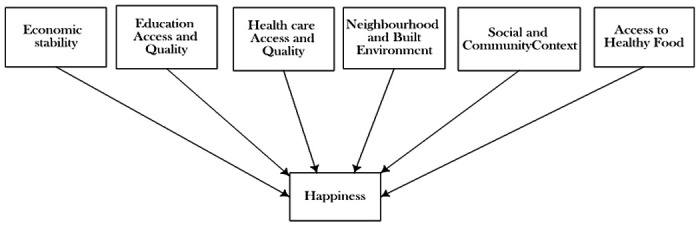
Social determinants of health [SDOH] and happiness have received meaningful consideration as foundational concepts in the field of public health. However, the relationship between the SDOH and happiness of older adults have not received the requisite recognition in Ghana. This study examined the relationship between the SDOH and happiness of older adults in Ghana.
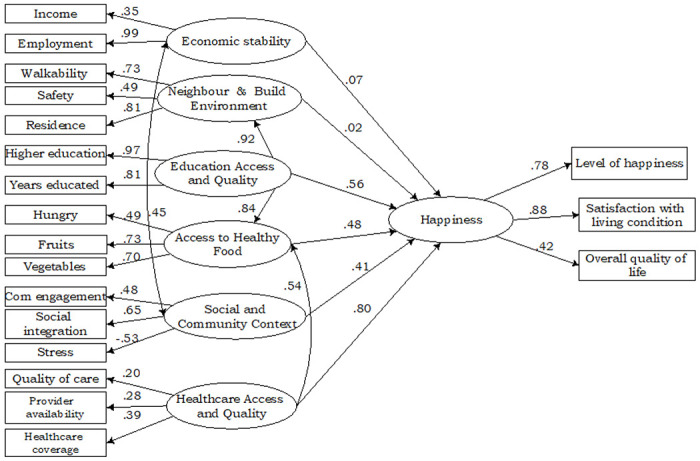
The study used data from the 2014/2015 Ghana Study on Global Ageing and Adult Health (SAGE) Wave 2. Data was analysed using the Structural Equation Modeling (SEM) technique to investigate the direct, indirect and covariances of the SDOH and happiness of older adults.
The results showed positive relationship between the SDOH and happiness among older adults. The economic stability ( = 0.07), neighbourhood and built environment ( = 0.02, < 0.001), access to quality education ( = 0.56, < 0.01), access to healthy food ( = 0.48, < 0.001) social and community context ( = 0.41, < 0.05), and access to quality healthcare ( = 0.80, < 0.001) had direct relationship with happiness of the older adults in Ghana.
This study shows that the conditions in which older adults were born, live, learn, work, play, worship, and age (SDOH) positively impact their happiness in later life. Neighbourhood and physical environment influence the effect of quality education on happiness of older adults. Social policies and interventions aiming at happiness of older adults should consider the social determinants of health and the mediating effects of food on happiness through quality education, and quality of healthcare system.
健康的社会决定因素(SDOH)和幸福感作为公共卫生领域的基础概念已得到了有意义的考量。然而,在加纳,老年人的健康社会决定因素与幸福感之间的关系尚未得到应有的重视。本研究考察了加纳老年人的健康社会决定因素与幸福感之间的关系。
本研究使用了2014/2015年加纳全球老龄化与成人健康研究(SAGE)第二轮的数据。采用结构方程模型(SEM)技术对数据进行分析,以研究老年人健康社会决定因素与幸福感的直接、间接和协方差关系。
结果显示,老年人的健康社会决定因素与幸福感之间存在正相关关系。经济稳定性(β = 0.07)、邻里和建筑环境(β = 0.02,p < 0.001)、获得优质教育(β = 0.56,p < 0.01)、获得健康食品(β = 0.48,p < 0.001)、社会和社区环境(β = 0.41,p < 0.05)以及获得优质医疗保健(β = 0.80,p < 0.001)与加纳老年人的幸福感直接相关。
本研究表明,老年人出生、生活、学习、工作、娱乐、信仰和变老的环境(健康社会决定因素)对他们晚年的幸福感有积极影响。邻里和物质环境影响优质教育对老年人幸福感的作用。旨在提高老年人幸福感的社会政策和干预措施应考虑健康的社会决定因素以及食物通过优质教育和医疗保健系统对幸福感的中介作用。